


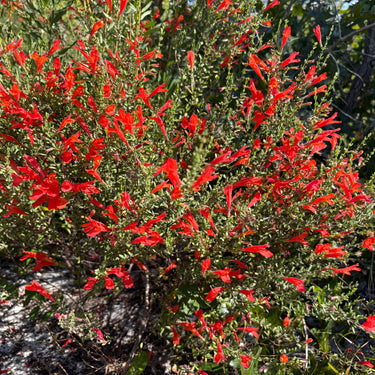


Scarlet Calamint
Clinopodium coccineum
In propagation
Currently growing out 1 Gallon pots. Expected Spring 2027.
Add your name with the notify button below, and we will email you the moment this plant is ready to bring home.
Learn how we grow on The Prop House.
Pickup currently unavailable at Aiken Nursery
Clinopodium coccineum is a small, aromatic, semi-evergreen subshrub of the mint family, native to the deep, well-drained sands of the southeastern coastal plain from Mississippi and Georgia down into Florida. The loose, open frame and small, spicy-scented leaves would earn a quiet place on their own, but the flowers are the event: scarlet tubes an inch or two long, held out like little trumpets. Bloom comes heaviest in spring and again in fall, with scattered flowers through the summer between, and in the mildest gardens of zones 8 and 9 the plant will open something in almost any month the weather stays soft.
Few plants have been shuffled between genera as often as this one. Nuttall’s material was published as a Cunila in 1825, and over the following century the species passed through Melissa, Gardoquia, Calamintha and Satureja before Kuntze settled the present combination in 1891. The fault was never with the plant. The characters that were supposed to separate those genera, calyx shape and leaf form and geography, grade into one another, and molecular work has since confirmed that the old boundaries do not hold. Clinopodium itself is a homely name, from the Greek for a bed and a little foot, a bedpost, for the shape of the flower clusters in the European type species. Woodlanders introduced the southern clinopodiums to gardeners in the 1980s and went on using that name straight through the decades when the authorities preferred Calamintha or Satureja. The authorities have since come round.
In the wild scarlet calamint belongs to the longleaf pine sandhills and open flatwoods, with scrub and coastal dune populations at the edges, always in white sand and always in full sun. The long nectar tubes are built for hummingbirds, and both the Lady Bird Johnson Wildflower Center and the Florida Wildflower Foundation name the plant a hummingbird draw; large butterflies work the flowers as well. The crushed foliage carries a clean, spicy scent that browsing deer usually pass over, though nobody should plant this or anything else on the assumption that deer read labels.
Give scarlet calamint full sun and fast-draining sand, and site the shrub where the flowers and the hummingbird traffic can be watched up close: a hot bank, a gravel or xeric border, a rock garden, the front of a sunny native bed. Pair with salvias, little bluestem and other plants that ask for the same lean, dry ground, and run the planting along a path where brushing past releases the scent. One honest caution comes with the toughness. Scarlet calamint can be slow to settle and will not forgive wet feet while establishing, and then asks for very little for the rest of a long life.
Photo credit to Jonas Meyer.
- Hardiness
- USDA Zones 7–9
- Sun
- Full Sun, Part Shade
- Soil
- Well-drained
- Mature size
- Height 2–4 Feet · Spread 2–3 Feet
- Growth rate
- Moderate
- Seasonality
- Semi-Evergreen
Scarlet to orange-red tubular, late spring to fall
From rooting to shipping, our top priority is ensuring you receive healthy, thriving plants for your garden’s success.
Because most of our plants are grown from rooted cuttings — alongside seed, air layering, and grafting chosen for each variety — you receive a stronger, true-to-type plant that establishes quickly in your garden.
Raised on organic soil blends and eco-friendly pest management — never harsh chemicals — your plant arrives healthy for your garden, your family, and the pollinators they feed.
Every purchase gives back. We donate to the Aiken Arboretum and support local wildlife conservation, so growing your garden helps protect the wider ecosystem too.

All our plant material is carefully propagated, grown, and nurtured at our humble nursery in Aiken, South Carolina.

Your plant arrives carefully packed and ready to settle in. Unpack them promptly, give them a day or two to acclimate, then plant following the notes we include — that’s all it takes. Clear care guidance comes with every order, so success is the easy part.
What to expect upon delivery
All our plants are sold in 1-gallon sizes, though the height of each plant can vary depending on its growth rate and seasonality, typically ranging from 1/2 to 2.5 feet.
Each plant is carefully packaged with its roots enclosed in a secure plastic bag containing moist soil, forming a compact root ball. To ensure safe transport, the box is padded with recycled newspaper, providing both stability and eco-friendly protection from weather during shipping.
What is your return policy?
Review our full return policy information on our SHIPPING AND RETURNS POLICY page.
What payment methods can I use?
We offer 35 different payment methods including major providers like Mastercard, Visa, PayPal, American Express and Diners as well as many different local payment methods including Klarna, iDEAL, AliPay, Sofort, giropay, and many more.
Can I make changes to my order after it’s been placed?
At Woodlanders, we strive to fulfill orders as quickly as possible. Therefore, we can only accommodate changes to your order within the first 24 hours after it has been placed. These changes include adding or removing products and modifying the delivery address. If you need to make any changes or if there has been a mistake with your order information, please reach out to us promptly via our CONTACT page with your order number for the quickest resolution.
Your satisfaction is our priority, and we appreciate your understanding and cooperation.