


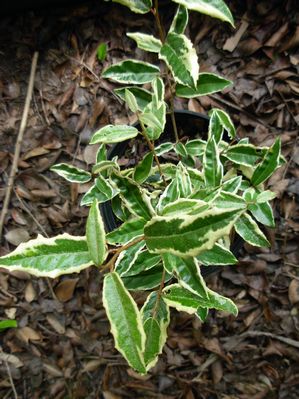

Variegated Silverthorn
Elaeagnus pungens 'Variegata'
Pickup currently unavailable at Aiken Nursery
The gold-edged form of silverthorn, and a genuinely useful evergreen for hard places. Leaves are leathery and wavy-margined, three inches or so long, glossy green through the middle with a broad creamy-gold border, and silvered underneath with a dusting of tiny brown scales that catches light when the wind turns them. In October and November the shrub produces small creamy-white bells, apetalous and easy to overlook entirely, which is a joke the plant plays every autumn: the flowers are nearly invisible and the scent is extraordinary, closer to gardenia than to anything else, and strong enough to stop people on a path while they work out where it is coming from. Small reddish-brown drupes follow in spring and are technically edible, though the birds are welcome to them.
A correction is owed here, because our own catalog carried it for years. This plant is not autumn olive. Autumn olive is Elaeagnus umbellata, a deciduous and notoriously aggressive relative. Elaeagnus pungens is thorny olive or silverthorn, evergreen, native to China and Japan, and named for the hooked thorns along the branchlets. Elaeagnus comes from the Greek elaia, olive, and agnos, the chaste tree, for a plant that resembles both and is closely related to neither. All the Elaeagnaceae fix nitrogen through root nodules, which is exactly why the whole family thrives on ground too poor to interest anything else.
In China the leaves are hu tui zi ye, and the use is specific and old. Li Shizhen recorded the leaf in the Bencao Gangmu in the sixteenth century as a remedy for severe asthma, cough, and bronchitis, classified among the herbs that moisten the lung and settle a dissipated lung qi. That tradition has held modern attention: published work has tested leaf extracts for antiasthmatic, antitussive, and expectorant activity in animal models, and reports lengthened latency before coughing and increased tracheal secretion. The chemistry is dominated by flavonoids and triterpenes.
Site in full sun with drainage and then leave the shrub alone; this is a plant for a dry bank, a hot corner, a wind-scoured boundary, or a coastal garden, and it is unbothered by salt, drought, poor soil, or neglect. Left unpruned, long whip-like shoots will scramble up into whatever is nearby and the whole thing turns vine-like, so cut those back through the season for a tight twelve to fifteen foot shrub or a dense screening hedge. Watch for reversion: shoots that come back plain green are more vigorous than the variegated growth and will take over if you let them, so cut them out at the base as they appear. One honest caution before you plant. Elaeagnus pungens has escaped cultivation across the Southeast and is assessed as invasive throughout Florida and listed in Texas, spread by birds carrying the fruit into woodland. A variegated clone is less vigorous than the plain species, but in the lower Southeast this is a shrub to keep pruned, watched, and away from a woodland edge.
- Hardiness
- USDA Zones 6–9
- Sun
- Full Sun, Part Shade
- Soil
- Well-drained
- Mature size
- Height 12–15 Feet · Spread 12–15 Feet
- Growth rate
- Fast
- Seasonality
- Evergreen
tiny creamy-white bells in the leaf axils, intensely fragrant, October to November
These statements have not been evaluated by the Food and Drug Administration. This information is shared for traditional and educational interest only and is not intended to diagnose, treat, cure, or prevent any disease. Please consult a qualified healthcare professional before any medicinal use.
- Not evaluated for safety in pregnancy or while breastfeeding
- Fruit is astringent and best left to birds
- May interact with prescribed respiratory medication
- Consult a qualified practitioner before use
From rooting to shipping, our top priority is ensuring you receive healthy, thriving plants for your garden’s success.
Because most of our plants are grown from rooted cuttings — alongside seed, air layering, and grafting chosen for each variety — you receive a stronger, true-to-type plant that establishes quickly in your garden.
Raised on organic soil blends and eco-friendly pest management — never harsh chemicals — your plant arrives healthy for your garden, your family, and the pollinators they feed.
Every purchase gives back. We donate to the Aiken Arboretum and support local wildlife conservation, so growing your garden helps protect the wider ecosystem too.

All our plant material is carefully propagated, grown, and nurtured at our humble nursery in Aiken, South Carolina.

Your plant arrives carefully packed and ready to settle in. Unpack them promptly, give them a day or two to acclimate, then plant following the notes we include — that’s all it takes. Clear care guidance comes with every order, so success is the easy part.
What to expect upon delivery
All our plants are sold in 1-gallon sizes, though the height of each plant can vary depending on its growth rate and seasonality, typically ranging from 1/2 to 2.5 feet.
Each plant is carefully packaged with its roots enclosed in a secure plastic bag containing moist soil, forming a compact root ball. To ensure safe transport, the box is padded with recycled newspaper, providing both stability and eco-friendly protection from weather during shipping.
What is your return policy?
Review our full return policy information on our SHIPPING AND RETURNS POLICY page.
What payment methods can I use?
We offer 35 different payment methods including major providers like Mastercard, Visa, PayPal, American Express and Diners as well as many different local payment methods including Klarna, iDEAL, AliPay, Sofort, giropay, and many more.
Can I make changes to my order after it’s been placed?
At Woodlanders, we strive to fulfill orders as quickly as possible. Therefore, we can only accommodate changes to your order within the first 24 hours after it has been placed. These changes include adding or removing products and modifying the delivery address. If you need to make any changes or if there has been a mistake with your order information, please reach out to us promptly via our CONTACT page with your order number for the quickest resolution.
Your satisfaction is our priority, and we appreciate your understanding and cooperation.