


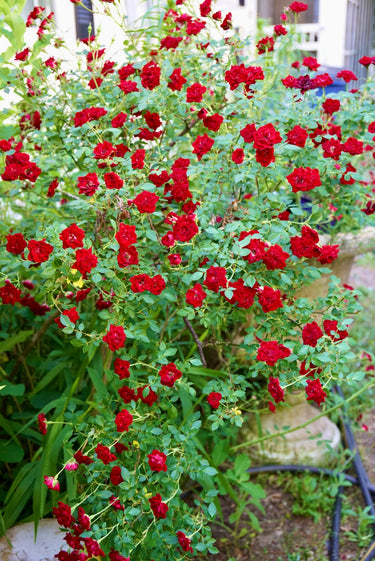


Magic Dragon Climbing Miniature Rose
Rosa sp. 'Magic Dragon'
Pickup currently unavailable at Aiken Nursery
A small rose with a long story. 'Magic Dragon' is a 1969 introduction by Ralph S. Moore (1907 to 2009), the legendary Father of Miniature Roses, who bred more than three hundred cultivars from a small nursery in Visalia, California across nearly seven decades. Moore all but invented the climbing miniature category single-handedly, crossing tiny old varieties like Rouletti with full-sized climbers and selecting the offspring that kept the small leaves and flowers but stretched into climbing wood.
Moore was famous for two habits that set him apart from the rose trade. He grew everything own-root rather than grafting onto rootstock, since grafted roses fail more often in the garden, and he selected for garden performance, for disease resistance, cold tolerance, and repeat bloom, over the show-bench glamour the industry chases. He called the big-flowered hybrid teas of the day cabbages on a stick, and he kept breeding into his nineties, dying at one hundred and two in 2009.
'Magic Dragon' is one of Moore's climbing miniatures from the late 1960s and shows everything he was breeding for. The flowers are small, about an inch and a half across, but come in showy clusters, fully double, in a clean deep red that holds through summer heat without fading or turning purple. Bloom starts in mid-spring and runs in waves through mid-fall, heaviest in late spring and again in early fall. The slender, flexible canes reach five to seven feet, easily trained on a low fence, a mailbox, a tuteur, or a small arbor, or left to ramble as a deep-red flowering groundcover. The small, leathery, dark green leaves carry the disease resistance Moore prized, and gardeners across many climates report the rose to be effectively immune to blackspot and mildew.
The rose came into the Woodlanders catalog the way most of ours do, hand to hand, gardener to gardener. George Mitchell, longtime senior staff at Woodlanders, received the plant some years ago from the late Norm Beal of Raleigh, North Carolina, a plantsman whose collections quietly fed southeastern gardens for decades. George took to 'Magic Dragon' at once, propagated the rose for the nursery, and added the plant to the list. So the chain runs from Ralph Moore in California in 1969, to Norm Beal in Raleigh, to George Mitchell at Woodlanders, and on to your garden, a small plant carrying a remarkable lineage.
'Magic Dragon' is genuinely versatile. Trained on a four-foot picket fence the rose makes a sea of small red flowers from May through October; grown on a tuteur in a patio container the plant becomes a focal point without a full climber's footprint; set at the foot of a trellis with a clematis threaded through, the contrasting flower sizes play off each other; left to ramble, the canes cover a slope or a wall as few miniatures can. Like all roses the plant wants full sun, decent drainage, and a late-winter pruning to stay tidy, and unlike most roses seems to want nothing else.
- Hardiness
- USDA Zones 7–9
- Sun
- Full Sun
- Soil
- Well-drained
- Mature size
- Height 2–6 Feet · Spread 2–4 Feet
- Growth rate
- Fast
- Seasonality
- Deciduous
From rooting to shipping, our top priority is ensuring you receive healthy, thriving plants for your garden’s success.
Because most of our plants are grown from rooted cuttings — alongside seed, air layering, and grafting chosen for each variety — you receive a stronger, true-to-type plant that establishes quickly in your garden.
Raised on organic soil blends and eco-friendly pest management — never harsh chemicals — your plant arrives healthy for your garden, your family, and the pollinators they feed.
Every purchase gives back. We donate to the Aiken Arboretum and support local wildlife conservation, so growing your garden helps protect the wider ecosystem too.

All our plant material is carefully propagated, grown, and nurtured at our humble nursery in Aiken, South Carolina.

Your plant arrives carefully packed and ready to settle in. Unpack them promptly, give them a day or two to acclimate, then plant following the notes we include — that’s all it takes. Clear care guidance comes with every order, so success is the easy part.
What to expect upon delivery
All our plants are sold in 1-gallon sizes, though the height of each plant can vary depending on its growth rate and seasonality, typically ranging from 1/2 to 2.5 feet.
Each plant is carefully packaged with its roots enclosed in a secure plastic bag containing moist soil, forming a compact root ball. To ensure safe transport, the box is padded with recycled newspaper, providing both stability and eco-friendly protection from weather during shipping.
What is your return policy?
Review our full return policy information on our SHIPPING AND RETURNS POLICY page.
What payment methods can I use?
We offer 35 different payment methods including major providers like Mastercard, Visa, PayPal, American Express and Diners as well as many different local payment methods including Klarna, iDEAL, AliPay, Sofort, giropay, and many more.
Can I make changes to my order after it’s been placed?
At Woodlanders, we strive to fulfill orders as quickly as possible. Therefore, we can only accommodate changes to your order within the first 24 hours after it has been placed. These changes include adding or removing products and modifying the delivery address. If you need to make any changes or if there has been a mistake with your order information, please reach out to us promptly via our CONTACT page with your order number for the quickest resolution.
Your satisfaction is our priority, and we appreciate your understanding and cooperation.