




Pineapple Guava
Acca sellowiana
Pickup available at Aiken Nursery
Usually ready in 2-4 days
Acca sellowiana, the pineapple guava, is that rare plant handsome enough for the border and generous enough for the kitchen. The shrub came to botanical notice through the German naturalist Friedrich Sellow, who collected in southern Brazil in 1819, and the name honors him still; for years the plant was known, and is often still sold, as Feijoa sellowiana. The true home is the subtropical highlands of southern Brazil, Uruguay, Paraguay and northern Argentina, and from there the species has traveled to warm gardens the world over.
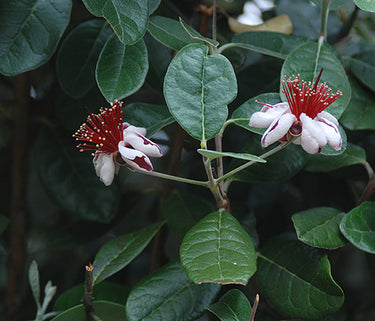
This is an evergreen of quiet good looks, with gray-green leaves that flash silver-white undersides in a breeze. In late spring come the flowers, and they are remarkable: thick, fleshy petals, white without and flushed purple within, surrounding a startling boss of long crimson stamens. The petals themselves are edible, sweet and faintly spicy, a treat to graze straight from the bush, and the birds and bees that come for them do the work of pollination. By late autumn the fruit ripens, oval and gray-green, with an aromatic flesh that tastes of pineapple, apple and mint at once, eaten fresh from the skin or made into jam.
The name has moved once and may move again. Otto Berg established the genus Acca in 1856, and the world went on calling the plant Feijoa anyway, after João da Silva Feijó, the Brazilian naturalist who directed the natural history museum at Bahia. The fruit is still sold under that name wherever the crop is grown, and in New Zealand, where feijoa found a second home, the season is a fixture of the autumn calendar.
In the garden the shrub is endlessly useful: an informal evergreen hedge, a screen, a small multi-stemmed specimen, or the backbone of an edible landscape. Drought and coastal wind are taken in stride, and the plant thrives across the warm South and into California, asking only sun and free-draining soil. Site the shrub where the flowers can be reached in late spring, since eating the petals is half the pleasure, and pair with rosemary, pomegranate and other sun-loving company content on the same sharp drainage. For the heaviest fruit set, grow more than one, since most plants crop best with a partner nearby.
- Hardiness
- USDA Zones 8–11
- Sun
- Full Sun, Part Shade
- Soil
- Well-drained
- Mature size
- Height 12–15 Feet · Spread 8–10 Feet
- Growth rate
- Fast
- Seasonality
- Evergreen
White petals outside, purplish within, dark red stamens, May to June
From rooting to shipping, our top priority is ensuring you receive healthy, thriving plants for your garden’s success.
Because most of our plants are grown from rooted cuttings — alongside seed, air layering, and grafting chosen for each variety — you receive a stronger, true-to-type plant that establishes quickly in your garden.
Raised on organic soil blends and eco-friendly pest management — never harsh chemicals — your plant arrives healthy for your garden, your family, and the pollinators they feed.
Every purchase gives back. We donate to the Aiken Arboretum and support local wildlife conservation, so growing your garden helps protect the wider ecosystem too.

All our plant material is carefully propagated, grown, and nurtured at our humble nursery in Aiken, South Carolina.

Your plant arrives carefully packed and ready to settle in. Unpack them promptly, give them a day or two to acclimate, then plant following the notes we include — that’s all it takes. Clear care guidance comes with every order, so success is the easy part.
What to expect upon delivery
All our plants are sold in 1-gallon sizes, though the height of each plant can vary depending on its growth rate and seasonality, typically ranging from 1/2 to 2.5 feet.
Each plant is carefully packaged with its roots enclosed in a secure plastic bag containing moist soil, forming a compact root ball. To ensure safe transport, the box is padded with recycled newspaper, providing both stability and eco-friendly protection from weather during shipping.
What is your return policy?
Review our full return policy information on our SHIPPING AND RETURNS POLICY page.
What payment methods can I use?
We offer 35 different payment methods including major providers like Mastercard, Visa, PayPal, American Express and Diners as well as many different local payment methods including Klarna, iDEAL, AliPay, Sofort, giropay, and many more.
Can I make changes to my order after it’s been placed?
At Woodlanders, we strive to fulfill orders as quickly as possible. Therefore, we can only accommodate changes to your order within the first 24 hours after it has been placed. These changes include adding or removing products and modifying the delivery address. If you need to make any changes or if there has been a mistake with your order information, please reach out to us promptly via our CONTACT page with your order number for the quickest resolution.
Your satisfaction is our priority, and we appreciate your understanding and cooperation.