


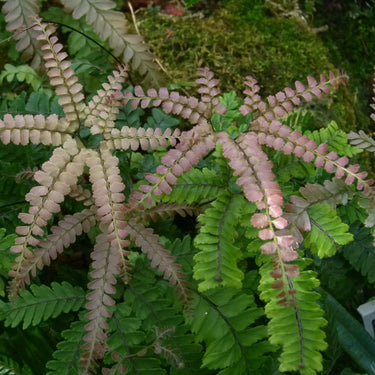


Rosy Maidenhair
Adiantum hispidulum
Pickup available at Aiken Nursery
Usually ready in 2-4 days
Maidenhairs take their English name from their stems, those fine black wiry stalks like strands of dark hair, and their Latin name from a quieter trick. Adiantum comes from the Greek adiantos, the unwetted one, because water will not cling to the fronds. Hold a maidenhair under a running tap and the frond comes out dry, the droplets beading and rolling off a surface built to refuse them. That is the sort of small marvel ferns keep to themselves until you go looking. This particular maidenhair breaks the family mold in one telling way. Where the rest are a byword for fragility, all lace and apology, the rosy maidenhair is faintly hairy and unbothered. Run a fingertip up the stipe and you will feel the bristles that named the fern: hispidulum, minutely hairy, set down by the Swedish botanist Olof Swartz in 1802.
The show is in the new growth. Fronds unfurl a vivid rosy pink, almost startling against the older leaves, before they harden off to a leathery dark green edged in bronze. They come up in hand-shaped, branching fans, the segments radiating like fingers from a point, which is how the plant earned the other name, five-fingered jack. Twelve to eighteen inches, clumping in neat tufts from short rhizomes rather than running off anywhere. Beneath the fertile fronds, along the very edges of the leaf, the spore cases hide under little folded-down flaps, false hems turned over the leaf margins.
They come from a long way off, and from almost everywhere: the shaded rainforests and rocky riverbanks of Australia, New Zealand, tropical Asia, Africa, and the Pacific, a genuinely pantropical fern. They have found the American South agreeable enough to slip out of a few gardens and naturalize along the Gulf, from Louisiana to Florida, which tells you most of what you need to know about siting them. Give them humus-rich, moist, well-drained ground in part shade, sheltered from wind, with the better-than-average humidity the whole tribe prefers. They take a little more sun than most maidenhairs without scorching, though they look their best in dappled light. Hardy in zones 8 to 10, deciduous through a Southern winter, semi-evergreen where the cold stays mild, and the most forgiving maidenhair of all on an east-facing windowsill. In a cold-edge garden the plants may sulk until midsummer before pushing the first pink fronds, so do not write them off in May.
A maidenhair that comes up pink, sheds the rain, and wears the bristles without apology. Tougher than the lacy looks suggest, softer in color than any fern has a right to be, and green wherever the winters allow.
- Hardiness
- USDA Zones 8–10
- Sun
- Part Shade, Full Shade
- Soil
- Moist, Well-drained
- Mature size
- Height 12–18 Inches · Spread 12–18 Inches
- Growth rate
- Fast
- Seasonality
- Dies back
From rooting to shipping, our top priority is ensuring you receive healthy, thriving plants for your garden’s success.
Because most of our plants are grown from rooted cuttings — alongside seed, air layering, and grafting chosen for each variety — you receive a stronger, true-to-type plant that establishes quickly in your garden.
Raised on organic soil blends and eco-friendly pest management — never harsh chemicals — your plant arrives healthy for your garden, your family, and the pollinators they feed.
Every purchase gives back. We donate to the Aiken Arboretum and support local wildlife conservation, so growing your garden helps protect the wider ecosystem too.

All our plant material is carefully propagated, grown, and nurtured at our humble nursery in Aiken, South Carolina.

Your plant arrives carefully packed and ready to settle in. Unpack them promptly, give them a day or two to acclimate, then plant following the notes we include — that’s all it takes. Clear care guidance comes with every order, so success is the easy part.
What to expect upon delivery
All our plants are sold in 1-gallon sizes, though the height of each plant can vary depending on its growth rate and seasonality, typically ranging from 1/2 to 2.5 feet.
Each plant is carefully packaged with its roots enclosed in a secure plastic bag containing moist soil, forming a compact root ball. To ensure safe transport, the box is padded with recycled newspaper, providing both stability and eco-friendly protection from weather during shipping.
What is your return policy?
Review our full return policy information on our SHIPPING AND RETURNS POLICY page.
What payment methods can I use?
We offer 35 different payment methods including major providers like Mastercard, Visa, PayPal, American Express and Diners as well as many different local payment methods including Klarna, iDEAL, AliPay, Sofort, giropay, and many more.
Can I make changes to my order after it’s been placed?
At Woodlanders, we strive to fulfill orders as quickly as possible. Therefore, we can only accommodate changes to your order within the first 24 hours after it has been placed. These changes include adding or removing products and modifying the delivery address. If you need to make any changes or if there has been a mistake with your order information, please reach out to us promptly via our CONTACT page with your order number for the quickest resolution.
Your satisfaction is our priority, and we appreciate your understanding and cooperation.