


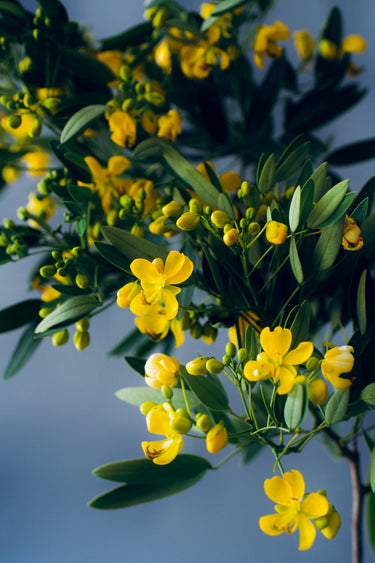


Argentine Senna
Cassia corymbosa
Pickup currently unavailable at Aiken Nursery
September is a difficult month to write for. The garden is still technically in summer, but the light has shifted, lower and more golden, arriving at an angle that changes everything it touches. Cassia corymbosa reads that shift and answers it. While most summer shrubs are winding down, this one is only beginning, throwing dense corymbs of deep golden-yellow flowers at the branch tips with an enthusiasm that seems almost contrarian for the season.
Native to the grasslands and gallery forests along the Río de la Plata in Argentina and Uruguay, the species has been grown in warm-climate gardens long enough that the origins are often forgotten. That is a shame, because the ecology of the Southern Cone, the windswept Pampas and the subtropical gallery forest pressing against open grassland, explains a great deal about the plant: upright, fast-growing, sun-hungry, and tuned to the kind of dramatic seasonal turn that September in the garden approximates, at least in spirit.
The distinction from the close relative Cassia bicapsularis is worth understanding before planting both, which you should. C. corymbosa blooms a full six weeks earlier, September rather than November, and is meaningfully more cold hardy, surviving zone 7 winters with careful siting and reliably root-hardy through zone 8. Where bicapsularis closes the season, corymbosa bridges summer and autumn, the golden clusters opening just as the first Salvia purples deepen and the ornamental grasses begin to catch the light differently. Grown together, the two make a Cassia succession that carries a warm-climate garden from September through the first hard frost, which is, by most measures, an excellent arrangement.
The cylindrical seed pods that follow are architecturally satisfying in their own right, persisting on bare branches through winter. The butterflies arrive reliably. The taxonomists, as with the sibling, continue to debate whether the plant belongs in Cassia or Senna. Woodlanders remains diplomatically agnostic.
- Hardiness
- USDA Zones 8–11
- Sun
- Full Sun
- Soil
- Well-drained, Fertile
- Mature size
- Height 6–10 Feet · Spread 4–6 Feet
- Growth rate
- Moderate
- Seasonality
- Deciduous
From rooting to shipping, our top priority is ensuring you receive healthy, thriving plants for your garden’s success.
Because most of our plants are grown from rooted cuttings — alongside seed, air layering, and grafting chosen for each variety — you receive a stronger, true-to-type plant that establishes quickly in your garden.
Raised on organic soil blends and eco-friendly pest management — never harsh chemicals — your plant arrives healthy for your garden, your family, and the pollinators they feed.
Every purchase gives back. We donate to the Aiken Arboretum and support local wildlife conservation, so growing your garden helps protect the wider ecosystem too.

All our plant material is carefully propagated, grown, and nurtured at our humble nursery in Aiken, South Carolina.

Your plant arrives carefully packed and ready to settle in. Unpack them promptly, give them a day or two to acclimate, then plant following the notes we include — that’s all it takes. Clear care guidance comes with every order, so success is the easy part.
What to expect upon delivery
All our plants are sold in 1-gallon sizes, though the height of each plant can vary depending on its growth rate and seasonality, typically ranging from 1/2 to 2.5 feet.
Each plant is carefully packaged with its roots enclosed in a secure plastic bag containing moist soil, forming a compact root ball. To ensure safe transport, the box is padded with recycled newspaper, providing both stability and eco-friendly protection from weather during shipping.
What is your return policy?
Review our full return policy information on our SHIPPING AND RETURNS POLICY page.
What payment methods can I use?
We offer 35 different payment methods including major providers like Mastercard, Visa, PayPal, American Express and Diners as well as many different local payment methods including Klarna, iDEAL, AliPay, Sofort, giropay, and many more.
Can I make changes to my order after it’s been placed?
At Woodlanders, we strive to fulfill orders as quickly as possible. Therefore, we can only accommodate changes to your order within the first 24 hours after it has been placed. These changes include adding or removing products and modifying the delivery address. If you need to make any changes or if there has been a mistake with your order information, please reach out to us promptly via our CONTACT page with your order number for the quickest resolution.
Your satisfaction is our priority, and we appreciate your understanding and cooperation.