


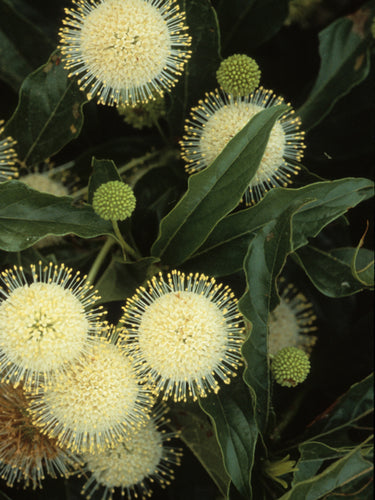


Buttonbush
Cephalanthus occidentalis
See the one Buttonbush we grow
Pickup available at Aiken Nursery
Usually ready in 2-4 days
Buttonbush is the shrub that fishermen know and gardeners forget. Along every slow river and pond margin from Nova Scotia to Florida and west into Texas, Cephalanthus occidentalis stands with roots in the water and flowers in the sun, and from June into August those flowers are unlike anything else in the native flora: perfect creamy-white spheres about an inch across, each one a pincushion of tiny tubular blooms with the styles sticking out like pins, honey-sweet and so thick with bees, swallowtails, and skippers that the whole shrub seems to hum. The name is older than the science. Colonial Americans saw the globes and called the plant buttonbush, or honey-balls, or in the Carolina lowcountry, globe-flower; Linnaeus took the Greek for head (kephale) and flower (anthos) and made the name official in 1753.
Buttonbush had a working life long before any garden. The Choctaw, Seminole, and Meskwaki all used the bitter bark in decoctions, and nineteenth-century physicians sold the bark as a quinine substitute during the malaria years in the river valleys, with the caution that the leaves carry glycosides and are not for eating. Beekeepers have always counted buttonbush among the great summer honey plants, and waterfowl hunters know the dense thickets as the place wood ducks nest and mallards feed on the round, nutlet-studded seedheads that ripen reddish-brown and hang on through winter.
In the garden the plant is a broad, rounded deciduous shrub of six to twelve feet, open and a little rangy if left alone, easily limbed up into a small multi-stemmed tree with handsome fissured bark. Buttonbush will stand in a foot of water through the growing season and survive weeks of flooding, which makes this the shrub for the one spot nothing else tolerates: the rain garden overflow, the pond edge, the ditch line, the low corner where the downspouts meet. Given ordinary moist garden soil and sun, the shrub behaves perfectly well in a border too. Cut hard in late winter if a tighter shape is wanted; flowers come on new wood, so nothing is lost.
Plant buttonbush where a July afternoon can be spent watching. Pair with Hibiscus coccineus, Itea virginica, and Lobelia cardinalis for a wet-foot border that runs from June to frost, or set a single plant at the water's edge and let the reflection double the globes. Few natives give this much to this many, and almost none do so in standing water.
- Hardiness
- USDA Zones 5–10
- Sun
- Full Sun, Part Shade
- Soil
- Wet, Average
- Mature size
- Height 6–12 Feet · Spread 6–8 Feet
- Growth rate
- Fast
- Seasonality
- Deciduous
1 to 1.25 inch creamy white, June-August
These statements have not been evaluated by the Food and Drug Administration. This information is shared for traditional and educational interest only and is not intended to diagnose, treat, cure, or prevent any disease. Please consult a qualified healthcare professional before any medicinal use.
- Toxic: all parts contain cephalanthin
- Ingestion can cause vomiting, convulsions, and paralysis
- Not for self-treatment or home use
- Keep bark and foliage away from children and livestock
From rooting to shipping, our top priority is ensuring you receive healthy, thriving plants for your garden’s success.
Because most of our plants are grown from rooted cuttings — alongside seed, air layering, and grafting chosen for each variety — you receive a stronger, true-to-type plant that establishes quickly in your garden.
Raised on organic soil blends and eco-friendly pest management — never harsh chemicals — your plant arrives healthy for your garden, your family, and the pollinators they feed.
Every purchase gives back. We donate to the Aiken Arboretum and support local wildlife conservation, so growing your garden helps protect the wider ecosystem too.

All our plant material is carefully propagated, grown, and nurtured at our humble nursery in Aiken, South Carolina.

Your plant arrives carefully packed and ready to settle in. Unpack them promptly, give them a day or two to acclimate, then plant following the notes we include — that’s all it takes. Clear care guidance comes with every order, so success is the easy part.
What to expect upon delivery
All our plants are sold in 1-gallon sizes, though the height of each plant can vary depending on its growth rate and seasonality, typically ranging from 1/2 to 2.5 feet.
Each plant is carefully packaged with its roots enclosed in a secure plastic bag containing moist soil, forming a compact root ball. To ensure safe transport, the box is padded with recycled newspaper, providing both stability and eco-friendly protection from weather during shipping.
What is your return policy?
Review our full return policy information on our SHIPPING AND RETURNS POLICY page.
What payment methods can I use?
We offer 35 different payment methods including major providers like Mastercard, Visa, PayPal, American Express and Diners as well as many different local payment methods including Klarna, iDEAL, AliPay, Sofort, giropay, and many more.
Can I make changes to my order after it’s been placed?
At Woodlanders, we strive to fulfill orders as quickly as possible. Therefore, we can only accommodate changes to your order within the first 24 hours after it has been placed. These changes include adding or removing products and modifying the delivery address. If you need to make any changes or if there has been a mistake with your order information, please reach out to us promptly via our CONTACT page with your order number for the quickest resolution.
Your satisfaction is our priority, and we appreciate your understanding and cooperation.