


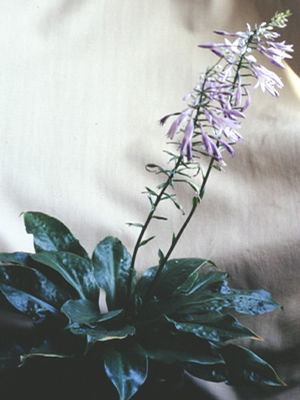

Yinger's Plantain Lily
Hosta yingeri
In propagation
Currently growing out 1 Gallon pots. Expected Summer 2026.
Add your name with the notify button below, and we will email you the moment this plant is ready to bring home.
Learn how we grow on The Prop House.
Pickup currently unavailable at Aiken Nursery
Hosta yingeri is one of the more recent hostas to reach gardens and one of the most distinct, a species found only on a scatter of rocky islands in the Huksan Archipelago off the southwestern coast of Korea. The American plantsman Barry Yinger collected the plant on Taehuksan Island in 1985, and the botanist Samuel B. Jones formally named the species in 1989 in Yinger's honor. For a genus most gardeners associate with the woodlands of Japan, this Korean islander broadened the family map.
What sets the plant apart is a hard, lacquered shine. The elliptic leaves are thick and almost succulent, a deep to medium green polished to a gloss on top and a pale grey-green beneath, built to endure sun-warmed rock and salt wind. Rather than the soft, quilted mounds of a classic blue hosta, this Korean species forms a low, tidy rosette barely a foot high, more chiseled than billowy, holding a clean shape through the season.
The flowers are the real surprise. Where most hostas hang their bells to one side of the stem, Hosta yingeri spaces near-radial, star-shaped purple flowers evenly all the way around the scape in late summer, with an unusually long second set of stamens giving each bloom a spidery, almost orchid-like poise. Bees work the flowers, and the airy purple spikes rise well above the glossy leaves just as the summer garden starts to tire.
Like other hostas, the plant belongs to a long tradition of shade gardening across East Asia, where the tightly rolled spring shoots of several species, called urui in Japan, are gathered as a seasonal vegetable. In the garden, Hosta yingeri earns a spot at the front of a shady bed, tucked into a shaded rock garden, or edging a woodland path where the polished leaves can catch what little light reaches them. Ferns, sedges, and epimediums make natural companions, and the glossy, substantial foliage shrugs off much of the slug damage that plagues thinner-leaved hostas, though deer will still browse a tender clump.
- Hardiness
- USDA Zones 5–8
- Sun
- Part Shade, Full Shade
- Soil
- Well-drained, Moist
- Mature size
- Height 15–18 Inches · Spread 15–18 Inches
- Growth rate
- Moderate
- Seasonality
- Dies back, depends on zone
Star-shaped purple, radial, late summer
From rooting to shipping, our top priority is ensuring you receive healthy, thriving plants for your garden’s success.
Because most of our plants are grown from rooted cuttings — alongside seed, air layering, and grafting chosen for each variety — you receive a stronger, true-to-type plant that establishes quickly in your garden.
Raised on organic soil blends and eco-friendly pest management — never harsh chemicals — your plant arrives healthy for your garden, your family, and the pollinators they feed.
Every purchase gives back. We donate to the Aiken Arboretum and support local wildlife conservation, so growing your garden helps protect the wider ecosystem too.

All our plant material is carefully propagated, grown, and nurtured at our humble nursery in Aiken, South Carolina.

Your plant arrives carefully packed and ready to settle in. Unpack them promptly, give them a day or two to acclimate, then plant following the notes we include — that’s all it takes. Clear care guidance comes with every order, so success is the easy part.
What to expect upon delivery
All our plants are sold in 1-gallon sizes, though the height of each plant can vary depending on its growth rate and seasonality, typically ranging from 1/2 to 2.5 feet.
Each plant is carefully packaged with its roots enclosed in a secure plastic bag containing moist soil, forming a compact root ball. To ensure safe transport, the box is padded with recycled newspaper, providing both stability and eco-friendly protection from weather during shipping.
What is your return policy?
Review our full return policy information on our SHIPPING AND RETURNS POLICY page.
What payment methods can I use?
We offer 35 different payment methods including major providers like Mastercard, Visa, PayPal, American Express and Diners as well as many different local payment methods including Klarna, iDEAL, AliPay, Sofort, giropay, and many more.
Can I make changes to my order after it’s been placed?
At Woodlanders, we strive to fulfill orders as quickly as possible. Therefore, we can only accommodate changes to your order within the first 24 hours after it has been placed. These changes include adding or removing products and modifying the delivery address. If you need to make any changes or if there has been a mistake with your order information, please reach out to us promptly via our CONTACT page with your order number for the quickest resolution.
Your satisfaction is our priority, and we appreciate your understanding and cooperation.