


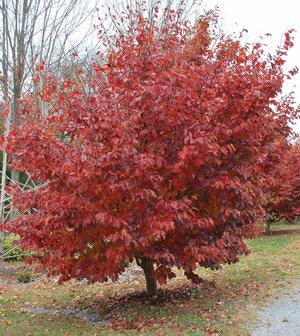

Persian Ironwood
Parrotia persica
Pickup currently unavailable at Aiken Nursery
There is a moment in late winter, before anything else in the garden has stirred, when Parrotia persica opens the first flowers. They have no petals, just a tight cluster of crimson stamens emerging from scaled buds along bare grey branches, small and startling against the cold. Most people walk past them. The ones who stop tend to become collectors.
Native to the forests along the southern shores of the Caspian Sea, Parrotia has been part of the horticultural conversation long enough that serious gardeners know the tree well, and yet Persian ironwood still has not found a way into nearly enough gardens. That seems like a problem worth solving.
The bark is the thing that stops people cold. On mature specimens the bark exfoliates in irregular plates the way a sycamore or stewartia does, revealing an understory of cream, grey, olive, and warm tan, a patchwork that grows more complex and more beautiful every year. The canopy is broadly spreading, often wider than tall, with a layered architecture that reads as sculpture in winter once the leaves have dropped.
And then the leaves turn in a manner worth discussing. Few trees offer fall color of this intensity across such a range, burgundy deepening to scarlet, orange bleeding into gold, sometimes all of it on the same branch at the same time. In a good autumn the display is, without exaggeration, one of the finest things growing in the temperate garden.
Parrotia persica is hardy, adaptable to a range of soils, and largely indifferent to urban conditions, qualities that, combined with everything else the tree offers, make the rarity genuinely hard to explain. We don't have an answer. We do have the tree.
- Hardiness
- USDA Zones 4–8
- Sun
- Full Sun, Part Shade
- Soil
- Well-drained
- Mature size
- Height 20–40 Feet · Spread 15–30 Feet
- Growth rate
- Moderate
- Seasonality
- Deciduous
Petalless clusters of crimson stamens on bare branches in late winter to early spring
From rooting to shipping, our top priority is ensuring you receive healthy, thriving plants for your garden’s success.
Because most of our plants are grown from rooted cuttings — alongside seed, air layering, and grafting chosen for each variety — you receive a stronger, true-to-type plant that establishes quickly in your garden.
Raised on organic soil blends and eco-friendly pest management — never harsh chemicals — your plant arrives healthy for your garden, your family, and the pollinators they feed.
Every purchase gives back. We donate to the Aiken Arboretum and support local wildlife conservation, so growing your garden helps protect the wider ecosystem too.

All our plant material is carefully propagated, grown, and nurtured at our humble nursery in Aiken, South Carolina.

Your plant arrives carefully packed and ready to settle in. Unpack them promptly, give them a day or two to acclimate, then plant following the notes we include — that’s all it takes. Clear care guidance comes with every order, so success is the easy part.
What to expect upon delivery
All our plants are sold in 1-gallon sizes, though the height of each plant can vary depending on its growth rate and seasonality, typically ranging from 1/2 to 2.5 feet.
Each plant is carefully packaged with its roots enclosed in a secure plastic bag containing moist soil, forming a compact root ball. To ensure safe transport, the box is padded with recycled newspaper, providing both stability and eco-friendly protection from weather during shipping.
What is your return policy?
Review our full return policy information on our SHIPPING AND RETURNS POLICY page.
What payment methods can I use?
We offer 35 different payment methods including major providers like Mastercard, Visa, PayPal, American Express and Diners as well as many different local payment methods including Klarna, iDEAL, AliPay, Sofort, giropay, and many more.
Can I make changes to my order after it’s been placed?
At Woodlanders, we strive to fulfill orders as quickly as possible. Therefore, we can only accommodate changes to your order within the first 24 hours after it has been placed. These changes include adding or removing products and modifying the delivery address. If you need to make any changes or if there has been a mistake with your order information, please reach out to us promptly via our CONTACT page with your order number for the quickest resolution.
Your satisfaction is our priority, and we appreciate your understanding and cooperation.