


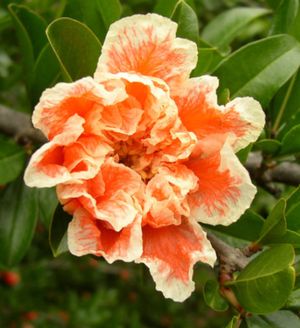

Pomegranate 'California Sunset'
Punica granatum 'California Sunset'
In propagation
Currently rooting cuttings. Expected Winter 2028.
Add your name with the notify button below, and we will email you the moment this plant is ready to bring home.
Learn how we grow on The Prop House.
Pickup currently unavailable at Aiken Nursery
Punica granatum 'California Sunset' turns the pomegranate into something closer to a florist's confection. The flowers arrive fully double, coral to salmon-red and streaked with creamy white, each one fluted and ruffled like an old boutonniere carnation rather than the tidy scarlet trumpet of the wild species. Because the petals are packed so tightly, the flowers rarely set fruit, which is precisely the point: this is a pomegranate grown for the long parade of bloom from early summer into fall, not for the leathery globes at the end of the season.
The plant carries two names and a small tangle of history. In Europe the shrub is still Punica granatum 'Madame Legrelle', or 'Legrellei', after Madame Legrelle d'Hanis of Belgium, who introduced the cultivar to horticulture shortly before 1858 after receiving the plant from her friend Madame Parmentier, a Belgian gardener then living in Illinois. American nurseries later rechristened the same shrub 'California Sunset', a nod to the Mediterranean-style gardens of the West Coast where the heat-loving pomegranate felt at home. One plant, two continents, and a name for each.
Behind the ornamental lies one of the oldest cultivated plants on earth. The species has been grown across Persia, the Levant, and the Mediterranean since antiquity, valued for fruit, dye, medicine, and a thick freight of myth, from Persephone's stolen seeds to the many-chambered fruit as an emblem of fertility and abundance. The botanical name tells a geographic story of its own: granatum means seeded or grainy, the root of the word grenade, while Punica points to Carthage and the Punic peoples through whom Rome first came to know the fruit. 'California Sunset' keeps the lineage and trades the harvest for spectacle.
In the garden, treat the shrub as a long-blooming ornamental for a hot, sunny, well-drained spot: a mixed border, a cottage planting, a courtyard, or a large container where the ruffled flowers can be studied at close range. Give full sun for the heaviest bloom, sharp drainage, and room for the deciduous, twiggy frame to reach eight to ten feet. Pair 'California Sunset' with other sun-and-drought lovers such as rosemary, salvias, and ornamental grasses, and site the plant where the summer-long flush of coral and cream can carry a bed through the hottest months, when many shrubs have long since finished.
- Hardiness
- USDA Zones 8–9
- Sun
- Full Sun, Part Shade
- Soil
- Well-drained
- Mature size
- Height 8–10 Feet · Spread 4–6 Feet
- Growth rate
- Moderate
- Seasonality
- Deciduous
Double, coral-red streaked with cream, summer to fall
From rooting to shipping, our top priority is ensuring you receive healthy, thriving plants for your garden’s success.
Because most of our plants are grown from rooted cuttings — alongside seed, air layering, and grafting chosen for each variety — you receive a stronger, true-to-type plant that establishes quickly in your garden.
Raised on organic soil blends and eco-friendly pest management — never harsh chemicals — your plant arrives healthy for your garden, your family, and the pollinators they feed.
Every purchase gives back. We donate to the Aiken Arboretum and support local wildlife conservation, so growing your garden helps protect the wider ecosystem too.

All our plant material is carefully propagated, grown, and nurtured at our humble nursery in Aiken, South Carolina.

Your plant arrives carefully packed and ready to settle in. Unpack them promptly, give them a day or two to acclimate, then plant following the notes we include — that’s all it takes. Clear care guidance comes with every order, so success is the easy part.
What to expect upon delivery
All our plants are sold in 1-gallon sizes, though the height of each plant can vary depending on its growth rate and seasonality, typically ranging from 1/2 to 2.5 feet.
Each plant is carefully packaged with its roots enclosed in a secure plastic bag containing moist soil, forming a compact root ball. To ensure safe transport, the box is padded with recycled newspaper, providing both stability and eco-friendly protection from weather during shipping.
What is your return policy?
Review our full return policy information on our SHIPPING AND RETURNS POLICY page.
What payment methods can I use?
We offer 35 different payment methods including major providers like Mastercard, Visa, PayPal, American Express and Diners as well as many different local payment methods including Klarna, iDEAL, AliPay, Sofort, giropay, and many more.
Can I make changes to my order after it’s been placed?
At Woodlanders, we strive to fulfill orders as quickly as possible. Therefore, we can only accommodate changes to your order within the first 24 hours after it has been placed. These changes include adding or removing products and modifying the delivery address. If you need to make any changes or if there has been a mistake with your order information, please reach out to us promptly via our CONTACT page with your order number for the quickest resolution.
Your satisfaction is our priority, and we appreciate your understanding and cooperation.