



Sacred Lily of China
Rohdea japonica 'Claudia Phelps'
Pickup available at Aiken Nursery
Usually ready in 2-4 days
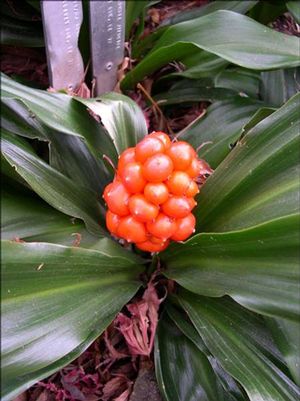
Rohdea japonica, the sacred lily or Nippon lily, is a bold, slow, tufted evergreen perennial grown above all for foliage, and this selection carries the darkest leaves of all, an almost black, glossy green that anchors a shaded planting through the whole year and lights up a winter landscape when little else holds. Rather sizeable red berries ripen in tight clusters, half-hidden at the base of the leaves, a quiet second season for anyone who looks closely.
Few plants carry so much cultural weight. Known in Japan as omoto, meaning evergreen, and prized for at least five hundred years as a symbol of long life and good fortune, Rohdea became the subject of a genuine craze: the sale of the plant was banned in 1852 to cool the speculation, and the Japan Rohdea Society today registers some six hundred named cultivars, the more dwarf, contorted, and variegated the more highly prized. As the old saying that Woodlanders is fond of repeating goes, in Japan old men devote their declining years to the culture of the various forms of this plant. The small, pale flowers, carried in a short dense spike among the leaves, are pollinated, remarkably, by snails.
In China the plant is wan nian qing, again evergreen, and the roots and leaves have a long place in traditional Chinese medicine as a cardiac and general tonic, a reminder that Rohdea, like foxglove and lily of the valley, carries potent cardiac glycosides and is poisonous if eaten. This particular clone has a home-ground story: the plant comes from Rosehill, the Aiken estate of the late Claudia Phelps, and was named for her by our friend Ted Stephens of Nurseries Caroliniana.
Grow 'Claudia Phelps' in shade to part shade, in rich, well-drained soil, as a bold evergreen groundcover, a foliage anchor at the front of a shaded border, or an accent in a courtyard or container where the near-black leaves can be read at close range. Slow and long-lived, deer-resistant, and drought-tolerant in shade once established, the plant pairs beautifully with ferns, hellebores, hostas, and other shade companions, and rewards the patient gardener with decades of quiet, sculptural presence.
- Hardiness
- USDA Zones 8–10
- Sun
- Part Shade, Full Shade
- Soil
- Well-drained, Rich
- Mature size
- Height 6–12 Inches · Spread 6–9 Inches
- Growth rate
- Slow
- Seasonality
- Evergreen
Small, pale, in a short dense spike hidden among the leaves; red berries follow
These statements have not been evaluated by the Food and Drug Administration. This information is shared for traditional and educational interest only and is not intended to diagnose, treat, cure, or prevent any disease. Please consult a qualified healthcare professional before any medicinal use.
- Not a substitute for professional medical care
- Contains potent cardiac glycosides and is poisonous; never self-administer
- Grow as an ornamental only; any medicinal use belongs to trained practitioners
From rooting to shipping, our top priority is ensuring you receive healthy, thriving plants for your garden’s success.
Because most of our plants are grown from rooted cuttings — alongside seed, air layering, and grafting chosen for each variety — you receive a stronger, true-to-type plant that establishes quickly in your garden.
Raised on organic soil blends and eco-friendly pest management — never harsh chemicals — your plant arrives healthy for your garden, your family, and the pollinators they feed.
Every purchase gives back. We donate to the Aiken Arboretum and support local wildlife conservation, so growing your garden helps protect the wider ecosystem too.

All our plant material is carefully propagated, grown, and nurtured at our humble nursery in Aiken, South Carolina.

Your plant arrives carefully packed and ready to settle in. Unpack them promptly, give them a day or two to acclimate, then plant following the notes we include — that’s all it takes. Clear care guidance comes with every order, so success is the easy part.
What to expect upon delivery
All our plants are sold in 1-gallon sizes, though the height of each plant can vary depending on its growth rate and seasonality, typically ranging from 1/2 to 2.5 feet.
Each plant is carefully packaged with its roots enclosed in a secure plastic bag containing moist soil, forming a compact root ball. To ensure safe transport, the box is padded with recycled newspaper, providing both stability and eco-friendly protection from weather during shipping.
What is your return policy?
Review our full return policy information on our SHIPPING AND RETURNS POLICY page.
What payment methods can I use?
We offer 35 different payment methods including major providers like Mastercard, Visa, PayPal, American Express and Diners as well as many different local payment methods including Klarna, iDEAL, AliPay, Sofort, giropay, and many more.
Can I make changes to my order after it’s been placed?
At Woodlanders, we strive to fulfill orders as quickly as possible. Therefore, we can only accommodate changes to your order within the first 24 hours after it has been placed. These changes include adding or removing products and modifying the delivery address. If you need to make any changes or if there has been a mistake with your order information, please reach out to us promptly via our CONTACT page with your order number for the quickest resolution.
Your satisfaction is our priority, and we appreciate your understanding and cooperation.