


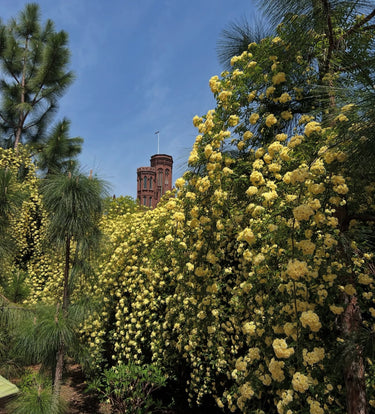


Rose 'Lady Banks'
Rosa banksiae 'Lutea'
Pickup available at Aiken Nursery
Usually ready in 2-4 days
Of all the plants that carry Sir Joseph Banks's name, and there are a great many, this rose carries his wife's. Banks was the most powerful botanist of his age: president of the Royal Society, the man who effectively built Kew, who had sailed with Cook to the far side of the world. When a thornless climbing rose came west out of the Chinese gardens, it was named not for him but for Dorothea, Lady Banks. The white double arrived first, collected at Canton in 1807. This one, the yellow, followed in 1824, carried back by the plant hunter John Damper Parks by way of the Calcutta botanic garden, an old Chinese garden form that had been grown and selected for generations before any Englishman set eyes on it.
She is the most generous of the Banks roses. For a few weeks in March and April, timed with the azaleas and the dogwoods, she covers herself in hanging sprays of small soft-yellow rosettes, hundreds to a cane, each flower no wider than a thumbnail and stuffed with petals. She blooms once and does not repeat, which is the bargain these roses strike: everything at once, then a long green rest. One thing the catalogs tend to fudge is the perfume. She has almost none. The famous violet scent belongs to her white sister; the yellow traded most of it away, and what she offers in exchange is hardiness and sheer volume of bloom.
She is nearly thornless, her long green canes smooth enough to train over an arch you walk under or a gate you lean on, which is why these roses turn up so often around porches and paths and in gardens where children play. Give her full sun, which she needs to ripen her wood for the next year's flowers, and almost any soil that drains; once established she is drought-tolerant and shrugs off the blackspot and mildew that plague lesser roses. She is the hardiest of her clan, reliable through zone 7 and into zone 6 with a sheltered wall, evergreen where winters stay mild and merely deciduous where they do not. The one rule worth knowing is when not to prune. She flowers on side-shoots two and three years old, so a winter tidy-up cuts off the show before it starts. Wait until the bloom is spent, then take out only the oldest wood. Her white sister, for the record, is the Tombstone rose in Arizona, a single Lady Banks set out in 1885 that now shades some eight thousand square feet on a trunk no one can reach around.
A rose named for a botanist's wife and grown ever since for her thornless ease and her one extravagant yellow fortnight. She wants more room than seems reasonable and full sun to ripen in, and where she gets both she becomes the kind of spring event the neighbors plan their walks around.
- Hardiness
- USDA Zones 7–9
- Sun
- Full Sun
- Soil
- Well-drained, Fertile
- Mature size
- Height 15–20 Feet · Spread 15–20 Feet
- Growth rate
- Fast
- Seasonality
- Evergreen
Double, lightly fragrant, yellow
From rooting to shipping, our top priority is ensuring you receive healthy, thriving plants for your garden’s success.
Because most of our plants are grown from rooted cuttings — alongside seed, air layering, and grafting chosen for each variety — you receive a stronger, true-to-type plant that establishes quickly in your garden.
Raised on organic soil blends and eco-friendly pest management — never harsh chemicals — your plant arrives healthy for your garden, your family, and the pollinators they feed.
Every purchase gives back. We donate to the Aiken Arboretum and support local wildlife conservation, so growing your garden helps protect the wider ecosystem too.

All our plant material is carefully propagated, grown, and nurtured at our humble nursery in Aiken, South Carolina.

Your plant arrives carefully packed and ready to settle in. Unpack them promptly, give them a day or two to acclimate, then plant following the notes we include — that’s all it takes. Clear care guidance comes with every order, so success is the easy part.
What to expect upon delivery
All our plants are sold in 1-gallon sizes, though the height of each plant can vary depending on its growth rate and seasonality, typically ranging from 1/2 to 2.5 feet.
Each plant is carefully packaged with its roots enclosed in a secure plastic bag containing moist soil, forming a compact root ball. To ensure safe transport, the box is padded with recycled newspaper, providing both stability and eco-friendly protection from weather during shipping.
What is your return policy?
Review our full return policy information on our SHIPPING AND RETURNS POLICY page.
What payment methods can I use?
We offer 35 different payment methods including major providers like Mastercard, Visa, PayPal, American Express and Diners as well as many different local payment methods including Klarna, iDEAL, AliPay, Sofort, giropay, and many more.
Can I make changes to my order after it’s been placed?
At Woodlanders, we strive to fulfill orders as quickly as possible. Therefore, we can only accommodate changes to your order within the first 24 hours after it has been placed. These changes include adding or removing products and modifying the delivery address. If you need to make any changes or if there has been a mistake with your order information, please reach out to us promptly via our CONTACT page with your order number for the quickest resolution.
Your satisfaction is our priority, and we appreciate your understanding and cooperation.