


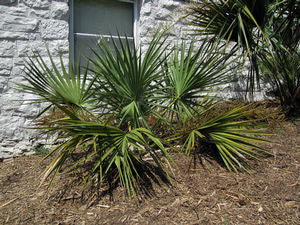

Scrub Palmetto
Sabal etonia
In propagation
Currently growing out 1 Gallon pots. Expected Summer 2027.
Add your name with the notify button below, and we will email you the moment this plant is ready to bring home.
Learn how we grow on The Prop House.
Pickup currently unavailable at Aiken Nursery
Sabal etonia, the scrub palmetto, is a small fan palm found nowhere in the world but Florida, where the palm is a signature of the sand pine scrub, most abundantly along the ancient dunes of the Lake Wales Ridge. The specific epithet etonia comes from the Etonia scrub of Putnam County, the country where the species was first collected, so the botanical name carries a Florida place with it.
Most of the trunk lives underground. Scrub palmetto usually holds a stem that runs beneath the sand, sending up only a low rosette of leaves, though now and then a short erect trunk appears above ground. Four to seven stiff, costapalmate, gray- to blue-green fans rise from the crown, each blade three feet across or more, arching in the strong, structural way of the genus. That buried stem is an elegant answer to a harsh home: in a habitat shaped by periodic fire, drought, and lean sand, the growing point sits safely below the surface and the palm simply resprouts after a burn.
Despite that deep-Florida origin, scrub palmetto proves remarkably cold hardy, thriving throughout Zone 8 and even into Zone 7. One of the plants in the photograph grows in Chattanooga, Tennessee, a long way north of the Florida scrub, and Woodlanders was among the first nurseries anywhere to offer the species to gardeners. Fragrant creamy-white flowers open in spring, held on branched sprays, and give way to glossy black fruit, in the manner of the palmettos that have long fed wildlife and furnished thatch and fiber across the Southeast.
In the garden Sabal etonia reads as a bold, low fan of blue-green among plants that share a taste for sun and sharp drainage. Site the palm as a specimen in a gravel or xeric bed, at the front of a dry sunny border, or in a sand-scrub or native planting, where the arching leaves can be seen from the side and given room to spread. Slow, drought-tolerant, and unbothered by heat, poor soil, or deer, this is a distinctive and genuinely rare palm for the collector and the native-plant gardener alike.
- Hardiness
- USDA Zones 7–10
- Sun
- Full Sun, Part Shade
- Soil
- Well-drained
- Mature size
- Height 4–6 Feet · Spread 3–6 Feet
- Growth rate
- Slow
- Seasonality
- Evergreen
inflorescence: shorter than leaves, from primary branches rachillae to 6 inches long. Flowers 3/16 inches long, creamy white.
From rooting to shipping, our top priority is ensuring you receive healthy, thriving plants for your garden’s success.
Because most of our plants are grown from rooted cuttings — alongside seed, air layering, and grafting chosen for each variety — you receive a stronger, true-to-type plant that establishes quickly in your garden.
Raised on organic soil blends and eco-friendly pest management — never harsh chemicals — your plant arrives healthy for your garden, your family, and the pollinators they feed.
Every purchase gives back. We donate to the Aiken Arboretum and support local wildlife conservation, so growing your garden helps protect the wider ecosystem too.

All our plant material is carefully propagated, grown, and nurtured at our humble nursery in Aiken, South Carolina.

Your plant arrives carefully packed and ready to settle in. Unpack them promptly, give them a day or two to acclimate, then plant following the notes we include — that’s all it takes. Clear care guidance comes with every order, so success is the easy part.
What to expect upon delivery
All our plants are sold in 1-gallon sizes, though the height of each plant can vary depending on its growth rate and seasonality, typically ranging from 1/2 to 2.5 feet.
Each plant is carefully packaged with its roots enclosed in a secure plastic bag containing moist soil, forming a compact root ball. To ensure safe transport, the box is padded with recycled newspaper, providing both stability and eco-friendly protection from weather during shipping.
What is your return policy?
Review our full return policy information on our SHIPPING AND RETURNS POLICY page.
What payment methods can I use?
We offer 35 different payment methods including major providers like Mastercard, Visa, PayPal, American Express and Diners as well as many different local payment methods including Klarna, iDEAL, AliPay, Sofort, giropay, and many more.
Can I make changes to my order after it’s been placed?
At Woodlanders, we strive to fulfill orders as quickly as possible. Therefore, we can only accommodate changes to your order within the first 24 hours after it has been placed. These changes include adding or removing products and modifying the delivery address. If you need to make any changes or if there has been a mistake with your order information, please reach out to us promptly via our CONTACT page with your order number for the quickest resolution.
Your satisfaction is our priority, and we appreciate your understanding and cooperation.