


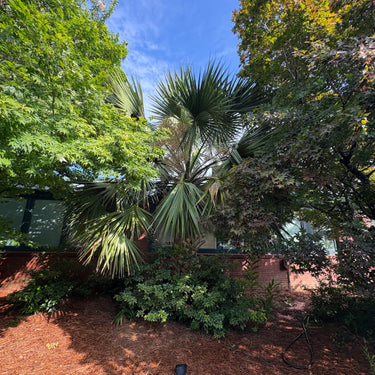


Texas Palmetto
Sabal mexicana
In propagation
Currently growing out 1 Gallon pots. Expected Summer 2027.
Add your name with the notify button below, and we will email you the moment this plant is ready to bring home.
Learn how we grow on The Prop House.
Pickup currently unavailable at Aiken Nursery
Sabal mexicana, the Texas Palmetto, is a large, robust fan palm once known as Sabal texana. In the United States the palm is native to the lower Rio Grande Valley of Texas, and formerly ranged northward along the south Texas Gulf coast, while the wider distribution reaches through eastern Mexico into Central America. The species resembles the cabbage palmetto of the Southeast but reads as heavier and more massive, and the much larger seed is the surest way to tell the two apart.
Few palms are woven more deeply into daily life. Across Mexico the broad leaves of Sabal mexicana have long thatched the palapa roofs of the coast, the leaf fiber has been twisted into cordage and woven into hats and baskets, and the small dark fruit has been eaten, so the palm carries a working history alongside a wild one. The name honors the country at the heart of that range.
Little grown and seldom seen in the Southeast, the Texas Palmetto is sought out by palm fanciers and collectors across the Deep South, where the bold silhouette stands apart from the more familiar cabbage palms. The species proves usefully cold hardy for a plant of such southern origin, and one of the palms in the photograph grows in Anniston, Alabama, a good measure of what the palm will take.
Given room, Sabal mexicana makes a commanding specimen or avenue tree for a large, warm garden, the massive fans and heavy trunk carrying real presence against sky or architecture. Site in full sun to part shade in well-drained soil, allow generous space for the mature spread, and expect slow, steady growth toward a palm that anchors a landscape for generations.
- Hardiness
- USDA Zones 8–10
- Sun
- Full Sun, Part Shade
- Soil
- Well-drained
- Mature size
- Height 18–35 Feet · Spread 10–15 Feet
- Growth rate
- Slow
- Seasonality
- Evergreen
White flowers on branched stalks that may exceed the leaves in summer, followed by dark fruit with a notably large seed.
From rooting to shipping, our top priority is ensuring you receive healthy, thriving plants for your garden’s success.
Because most of our plants are grown from rooted cuttings — alongside seed, air layering, and grafting chosen for each variety — you receive a stronger, true-to-type plant that establishes quickly in your garden.
Raised on organic soil blends and eco-friendly pest management — never harsh chemicals — your plant arrives healthy for your garden, your family, and the pollinators they feed.
Every purchase gives back. We donate to the Aiken Arboretum and support local wildlife conservation, so growing your garden helps protect the wider ecosystem too.

All our plant material is carefully propagated, grown, and nurtured at our humble nursery in Aiken, South Carolina.

Your plant arrives carefully packed and ready to settle in. Unpack them promptly, give them a day or two to acclimate, then plant following the notes we include — that’s all it takes. Clear care guidance comes with every order, so success is the easy part.
What to expect upon delivery
All our plants are sold in 1-gallon sizes, though the height of each plant can vary depending on its growth rate and seasonality, typically ranging from 1/2 to 2.5 feet.
Each plant is carefully packaged with its roots enclosed in a secure plastic bag containing moist soil, forming a compact root ball. To ensure safe transport, the box is padded with recycled newspaper, providing both stability and eco-friendly protection from weather during shipping.
What is your return policy?
Review our full return policy information on our SHIPPING AND RETURNS POLICY page.
What payment methods can I use?
We offer 35 different payment methods including major providers like Mastercard, Visa, PayPal, American Express and Diners as well as many different local payment methods including Klarna, iDEAL, AliPay, Sofort, giropay, and many more.
Can I make changes to my order after it’s been placed?
At Woodlanders, we strive to fulfill orders as quickly as possible. Therefore, we can only accommodate changes to your order within the first 24 hours after it has been placed. These changes include adding or removing products and modifying the delivery address. If you need to make any changes or if there has been a mistake with your order information, please reach out to us promptly via our CONTACT page with your order number for the quickest resolution.
Your satisfaction is our priority, and we appreciate your understanding and cooperation.