


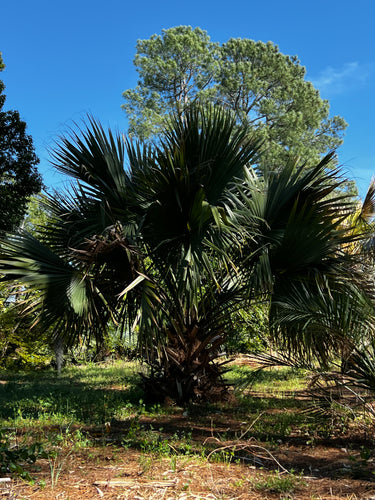


Llano Palm
Sabal rosei
In propagation
Currently growing out 1 Gallon pots. Expected Summer 2027.
Add your name with the notify button below, and we will email you the moment this plant is ready to bring home.
Learn how we grow on The Prop House.
Pickup currently unavailable at Aiken Nursery
Sabal rosei, the Llano Palm, is a handsome fan palm from the Pacific side of Mexico, ranging through the states of Sinaloa and Jalisco, where the palm covers the coastal plains, the llanos, by the hundred thousand. Thick, blue-green, leathery fan leaves give the plant a bold, sculptural quality, and the slim, straight trunk is either patterned with a neat spiral of old leaf bases or swept clean to reveal the ring-like scars beneath.
For all that abundance in the wild, Sabal rosei is almost unknown in cultivation, which makes the palm a real find for the collector. Our own plants were grown from seed given to us by Joe Le Vert of Aquinas High School, and we are glad to have it: the species is easy from seed and, unusually for a Sabal, a fast and reliable grower, tolerating both flooding and drought while favoring the dry, open ground of the native llanos. Small yellow flowers, an uncommon color in a genus mostly given to whitish bloom, are followed by black berries.
Despite the tropical Mexican home, the Llano Palm is cold hardy to around twenty degrees Fahrenheit, into USDA Zone 8, opening the door to gardeners well outside the tropics. Like the other fan palms of Mexico, the species belongs to a group whose leaves have long been cut for thatch and fiber, so a working history sits behind the ornamental one.
In the garden Sabal rosei makes a striking specimen for a hot, sunny, well-drained spot, the thick blue-green fans and clean trunk reading against sky, stone, or a plain wall. Drought tolerant once established and unbothered by heat, the palm pairs naturally with agaves, yuccas, and other sun-and-drought lovers in a gravel or xeric planting. Site in full sun, give room for the crown, and grow a genuinely rare palm with room to reward a collector's patience.
- Hardiness
- USDA Zones 8–10
- Sun
- Full Sun, Part Shade
- Soil
- Well-drained
- Mature size
- Height 15–20 Feet · Spread 8–10 Feet
- Growth rate
- Moderate to Fast
- Seasonality
- Evergreen
Small yellow flowers, an unusual color for the genus, followed by black berries.
From rooting to shipping, our top priority is ensuring you receive healthy, thriving plants for your garden’s success.
Because most of our plants are grown from rooted cuttings — alongside seed, air layering, and grafting chosen for each variety — you receive a stronger, true-to-type plant that establishes quickly in your garden.
Raised on organic soil blends and eco-friendly pest management — never harsh chemicals — your plant arrives healthy for your garden, your family, and the pollinators they feed.
Every purchase gives back. We donate to the Aiken Arboretum and support local wildlife conservation, so growing your garden helps protect the wider ecosystem too.

All our plant material is carefully propagated, grown, and nurtured at our humble nursery in Aiken, South Carolina.

Your plant arrives carefully packed and ready to settle in. Unpack them promptly, give them a day or two to acclimate, then plant following the notes we include — that’s all it takes. Clear care guidance comes with every order, so success is the easy part.
What to expect upon delivery
All our plants are sold in 1-gallon sizes, though the height of each plant can vary depending on its growth rate and seasonality, typically ranging from 1/2 to 2.5 feet.
Each plant is carefully packaged with its roots enclosed in a secure plastic bag containing moist soil, forming a compact root ball. To ensure safe transport, the box is padded with recycled newspaper, providing both stability and eco-friendly protection from weather during shipping.
What is your return policy?
Review our full return policy information on our SHIPPING AND RETURNS POLICY page.
What payment methods can I use?
We offer 35 different payment methods including major providers like Mastercard, Visa, PayPal, American Express and Diners as well as many different local payment methods including Klarna, iDEAL, AliPay, Sofort, giropay, and many more.
Can I make changes to my order after it’s been placed?
At Woodlanders, we strive to fulfill orders as quickly as possible. Therefore, we can only accommodate changes to your order within the first 24 hours after it has been placed. These changes include adding or removing products and modifying the delivery address. If you need to make any changes or if there has been a mistake with your order information, please reach out to us promptly via our CONTACT page with your order number for the quickest resolution.
Your satisfaction is our priority, and we appreciate your understanding and cooperation.