


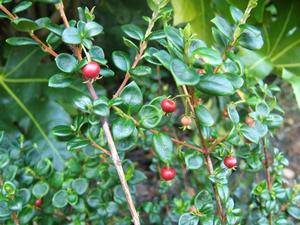

Chilean Guava
Ugni molinae
In propagation
Currently growing out 1 Gallon pots. Expected Summer 2027.
Add your name with the notify button below, and we will email you the moment this plant is ready to bring home.
Learn how we grow on The Prop House.
Pickup currently unavailable at Aiken Nursery
Ugni molinae, the Chilean guava, is a small evergreen shrub of the myrtle family, native to the temperate forests of Chile and adjoining southern Argentina. Gardeners of an older generation will know the plant as Myrtus ugni, the name the shrub long circulated under. The genus name Ugni comes straight from uñi, the Mapuche word for the plant, while the species honors Juan Ignacio Molina, the Jesuit naturalist who first chronicled the flora of Chile; in the plant's homeland the shrub is simply murta or murtilla.
Small, glossy, leathery leaves clothe the shrub in dense, aromatic evergreen texture, and in late spring nodding white to pale-pink bells hang among them, sweet-scented and thick with stamens. What follows is the whole point of the plant: small round berries, dusky red when ripe, tasting of strawberry and cranberry with a resinous, wild-honey warmth. Chileans call the fruit murta, steep the berries into the liqueur murtado, cook them into jam and kuchen, and pair them with quince, while English gardeners simply call the fruit delicious.
The Chilean guava carries a small, famous piece of horticultural legend. Introduced to England in the 1840s by the plant hunter William Lobb, the fruit is said to have become a favorite of Queen Victoria, who reportedly had the berries brought up from Cornwall for the royal table. The Mapuche people had long gathered murtilla from the wild for food and for aromatic leaf infusions, and the plant remains a cherished country fruit across southern Chile, harvested from wild and tended stands alike.
In the garden the Chilean guava earns a place as a neat, fine-textured evergreen for a sunny border, a low informal hedge, an edible landscape, or a large container. Still barely known in the southern United States, though better established in the Pacific Northwest, the shrub is worth trying in zones 8 and 9, ideally in sandy, acid, well-drained soil with shelter from fierce afternoon sun where summers turn hot. Give the plant a warm, bright spot and the reward is a handsome evergreen that also fills a bowl with one of the finest small fruits a temperate garden can ripen.
- Hardiness
- USDA Zones 8–9
- Sun
- Full Sun, Part Shade
- Soil
- Well-drained, Moist
- Mature size
- Height 3–6 Feet · Spread 3–4 Feet
- Growth rate
- Moderate
- Seasonality
- Evergreen
White to pale pink bells, late spring
From rooting to shipping, our top priority is ensuring you receive healthy, thriving plants for your garden’s success.
Because most of our plants are grown from rooted cuttings — alongside seed, air layering, and grafting chosen for each variety — you receive a stronger, true-to-type plant that establishes quickly in your garden.
Raised on organic soil blends and eco-friendly pest management — never harsh chemicals — your plant arrives healthy for your garden, your family, and the pollinators they feed.
Every purchase gives back. We donate to the Aiken Arboretum and support local wildlife conservation, so growing your garden helps protect the wider ecosystem too.

All our plant material is carefully propagated, grown, and nurtured at our humble nursery in Aiken, South Carolina.

Your plant arrives carefully packed and ready to settle in. Unpack them promptly, give them a day or two to acclimate, then plant following the notes we include — that’s all it takes. Clear care guidance comes with every order, so success is the easy part.
What to expect upon delivery
All our plants are sold in 1-gallon sizes, though the height of each plant can vary depending on its growth rate and seasonality, typically ranging from 1/2 to 2.5 feet.
Each plant is carefully packaged with its roots enclosed in a secure plastic bag containing moist soil, forming a compact root ball. To ensure safe transport, the box is padded with recycled newspaper, providing both stability and eco-friendly protection from weather during shipping.
What is your return policy?
Review our full return policy information on our SHIPPING AND RETURNS POLICY page.
What payment methods can I use?
We offer 35 different payment methods including major providers like Mastercard, Visa, PayPal, American Express and Diners as well as many different local payment methods including Klarna, iDEAL, AliPay, Sofort, giropay, and many more.
Can I make changes to my order after it’s been placed?
At Woodlanders, we strive to fulfill orders as quickly as possible. Therefore, we can only accommodate changes to your order within the first 24 hours after it has been placed. These changes include adding or removing products and modifying the delivery address. If you need to make any changes or if there has been a mistake with your order information, please reach out to us promptly via our CONTACT page with your order number for the quickest resolution.
Your satisfaction is our priority, and we appreciate your understanding and cooperation.