

New Very Rare

Lemonade Japanese Cedar

Cryptomeria japonica 'Lemonade'

$62.00 Sold out
USDA Zones 5–9 Full Sun and Part Shade Matures 4–6 Feet

Cryptomeria japonica 'Lemonade' is a slow, small Japanese cedar whose spring flush glows the pale yellow of cold lemonade before settling to soft chartreuse.

Pickup currently unavailable at Aiken Nursery

Healthy-arrival guarantee Free shipping over $150
Roots wrapped in moist soil and padded for safe transit
Grown and shipped from our nursery in Aiken, SC
Shipping later in the season? Schedule your delivery date in your cart.

A small, slow Japanese cedar that flushes the color of cold lemonade in spring, pale, almost translucent yellow, then settles into soft chartreuse through summer. The foliage stays juvenile throughout, fine and feathery rather than the awl-shaped scale of a mature Cryptomeria, which gives 'Lemonade' a softer presence than most gardeners expect of a conifer. This is texture you can run a hand through.

'Lemonade' is dwarf, or close enough to it, growing upright and gently conical to something in the four to six foot range over many years, with a narrow footprint that suits smaller gardens, foundation plantings, and the kind of mixed conifer composition where one plant needs to carry the light. Site the cedar where afternoon sun will not bleach the new growth; part shade holds the color longest, though a few hours of morning sun seem to deepen it.

Our stock traces back to the JC Raulston Arboretum in Raleigh, where 'Lemonade' has grown since 2014. We took cuttings from accessioned material there, the kind of provenance we trust: documented, and observed over years in a real southeastern climate. Still uncommon in the trade, and worth knowing about before everyone else does.

'Lemonade' pairs unexpectedly well with darker-leaved companions, Loropetalum, black mondo, a deep-green camellia behind, where the spring flush reads almost luminous.

Will this plant thrive in your zone?

Plant Profile
At a glance
Hardiness
USDA Zones 5–9
Sun
Full Sun, Part Shade
Soil
Moist, Well-drained
Mature size
Height 4–6 Feet · Spread 3–5 Feet
Growth rate
Slow
Seasonality
Evergreen
Design Notes

'Lemonade' is one of those rare conifers that reads as a soft plant rather than a structural one. The color sits halfway between gold and green, too quiet to call chartreuse, too warm to call lime, and that ambiguity is what makes the cultivar so useful. 'Lemonade' lights up shaded compositions without the brashness of a true gold conifer, and cools down hot, sun-bleached beds without disappearing into them.

Pair 'Lemonade' with deep, saturated foliage and the contrast does most of the work. Loropetalum chinense in any of the burgundy forms, Ophiopogon planiscapus 'Nigrescens' at the foot, the near-black leaves of Aeonium 'Zwartkop' in a Mediterranean bed, or a backdrop of Camellia japonica in glossy dark green all throw the new growth into relief. In a more tonal scheme, set the cedar against the blue-grey of Juniperus 'Blue Star' or Picea pungens, where the yellow-green reads almost incandescent by contrast.

'Lemonade' earns a place in a Japanese-inflected garden, since the genus has the lineage for it, and the soft texture pairs naturally with moss, stone, and the rounded forms of clipped Ilex crenata or azalea. But the cultivar is just as much at home in a cottage border or a contemporary mixed planting, particularly where you want vertical interest without the rigid column of an Italian cypress or the heaviness of a yew.

A few placement notes. Site 'Lemonade' where the spring flush gets seen, near a path, beside a doorway, framing a bench, because that two to three week window of pale yellow is the headline performance and deserves an audience. Avoid full afternoon sun in the lower South, where the new growth scorches before hardening off, and the color holds longer in part shade regardless. The cedar pairs beautifully with spring ephemerals at the base, hellebores, early daffodils, woodland phlox, all of which finish their show just as the Cryptomeria peaks and then retreat for the season.

For smaller gardens or courtyards, one specimen carries enough presence to anchor a corner. In larger spaces, a loose grouping of three reads better than a formal row, since Cryptomeria does not want to be a hedge, and 'Lemonade' especially does not want to be uniform. Let the plant breathe.

Flower, Fruit & Foliage

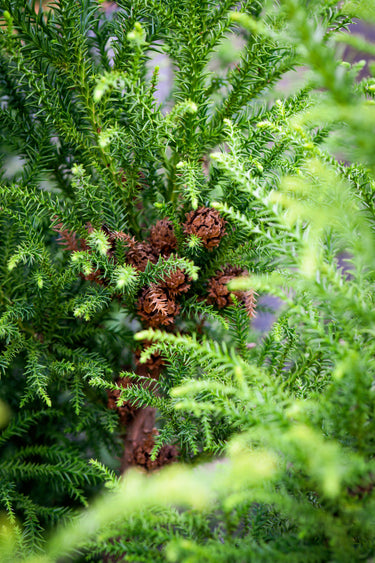
Foliage. The foliage is what carries this cultivar. Each shoot is densely packed with short, awl-shaped needles arranged in a soft spiral around the stem, a texture closer to a bottlebrush than to the flat sprays of most cedars or arborvitae. New growth emerges in spring as a pale, almost cream-yellow flush, the color behind the name 'Lemonade'. Through summer the foliage settles into a soft chartreuse, never quite turning the deep forest green of the species. In winter the older needles take on a faint bronze cast at the tips, particularly where the plant catches cold wind, and recover color with the spring push.

Texture. Run a hand along a shoot and the needles give slightly, fine and yielding rather than prickly. 'Lemonade' holds juvenile foliage throughout, which is part of what keeps the texture so soft; many Cryptomeria transition to a coarser, more scale-like adult leaf with age, and this cultivar largely does not.

Cones. Cones appear on mature plants, clustered along the inner branches in tight rosettes about the size of a large marble. Young cones are green and tightly closed, ripening through a season to a warm cinnamon brown with the spiky, recurved bracts that give Cryptomeria cones their distinct silhouette, almost spherical, sculptural, and persistent on the branch long after shedding seed. Not showy, but worth looking for. A plant in cone is a plant settled in.

Habit. Upright and gently conical, with branches that hold close to the trunk and feather outward at the tips. Density is naturally good, with no shearing required to keep the plant full, and 'Lemonade' takes light pruning well when you want to refine the silhouette. Young plants can look a little open and feathery; the form fills in by year three or four.

Care

Read our full care guide

Light. Part shade to sun. Color holds best with afternoon shade in the lower South.

Soil. Moist, well-drained, slightly acidic. Tolerant once established, but not a dry-soil plant.

Water. Regular through the first two summers. Mulch to keep the roots cool.

Form. Slow, upright, gently conical. Expect four to six feet in time, with an eventual ceiling that is unknown but unhurried.

Pests. None of consequence; Cryptomeria as a genus is remarkably untroubled in the Southeast.

Hardiness. USDA zones 5 to 9.

Here’s a closer look at how we produce our plants

From rooting to shipping, our top priority is ensuring you receive healthy, thriving plants for your garden’s success.

Woodlanders Growing Process

Because most of our plants are grown from rooted cuttings — alongside seed, air layering, and grafting chosen for each variety — you receive a stronger, true-to-type plant that establishes quickly in your garden.

Sustainable Growing Practices

Raised on organic soil blends and eco-friendly pest management — never harsh chemicals — your plant arrives healthy for your garden, your family, and the pollinators they feed.

Supporting Local Biodiversity

Every purchase gives back. We donate to the Aiken Arboretum and support local wildlife conservation, so growing your garden helps protect the wider ecosystem too.

At Woodlanders, we are committed to quality.
Grown in Aiken, South Carolina
At Woodlanders, we are committed to quality.

All our plant material is carefully propagated, grown, and nurtured at our humble nursery in Aiken, South Carolina.

Learn more about Woodlanders
Healthy plants, ready to thrive
Success, made simple
Healthy plants, ready to thrive

Your plant arrives carefully packed and ready to settle in. Unpack them promptly, give them a day or two to acclimate, then plant following the notes we include — that’s all it takes. Clear care guidance comes with every order, so success is the easy part.

Read the care guide
Frequently Asked Questions
What to expect upon delivery

All our plants are sold in 1-gallon sizes, though the height of each plant can vary depending on its growth rate and seasonality, typically ranging from 1/2 to 2.5 feet.

Each plant is carefully packaged with its roots enclosed in a secure plastic bag containing moist soil, forming a compact root ball. To ensure safe transport, the box is padded with recycled newspaper, providing both stability and eco-friendly protection from weather during shipping.

What is your return policy?

Review our full return policy information on our SHIPPING AND RETURNS POLICY page.

What payment methods can I use?

We offer 35 different payment methods including major providers like Mastercard, Visa, PayPal, American Express and Diners as well as many different local payment methods including Klarna, iDEAL, AliPay, Sofort, giropay, and many more.

Can I make changes to my order after it’s been placed?

At Woodlanders, we strive to fulfill orders as quickly as possible. Therefore, we can only accommodate changes to your order within the first 24 hours after it has been placed. These changes include adding or removing products and modifying the delivery address. If you need to make any changes or if there has been a mistake with your order information, please reach out to us promptly via our CONTACT page with your order number for the quickest resolution.

Your satisfaction is our priority, and we appreciate your understanding and cooperation.