


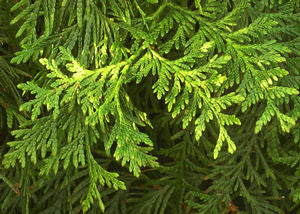

Western Red Cedar
Thuja plicata 'Atrovirens'
Pickup available at Aiken Nursery
Usually ready in 2-4 days
A Victorian-era English selection of one of the great trees of North America. The species, Thuja plicata, the western red cedar, is the dominant conifer of the Pacific Northwest coastal rainforest, the tree that towers 150 to 200 feet above the forest floor in old-growth stands of British Columbia, Washington, Oregon, and northern California, with individual specimens documented at over a thousand years old. To the Coast Salish, Haida, Tlingit, Kwakwaka'wakw, and other Pacific Northwest Indigenous peoples, western red cedar is the Tree of Life: the wood used for longhouses, dugout canoes, totem poles, and ceremonial regalia; the bark woven into baskets, mats, capes, and dress; the whole tree a structural and cultural foundation for thousands of years. That natural rot-resistance comes from the same volatile terpenoids that give the crushed foliage a sweet, cedary fragrance, the smell of the Pacific Northwest forest itself.
'Atrovirens' is the form most American gardeners will meet. The clone originated as a selected seedling at a nursery in Worcester, England, around 1874, Victorian horticulture refining a garden cultivar from an Indigenous American giant. The Latin name joins atro, dark, and virens, green, and means exactly that, a dark-green form, glossier and richer than the typical Pacific Northwest population, with denser foliage and a more uniformly conical habit. The plant earned the Royal Horticultural Society's Award of Garden Merit in 2002, a meaningful sign of a reliably good clone rather than merely a good species. In garden cultivation 'Atrovirens' reaches 25 to 45 feet tall and 8 to 15 feet wide, a fraction of the wild parent's stature, but more than enough for use as a specimen, screen, hedge, or windbreak.
Three things make the tree useful in the Southeast and East, well outside the Pacific Northwest home range. First, 'Atrovirens' tolerates eastern conditions remarkably well when properly sited, in deep, moist, well-drained soil, full sun to part shade, and shelter from drying winter wind. Second, the plant is substantially deer-resistant, a real advantage over the East's standard hedging conifer, Thuja occidentalis, the American arborvitae, which deer will browse to skeletons where pressure is high; western red cedar's terpenoid chemistry is far less palatable to white-tailed deer. Third, the tree takes hard pruning without complaint, since cutting back into old wood does not leave the dead brown patches that plague other hedging conifers, so a dense formal hedge can be held at any height a gardener chooses.
The foliage is the show beyond the structure: flat sprays of small, scale-like leaves arranged in interlocking patterns on slightly drooping branchlets, releasing a sweet, resinous cedar scent when crushed. Glossy dark green through summer, the outer foliage may pick up bronze or coppery tints in cold weather, greening back up in spring. Seen up close the texture is genuinely lovely, fine and lacy and refined, far more so than the coarser Leyland cypress or Italian cypress.
A tree for the gardener planting a long-term privacy screen who wants something better than Leyland cypress, for the deer-besieged eastern landscape that has already lost a round of Thuja occidentalis, for the conifer collector drawn to Pacific Northwest natives, or for anyone who wants to plant a tree with a thousand-year cultural history behind it.
- Hardiness
- USDA Zones 5–8
- Sun
- Full Sun, Part Shade
- Soil
- Moist, Well-drained
- Mature size
- Height 25–45 Feet · Spread 8–15 Feet
- Growth rate
- Fast
- Seasonality
- Evergreen
From rooting to shipping, our top priority is ensuring you receive healthy, thriving plants for your garden’s success.
Because most of our plants are grown from rooted cuttings — alongside seed, air layering, and grafting chosen for each variety — you receive a stronger, true-to-type plant that establishes quickly in your garden.
Raised on organic soil blends and eco-friendly pest management — never harsh chemicals — your plant arrives healthy for your garden, your family, and the pollinators they feed.
Every purchase gives back. We donate to the Aiken Arboretum and support local wildlife conservation, so growing your garden helps protect the wider ecosystem too.

All our plant material is carefully propagated, grown, and nurtured at our humble nursery in Aiken, South Carolina.

Your plant arrives carefully packed and ready to settle in. Unpack them promptly, give them a day or two to acclimate, then plant following the notes we include — that’s all it takes. Clear care guidance comes with every order, so success is the easy part.
What to expect upon delivery
All our plants are sold in 1-gallon sizes, though the height of each plant can vary depending on its growth rate and seasonality, typically ranging from 1/2 to 2.5 feet.
Each plant is carefully packaged with its roots enclosed in a secure plastic bag containing moist soil, forming a compact root ball. To ensure safe transport, the box is padded with recycled newspaper, providing both stability and eco-friendly protection from weather during shipping.
What is your return policy?
Review our full return policy information on our SHIPPING AND RETURNS POLICY page.
What payment methods can I use?
We offer 35 different payment methods including major providers like Mastercard, Visa, PayPal, American Express and Diners as well as many different local payment methods including Klarna, iDEAL, AliPay, Sofort, giropay, and many more.
Can I make changes to my order after it’s been placed?
At Woodlanders, we strive to fulfill orders as quickly as possible. Therefore, we can only accommodate changes to your order within the first 24 hours after it has been placed. These changes include adding or removing products and modifying the delivery address. If you need to make any changes or if there has been a mistake with your order information, please reach out to us promptly via our CONTACT page with your order number for the quickest resolution.
Your satisfaction is our priority, and we appreciate your understanding and cooperation.