


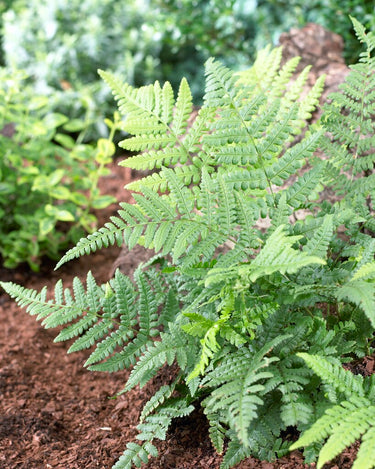


Remote Wood Fern
Dryopteris remota
Pickup available at Aiken Nursery
Usually ready in 2-4 days
Dryopteris ×remota, the remote wood fern or scaly buckler fern, is one of those quiet accidents of nature that turns out better than anything a breeder set out to make. The fern is a naturally occurring hybrid between the scaly male fern, Dryopteris affinis, of western Europe and the British Isles, and the broad buckler fern, Dryopteris expansa, of cooler northern woods. From the affinis parent the hybrid took shaggy stalks thickly clothed in golden-brown scales; from expansa, the fine, lacy cut of the frond. The epithet remota, meaning scattered or spaced apart, points to the way the lowest segments stand a little distant from one another along the frond, a subtle tell that separates this fern from the crowd of look-alike wood ferns.
There is a genuine botanical curiosity folded into this plant. Like the rest of the Dryopteris affinis complex, the remote wood fern is apogamous, meaning the fern sets viable spores without fertilization and comes true from them, so every offspring repeats the parent exactly. A hybrid that would normally be a sterile dead end instead behaves like a stable species, part of why gardeners have kept and passed the fern along for well over a century. The American pteridologist John Mickel, who trialed hundreds of ferns at the New York Botanical Garden, called this one “one of my favorite ferns for the garden,” and coming from Mickel that is close to canonization.
In the garden the remote wood fern reads as architecture rather than filler. Arching, lance-shaped fronds rise two to three feet from a central crown and hold themselves in a tidy, vase-shaped clump that neither flops nor runs, so the fern keeps a composed silhouette from the first spring croziers until frost. Set the fern where the golden scales on the emerging stalks catch a low morning light, underplant with hellebores, epimediums, and woodland phlox, or run a drift of them along a shaded path where their upright poise can steady looser, softer companions.
Few ferns ask for so little. Hardy from USDA zones 4 through 8, the remote wood fern takes light to full shade and average to rich, moisture-retentive soil, tolerates both summer dry spells and hard winter cold, and shrugs off the deer and rabbits that graze almost everything else in the shade border. Give the crown a mulch of leaf litter, cut the tired fronds back before the fiddleheads climb, and this unassuming hybrid will hold that post for decades.
Additional photo credit to Vision Pictures.
- Hardiness
- USDA Zones 4–8
- Sun
- Part Shade, Full Shade
- Soil
- Moist, Rich
- Mature size
- Height 2–3 Feet · Spread 2–3 Feet
- Growth rate
- Fast
- Seasonality
- Semi-Evergreen
From rooting to shipping, our top priority is ensuring you receive healthy, thriving plants for your garden’s success.
Because most of our plants are grown from rooted cuttings — alongside seed, air layering, and grafting chosen for each variety — you receive a stronger, true-to-type plant that establishes quickly in your garden.
Raised on organic soil blends and eco-friendly pest management — never harsh chemicals — your plant arrives healthy for your garden, your family, and the pollinators they feed.
Every purchase gives back. We donate to the Aiken Arboretum and support local wildlife conservation, so growing your garden helps protect the wider ecosystem too.

All our plant material is carefully propagated, grown, and nurtured at our humble nursery in Aiken, South Carolina.

Your plant arrives carefully packed and ready to settle in. Unpack them promptly, give them a day or two to acclimate, then plant following the notes we include — that’s all it takes. Clear care guidance comes with every order, so success is the easy part.
What to expect upon delivery
All our plants are sold in 1-gallon sizes, though the height of each plant can vary depending on its growth rate and seasonality, typically ranging from 1/2 to 2.5 feet.
Each plant is carefully packaged with its roots enclosed in a secure plastic bag containing moist soil, forming a compact root ball. To ensure safe transport, the box is padded with recycled newspaper, providing both stability and eco-friendly protection from weather during shipping.
What is your return policy?
Review our full return policy information on our SHIPPING AND RETURNS POLICY page.
What payment methods can I use?
We offer 35 different payment methods including major providers like Mastercard, Visa, PayPal, American Express and Diners as well as many different local payment methods including Klarna, iDEAL, AliPay, Sofort, giropay, and many more.
Can I make changes to my order after it’s been placed?
At Woodlanders, we strive to fulfill orders as quickly as possible. Therefore, we can only accommodate changes to your order within the first 24 hours after it has been placed. These changes include adding or removing products and modifying the delivery address. If you need to make any changes or if there has been a mistake with your order information, please reach out to us promptly via our CONTACT page with your order number for the quickest resolution.
Your satisfaction is our priority, and we appreciate your understanding and cooperation.