


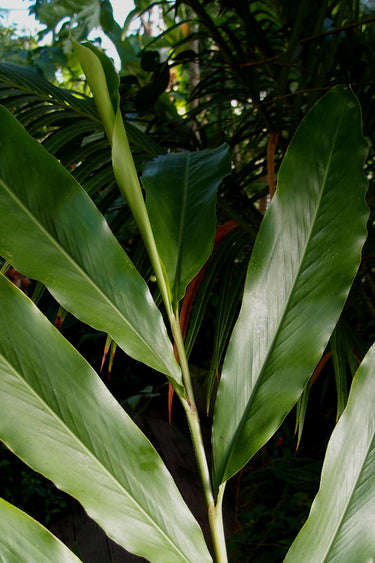


Cardamom
Elettaria cardamomum
Pickup available at Aiken Nursery
Usually ready in 2-4 days
True cardamom, Elettaria cardamomum, is a lush, aromatic member of the ginger family and the source of green cardamom, the ancient and costly spice traded for millennia along the Silk Road and across the Indian Ocean. Native to the humid, evergreen hill forests of southern India and Sri Lanka, the plant grows in the dappled shade of the understory, in deep, fertile, always-moist soil. Ranked historically among the most valuable spices in the world, cardamom carries a history as rich as the flavor.
From thick, slowly creeping rhizomes rise upright, reed-like pseudostems clad in glossy, lance-shaped leaves of medium to deep green, softly tapered and gently arching. Brushed or crushed, the foliage gives off a fresh, spicy-sweet scent, a preview of the aroma locked in the seed pods. In true tropical conditions the plant can reach six to twelve feet and form dense colonies; in the American South and similar temperate gardens, expect something far more modest, often under two feet where winter cold checks the top growth, though even then the plant offers a refined, tropical texture for a sheltered spot or a large pot.
In warm, frost-free climates, separate flowering stems snake out along the ground from the base of the plant, carrying delicate blooms of pale green to creamy white marked with lavender or yellow on the lip. These give way to the small green capsules that, harvested and dried, become the cardamom of the spice rack, each pod packed with intensely fragrant black seeds. Flowering and fruiting are uncommon outside genuine tropical warmth, so in most gardens cardamom is grown for the handsome foliage and the fragrance rather than a home-grown harvest.
Like most of the ginger tribe, cardamom wants humus-rich soil that mimics forest leaf litter, steady moisture, and shelter from hot direct sun, and a generous mulch improves both summer vigor and winter survival. Hardy in the ground in USDA zones 8 to 10 and easily wintered indoors farther north, the plant suits shaded subtropical borders, woodland gardens, large overwinterable containers, and any collection of fragrant or useful plants. Beyond the kitchen, cardamom has been a mainstay of Ayurvedic and Unani medicine for centuries, which only deepens the appeal of growing a living piece of spice history.
Additional photo courtesy of Afifa Afrin.
- Hardiness
- USDA Zones 8–10
- Sun
- Part Shade, Full Shade
- Soil
- Well-drained, Moist
- Mature size
- Height 6–12 Feet · Spread 3–6 Feet
- Growth rate
- Fast
- Seasonality
- Dies back, depends on zone
Low, ground-creeping stems of small pale green to creamy-white flowers with a lavender-marked lip, followed by the green seed capsules dried as cardamom; flowering mainly in the tropics
These statements have not been evaluated by the Food and Drug Administration. This information is shared for traditional and educational interest only and is not intended to diagnose, treat, cure, or prevent any disease. Please consult a qualified healthcare professional before any medicinal use.
- Culinary amounts are widely regarded as safe; concentrated medicinal doses and the essential oil are far stronger
- People with gallstones should be cautious with therapeutic doses
- Recorded for educational and traditional context, not medical advice
From rooting to shipping, our top priority is ensuring you receive healthy, thriving plants for your garden’s success.
Because most of our plants are grown from rooted cuttings — alongside seed, air layering, and grafting chosen for each variety — you receive a stronger, true-to-type plant that establishes quickly in your garden.
Raised on organic soil blends and eco-friendly pest management — never harsh chemicals — your plant arrives healthy for your garden, your family, and the pollinators they feed.
Every purchase gives back. We donate to the Aiken Arboretum and support local wildlife conservation, so growing your garden helps protect the wider ecosystem too.

All our plant material is carefully propagated, grown, and nurtured at our humble nursery in Aiken, South Carolina.

Your plant arrives carefully packed and ready to settle in. Unpack them promptly, give them a day or two to acclimate, then plant following the notes we include — that’s all it takes. Clear care guidance comes with every order, so success is the easy part.
What to expect upon delivery
All our plants are sold in 1-gallon sizes, though the height of each plant can vary depending on its growth rate and seasonality, typically ranging from 1/2 to 2.5 feet.
Each plant is carefully packaged with its roots enclosed in a secure plastic bag containing moist soil, forming a compact root ball. To ensure safe transport, the box is padded with recycled newspaper, providing both stability and eco-friendly protection from weather during shipping.
What is your return policy?
Review our full return policy information on our SHIPPING AND RETURNS POLICY page.
What payment methods can I use?
We offer 35 different payment methods including major providers like Mastercard, Visa, PayPal, American Express and Diners as well as many different local payment methods including Klarna, iDEAL, AliPay, Sofort, giropay, and many more.
Can I make changes to my order after it’s been placed?
At Woodlanders, we strive to fulfill orders as quickly as possible. Therefore, we can only accommodate changes to your order within the first 24 hours after it has been placed. These changes include adding or removing products and modifying the delivery address. If you need to make any changes or if there has been a mistake with your order information, please reach out to us promptly via our CONTACT page with your order number for the quickest resolution.
Your satisfaction is our priority, and we appreciate your understanding and cooperation.