


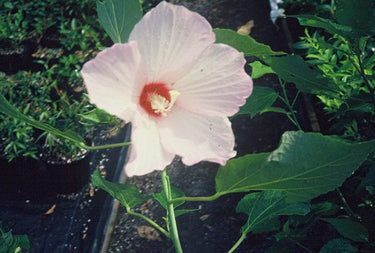

Swamp Rose-Mallow
Hibiscus palustris
Pickup currently unavailable at Aiken Nursery
Hibiscus palustris is the northern, cold-hardy face of the American rose-mallows, a marsh dweller whose species name comes straight from the Latin palus, a swamp or marsh. Botanists today often fold the plant into Hibiscus moscheutos as a subspecies, but the old name still travels with the pink-flowered marsh plants of the Northeast, and gardeners know exactly which plant the name marks. Where many tropical hibiscus sulk at the first frost, this perennial dies cleanly to the ground each winter and returns from a woody crown, unfazed by zone 5 cold.
Through late summer the stout, upright stems open a run of broad pink flowers, each a satiny five-petaled saucer four to seven inches across, often with a deeper rose or crimson flush at the base of the petals. Every bloom lasts only a day or two, but the plants open in generous succession over many weeks. Breeders leaned hard on this native and the closely related rose-mallows to build the modern hardy hibiscus, the dinner-plate perennials now sold everywhere, so the wild parent stands quietly behind a whole nursery aisle of showier offspring.
The rose-mallows belong to Malvaceae, the mallow family, and share the family's mucilaginous, softening sap with true marshmallow, Althaea officinalis, whose roots once thickened the original confection. Across the plant's native range the mallows were among the soothing, demulcent herbs that early gardeners and Indigenous peoples valued for their slippery, cooling tissue, a folk association that runs through the whole clan rather than resting on this one species. Even the broad leaves and seed capsules carry that soft, faintly downy mallow texture.
For design, Hibiscus palustris solves the hardest corner in many gardens: the low, wet spot that stays soggy. Plant the rose-mallow at a pond edge, in a rain garden, along a ditch, or at the moist back of a border, where the tall stems and huge flowers can rise over Joe-Pye weed, swamp milkweed, and native sedges. Bees and hummingbirds work the flowers, and specialist bees depend on rose-mallows in particular. Because the plant emerges late in spring, set the crown among earlier perennials that cover the bare ground until the stems shoot up and take over the show.
- Hardiness
- USDA Zones 5–9
- Sun
- Full Sun, Part Shade
- Soil
- Well-drained, Moist
- Mature size
- Height 4–6 Feet · Spread 2–4 Feet
- Growth rate
- Fast
- Seasonality
- Dies back, depends on zone
Broad pink, deeper base, midsummer to fall
From rooting to shipping, our top priority is ensuring you receive healthy, thriving plants for your garden’s success.
Because most of our plants are grown from rooted cuttings — alongside seed, air layering, and grafting chosen for each variety — you receive a stronger, true-to-type plant that establishes quickly in your garden.
Raised on organic soil blends and eco-friendly pest management — never harsh chemicals — your plant arrives healthy for your garden, your family, and the pollinators they feed.
Every purchase gives back. We donate to the Aiken Arboretum and support local wildlife conservation, so growing your garden helps protect the wider ecosystem too.

All our plant material is carefully propagated, grown, and nurtured at our humble nursery in Aiken, South Carolina.

Your plant arrives carefully packed and ready to settle in. Unpack them promptly, give them a day or two to acclimate, then plant following the notes we include — that’s all it takes. Clear care guidance comes with every order, so success is the easy part.
What to expect upon delivery
All our plants are sold in 1-gallon sizes, though the height of each plant can vary depending on its growth rate and seasonality, typically ranging from 1/2 to 2.5 feet.
Each plant is carefully packaged with its roots enclosed in a secure plastic bag containing moist soil, forming a compact root ball. To ensure safe transport, the box is padded with recycled newspaper, providing both stability and eco-friendly protection from weather during shipping.
What is your return policy?
Review our full return policy information on our SHIPPING AND RETURNS POLICY page.
What payment methods can I use?
We offer 35 different payment methods including major providers like Mastercard, Visa, PayPal, American Express and Diners as well as many different local payment methods including Klarna, iDEAL, AliPay, Sofort, giropay, and many more.
Can I make changes to my order after it’s been placed?
At Woodlanders, we strive to fulfill orders as quickly as possible. Therefore, we can only accommodate changes to your order within the first 24 hours after it has been placed. These changes include adding or removing products and modifying the delivery address. If you need to make any changes or if there has been a mistake with your order information, please reach out to us promptly via our CONTACT page with your order number for the quickest resolution.
Your satisfaction is our priority, and we appreciate your understanding and cooperation.