


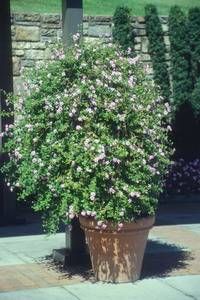

Trailing Lantana
Lantana montevidensis
Pickup currently unavailable at Aiken Nursery
Where the shrubby lantanas stand up, Lantana montevidensis lies down and travels. This is the trailing lantana, a low, weeping member of the verbena family, Verbenaceae, native to the warm grasslands of southern South America, from southern Brazil across Uruguay and Paraguay into Argentina. The species carries a place name in the epithet: montevidensis means of Montevideo, the Uruguayan capital near which the plant was first gathered and described, so the botanical name is really a small geography lesson tucked into Latin.
Since leaving the pampas the trailing lantana has become one of the most planted groundcovers of warm gardens worldwide, valued wherever summers run long and water runs short. The oval, deep green leaves are strongly scented, giving off a sharp herbal smell when brushed that most browsing animals decline, which is part of why deer and rabbits pass the plant by. As with the rest of the genus the foliage is not for eating, and the small dark fruits are best left to the birds; the value here is ornamental and ecological rather than edible. Bees and butterflies, on the other hand, treat the flowers as a reliable filling station, and the trailing lantana blooms so steadily that the buffet rarely closes.
The flowers themselves are the color of dusk, clusters of small lavender to violet-purple florets, each with a paler, sometimes creamy eye, carried in flat little heads just above the foliage. In frost-free gardens the show runs nearly year-round, and elsewhere from spring until cold weather calls a halt. The stems root as they run, weaving a dense, weed-smothering mat perhaps a foot or two deep and spreading three to five feet or more, and where a stem meets an edge the growth simply pours over the lip in a soft violet waterfall.
Put that trailing habit to work: let the plant cascade over a retaining wall, spill from a raised bed or tall container, ramble down a hot bank too steep to mow, or knit together the front of a dry, sunny border. Full sun brings the heaviest bloom, though the trailing lantana tolerates light shade better than the shrubby kinds do. Lean, sharply drained soil is all the plant asks, and once established the groundcover shrugs off drought and the reflected heat of paving and stone. In the frost-free Deep South the mat stays evergreen; farther north the trailing lantana behaves as a root-hardy perennial, so shear the frosted top in early spring and let fresh runners return from the base. Set the purple against silver artemisia, gold lantana, or blue plumbago for a planting built to take the worst of summer.
- Hardiness
- USDA Zones 8–10
- Sun
- Full Sun, Part Shade
- Soil
- Well-drained
- Mature size
- Height 1–2 Feet · Spread 3–5 Feet
- Growth rate
- Fast
- Seasonality
- Dies back, depends on zone
Lavender to violet-purple with a pale eye, nearly year-round in frost-free gardens
From rooting to shipping, our top priority is ensuring you receive healthy, thriving plants for your garden’s success.
Because most of our plants are grown from rooted cuttings — alongside seed, air layering, and grafting chosen for each variety — you receive a stronger, true-to-type plant that establishes quickly in your garden.
Raised on organic soil blends and eco-friendly pest management — never harsh chemicals — your plant arrives healthy for your garden, your family, and the pollinators they feed.
Every purchase gives back. We donate to the Aiken Arboretum and support local wildlife conservation, so growing your garden helps protect the wider ecosystem too.

All our plant material is carefully propagated, grown, and nurtured at our humble nursery in Aiken, South Carolina.

Your plant arrives carefully packed and ready to settle in. Unpack them promptly, give them a day or two to acclimate, then plant following the notes we include — that’s all it takes. Clear care guidance comes with every order, so success is the easy part.
What to expect upon delivery
All our plants are sold in 1-gallon sizes, though the height of each plant can vary depending on its growth rate and seasonality, typically ranging from 1/2 to 2.5 feet.
Each plant is carefully packaged with its roots enclosed in a secure plastic bag containing moist soil, forming a compact root ball. To ensure safe transport, the box is padded with recycled newspaper, providing both stability and eco-friendly protection from weather during shipping.
What is your return policy?
Review our full return policy information on our SHIPPING AND RETURNS POLICY page.
What payment methods can I use?
We offer 35 different payment methods including major providers like Mastercard, Visa, PayPal, American Express and Diners as well as many different local payment methods including Klarna, iDEAL, AliPay, Sofort, giropay, and many more.
Can I make changes to my order after it’s been placed?
At Woodlanders, we strive to fulfill orders as quickly as possible. Therefore, we can only accommodate changes to your order within the first 24 hours after it has been placed. These changes include adding or removing products and modifying the delivery address. If you need to make any changes or if there has been a mistake with your order information, please reach out to us promptly via our CONTACT page with your order number for the quickest resolution.
Your satisfaction is our priority, and we appreciate your understanding and cooperation.