


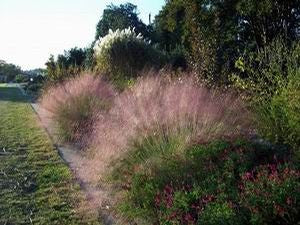

Pink Muhly Grass
Muhlenbergia capillaris
Pickup currently unavailable at Aiken Nursery
Few native grasses put on a show like Muhlenbergia capillaris. For most of the year pink muhly is a modest, upright tuft of fine, wiry, dark green blades, easy to overlook. Then, in the shortening days of autumn, the whole clump erupts into a haze of tiny flowers, an airy cloud of pink to rose-red that seems to hover a foot above the foliage and glows when backlit by low sun. Massed in a drift, the effect is one of the most spectacular in the fall garden.
Pink muhly belongs to a large American genus named for Gotthilf Henry Ernest Muhlenberg, the Pennsylvania botanist and Lutheran minister who did much of the early work on North American grasses. The species has a famously tangled relationship with the coastal sweetgrass long known as Muhlenbergia filipes, a grass so close to pink muhly that botanists once folded the two together, treating sweetgrass as a variety of M. capillaris itself. It is that coastal sweetgrass, rather than pink muhly, whose wiry leaves the Gullah basketmakers of the South Carolina Lowcountry coil into the celebrated sweetgrass baskets, a craft carried from West Africa and kept alive for generations along the coast.
For all the delicacy of the bloom, pink muhly is a tough, adaptable native of the eastern and central United States, at home on sandy pinelands, rocky glades, and coastal flats. The grass shrugs off heat, humidity, drought, and poor soil once established, asks for nothing in the way of feeding, and stays neatly clump-forming rather than running. Deer pass the wiry foliage by, and the seed heads shelter small birds and insects through the colder months.
Pink muhly earns a place wherever the autumn display can be seen to advantage, and above all where low morning or evening light can pass through the pink cloud. Mass the grass in a sweep at the front or middle of a sunny border, repeat a rhythm of clumps along a path or drive, or set a drift against a dark backdrop of evergreens or a wall so the color reads. The plant pairs beautifully with little bluestem, asters, goldenrod, and other fall natives, thrives in gravel gardens and coastal plantings, and asks only full sun and sharp drainage. Cut the old foliage to the ground in late winter before new growth begins.
- Hardiness
- USDA Zones 7–10
- Sun
- Full Sun
- Soil
- Well-drained
- Mature size
- Height 2–3 Feet · Spread 1–2 Feet
- Growth rate
- Fast
- Seasonality
- Semi-Evergreen
Airy pink to rose-red plumes, fall
From rooting to shipping, our top priority is ensuring you receive healthy, thriving plants for your garden’s success.
Because most of our plants are grown from rooted cuttings — alongside seed, air layering, and grafting chosen for each variety — you receive a stronger, true-to-type plant that establishes quickly in your garden.
Raised on organic soil blends and eco-friendly pest management — never harsh chemicals — your plant arrives healthy for your garden, your family, and the pollinators they feed.
Every purchase gives back. We donate to the Aiken Arboretum and support local wildlife conservation, so growing your garden helps protect the wider ecosystem too.

All our plant material is carefully propagated, grown, and nurtured at our humble nursery in Aiken, South Carolina.

Your plant arrives carefully packed and ready to settle in. Unpack them promptly, give them a day or two to acclimate, then plant following the notes we include — that’s all it takes. Clear care guidance comes with every order, so success is the easy part.
What to expect upon delivery
All our plants are sold in 1-gallon sizes, though the height of each plant can vary depending on its growth rate and seasonality, typically ranging from 1/2 to 2.5 feet.
Each plant is carefully packaged with its roots enclosed in a secure plastic bag containing moist soil, forming a compact root ball. To ensure safe transport, the box is padded with recycled newspaper, providing both stability and eco-friendly protection from weather during shipping.
What is your return policy?
Review our full return policy information on our SHIPPING AND RETURNS POLICY page.
What payment methods can I use?
We offer 35 different payment methods including major providers like Mastercard, Visa, PayPal, American Express and Diners as well as many different local payment methods including Klarna, iDEAL, AliPay, Sofort, giropay, and many more.
Can I make changes to my order after it’s been placed?
At Woodlanders, we strive to fulfill orders as quickly as possible. Therefore, we can only accommodate changes to your order within the first 24 hours after it has been placed. These changes include adding or removing products and modifying the delivery address. If you need to make any changes or if there has been a mistake with your order information, please reach out to us promptly via our CONTACT page with your order number for the quickest resolution.
Your satisfaction is our priority, and we appreciate your understanding and cooperation.