


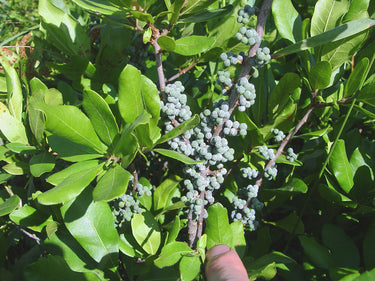


Southern Bayberry
Morella caroliniensis
See all 7 Bayberries & Wax Myrtles
Pickup currently unavailable at Aiken Nursery
The bayberry candle is one of those traditions so old it has become purely symbolic, burned at Christmas for luck, the scent faint and slightly waxy and unlike anything paraffin has managed to replicate in three centuries of trying. Most people who burn one have no idea what plant produced it, or that the plant is still out there, growing in sandy pocosins and coastal flats from New Jersey to the Gulf, doing quiet work in the margins of the southeastern landscape. That plant is Morella caroliniensis.
The wax is real. Colonists harvested it by boiling the berries and skimming the floating hydrocarbons from the surface, a process that took something like fifteen pounds of fruit to yield a single pound of wax, which tells you how highly they valued the result. The candles burned clean, held their shape in summer heat, and carried that particular fragrance that made them worth the effort. The practice faded when paraffin arrived. The plant did not.
This bayberry has been here longer than the common wax myrtle has been in cultivation, longer than most of the shrubs in the average garden center, fixing nitrogen in the root zone through a bacterial partnership that actively improves the surrounding soil. The berries persist on female plants through winter, deep blue-black under a pale waxy bloom, and sustain yellow-rumped warblers through the lean months in a way no ornamental exotic can. Here is a plant with a real history of usefulness in the landscape, which in the current moment is not a small thing.
And this is not the wax myrtle. Morella cerifera is faster, larger, and given to colonizing at a scale that needs managing; Morella caroliniensis, still listed in older references as Myrica heterophylla, is more considered, holding a position rather than claiming new ground. For the gardener who wants a native bayberry with actual restraint, this is the one. The genus belongs to the bayberry family, Myricaceae, and the aromatic, semi-glossy evergreen leaves release the classic bayberry scent when crushed.
- Hardiness
- USDA Zones 6–9
- Sun
- Full Sun, Part Shade
- Soil
- Well-drained, Acid, Loam, Sandy, Clay
- Mature size
- Height 6–8 Feet · Spread 6–8 Feet
- Growth rate
- Fast
- Seasonality
- Evergreen
Inconspicuous catkins in spring; waxy blue-black berries on female plants in winter
From rooting to shipping, our top priority is ensuring you receive healthy, thriving plants for your garden’s success.
Because most of our plants are grown from rooted cuttings — alongside seed, air layering, and grafting chosen for each variety — you receive a stronger, true-to-type plant that establishes quickly in your garden.
Raised on organic soil blends and eco-friendly pest management — never harsh chemicals — your plant arrives healthy for your garden, your family, and the pollinators they feed.
Every purchase gives back. We donate to the Aiken Arboretum and support local wildlife conservation, so growing your garden helps protect the wider ecosystem too.

All our plant material is carefully propagated, grown, and nurtured at our humble nursery in Aiken, South Carolina.

Your plant arrives carefully packed and ready to settle in. Unpack them promptly, give them a day or two to acclimate, then plant following the notes we include — that’s all it takes. Clear care guidance comes with every order, so success is the easy part.
What to expect upon delivery
All our plants are sold in 1-gallon sizes, though the height of each plant can vary depending on its growth rate and seasonality, typically ranging from 1/2 to 2.5 feet.
Each plant is carefully packaged with its roots enclosed in a secure plastic bag containing moist soil, forming a compact root ball. To ensure safe transport, the box is padded with recycled newspaper, providing both stability and eco-friendly protection from weather during shipping.
What is your return policy?
Review our full return policy information on our SHIPPING AND RETURNS POLICY page.
What payment methods can I use?
We offer 35 different payment methods including major providers like Mastercard, Visa, PayPal, American Express and Diners as well as many different local payment methods including Klarna, iDEAL, AliPay, Sofort, giropay, and many more.
Can I make changes to my order after it’s been placed?
At Woodlanders, we strive to fulfill orders as quickly as possible. Therefore, we can only accommodate changes to your order within the first 24 hours after it has been placed. These changes include adding or removing products and modifying the delivery address. If you need to make any changes or if there has been a mistake with your order information, please reach out to us promptly via our CONTACT page with your order number for the quickest resolution.
Your satisfaction is our priority, and we appreciate your understanding and cooperation.