


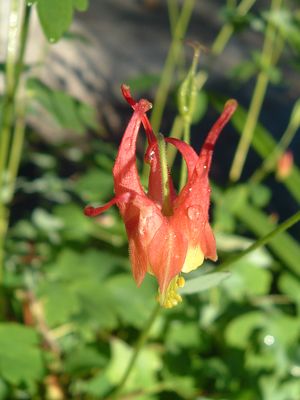

Eastern Red Columbine
Aquilegia canadensis
Pickup currently unavailable at Aiken Nursery
Few spring sights stir the woodland gardener like wild columbine in bloom. Aquilegia canadensis hangs nodding red-and-yellow bells, spurred and lantern-like, over lacy blue-green foliage, catching the low light of April along forest edges, rocky outcrops, and Appalachian coves where the plant has grown for ages. The eastern red columbine, or simply wild columbine, is among the most beloved of native spring wildflowers.
The spurred flowers are a small marvel of design, shaped for the long tongues of hummingbirds and early bees that follow the bright signals through clearings as the canopy leafs out. Upright and branching, the plant reseeds gently into informal drifts without ever becoming a nuisance, and grows best in fertile, moist but well-drained soil, on the neutral to slightly alkaline side. In the right spot the columbine naturalizes beautifully, lending a planting a settled sense of place.
Native peoples knew the plant well. The Cherokee and Iroquois used small amounts of the root for heart, kidney, and bladder complaints and as an aid in childbirth, while crushed seeds served for headache and fever, were rubbed into the hair against lice, and were carried as love charms. Every part is poisonous in quantity, so the plant is grown here for beauty, not use. The genus name Aquilegia, from the Latin for eagle, points to the claw-like spurs of the flower, curved like a raptor's talon.
- Hardiness
- USDA Zones 4–9
- Sun
- Full Sun, Part Shade
- Soil
- Moist, Well-drained
- Mature size
- Height 12–18 Inches · Spread 12–15 Inches
- Growth rate
- Moderate
- Seasonality
- Dies back
Nodding red-and-yellow spurred flowers in early spring
These statements have not been evaluated by the Food and Drug Administration. This information is shared for traditional and educational interest only and is not intended to diagnose, treat, cure, or prevent any disease. Please consult a qualified healthcare professional before any medicinal use.
- Seeds and roots contain cardiogenic toxins and are poisonous
- Traditional use only; not safe for self-treatment
- Keep seeds away from children
From rooting to shipping, our top priority is ensuring you receive healthy, thriving plants for your garden’s success.
Because most of our plants are grown from rooted cuttings — alongside seed, air layering, and grafting chosen for each variety — you receive a stronger, true-to-type plant that establishes quickly in your garden.
Raised on organic soil blends and eco-friendly pest management — never harsh chemicals — your plant arrives healthy for your garden, your family, and the pollinators they feed.
Every purchase gives back. We donate to the Aiken Arboretum and support local wildlife conservation, so growing your garden helps protect the wider ecosystem too.

All our plant material is carefully propagated, grown, and nurtured at our humble nursery in Aiken, South Carolina.

Your plant arrives carefully packed and ready to settle in. Unpack them promptly, give them a day or two to acclimate, then plant following the notes we include — that’s all it takes. Clear care guidance comes with every order, so success is the easy part.
What to expect upon delivery
All our plants are sold in 1-gallon sizes, though the height of each plant can vary depending on its growth rate and seasonality, typically ranging from 1/2 to 2.5 feet.
Each plant is carefully packaged with its roots enclosed in a secure plastic bag containing moist soil, forming a compact root ball. To ensure safe transport, the box is padded with recycled newspaper, providing both stability and eco-friendly protection from weather during shipping.
What is your return policy?
Review our full return policy information on our SHIPPING AND RETURNS POLICY page.
What payment methods can I use?
We offer 35 different payment methods including major providers like Mastercard, Visa, PayPal, American Express and Diners as well as many different local payment methods including Klarna, iDEAL, AliPay, Sofort, giropay, and many more.
Can I make changes to my order after it’s been placed?
At Woodlanders, we strive to fulfill orders as quickly as possible. Therefore, we can only accommodate changes to your order within the first 24 hours after it has been placed. These changes include adding or removing products and modifying the delivery address. If you need to make any changes or if there has been a mistake with your order information, please reach out to us promptly via our CONTACT page with your order number for the quickest resolution.
Your satisfaction is our priority, and we appreciate your understanding and cooperation.