



Redwing
Heteropterys glabra
In propagation
Currently rooting cuttings. Expected Fall 2027.
Add your name with the notify button below, and we will email you the moment this plant is ready to bring home.
Learn how we grow on The Prop House.
Pickup currently unavailable at Aiken Nursery
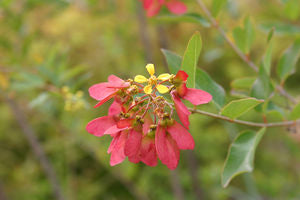
Redwing is grown less for the flowers than for what follows them. Through the warm months this fast, twining, semi-woody climber carries loose clusters of small clear-yellow flowers along the stems, pretty enough in passing, but the real event comes after, when each pollinated bloom ripens into a bright red winged fruit, a samara built exactly like the spinning key of a maple. In quantity the red keys smother the vine and glow against the small, neat foliage, an unexpected and long-lasting display that few visitors can name.
The resemblance to maple is pure coincidence. Redwing belongs to the Malpighiaceae, the tropical family of the acerola or Barbados cherry, and comes by the winged fruit through an entirely separate line: the genus name Heteropterys, from the Greek for different wings, marks the unequal wings on the samara, while glabra notes the smooth, hairless leaves. Native to South America, the vine brings a touch of the subtropics to a warm-temperate garden and remains genuinely uncommon in cultivation, a plant for the collector and the curious.
As a garden plant, redwing is easygoing and quick. The long, flexible stems climb and scramble readily, so give the vine a sturdy support to clothe: an arbor, a pergola, a fence, or a large trellis in full sun to part shade. Growth is fast once established, the small leaves cast light, dappled shade, and the plant asks only for reasonable drainage and warmth. Where winters bite, the top may die back and return, or a plant can be grown in a large pot and wintered under cover.
In the garden, treat redwing as a warm-season screen or a conversation piece where the red-keyed fruit can be seen at close range: along a rail, over a gateway, or against a wall where the color reads. Pair with other subtropical climbers and hot-border plants, and site where late-summer sun can light the ripening samaras. Nothing else in the garden will look quite like the vine hung with red maple keys that never came from a maple.
- Hardiness
- USDA Zones 7–10
- Sun
- Full Sun, Part Shade
- Soil
- Well-drained
- Mature size
- Height 10–20 Feet · Spread 6–10 Feet
- Growth rate
- Fast
- Seasonality
- Deciduous
From rooting to shipping, our top priority is ensuring you receive healthy, thriving plants for your garden’s success.
Because most of our plants are grown from rooted cuttings — alongside seed, air layering, and grafting chosen for each variety — you receive a stronger, true-to-type plant that establishes quickly in your garden.
Raised on organic soil blends and eco-friendly pest management — never harsh chemicals — your plant arrives healthy for your garden, your family, and the pollinators they feed.
Every purchase gives back. We donate to the Aiken Arboretum and support local wildlife conservation, so growing your garden helps protect the wider ecosystem too.

All our plant material is carefully propagated, grown, and nurtured at our humble nursery in Aiken, South Carolina.

Your plant arrives carefully packed and ready to settle in. Unpack them promptly, give them a day or two to acclimate, then plant following the notes we include — that’s all it takes. Clear care guidance comes with every order, so success is the easy part.
What to expect upon delivery
All our plants are sold in 1-gallon sizes, though the height of each plant can vary depending on its growth rate and seasonality, typically ranging from 1/2 to 2.5 feet.
Each plant is carefully packaged with its roots enclosed in a secure plastic bag containing moist soil, forming a compact root ball. To ensure safe transport, the box is padded with recycled newspaper, providing both stability and eco-friendly protection from weather during shipping.
What is your return policy?
Review our full return policy information on our SHIPPING AND RETURNS POLICY page.
What payment methods can I use?
We offer 35 different payment methods including major providers like Mastercard, Visa, PayPal, American Express and Diners as well as many different local payment methods including Klarna, iDEAL, AliPay, Sofort, giropay, and many more.
Can I make changes to my order after it’s been placed?
At Woodlanders, we strive to fulfill orders as quickly as possible. Therefore, we can only accommodate changes to your order within the first 24 hours after it has been placed. These changes include adding or removing products and modifying the delivery address. If you need to make any changes or if there has been a mistake with your order information, please reach out to us promptly via our CONTACT page with your order number for the quickest resolution.
Your satisfaction is our priority, and we appreciate your understanding and cooperation.