


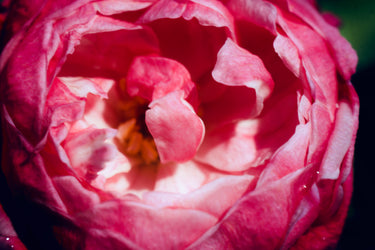


Louis Philippe Rose
Rosa hybrid 'Louis Philippe'
Pickup available at Aiken Nursery
Usually ready in 2-4 days
Rosa 'Louis Philippe' came into the world in 1834 at Angers, France, raised by the rosarian Modeste Guérin and named for the man then on the throne, Louis Philippe, the Citizen King. His blood was royal in a second sense. Guérin is said to have bred him from 'Slater's Crimson China', one of the handful of repeat-blooming China roses that had reached Europe a generation earlier and overturned everything Western gardeners thought a rose could do. That rose had grown in Empress Joséphine's garden at Malmaison and been painted there by Redouté, and cuttings of its line found their way to Guérin's bench. This was a fashionable, well-connected rose, bound for the gardens of the European elite.
He did not stay fashionable. He went south, and then he went feral. The rose reached America in the hands of Lorenzo de Zavala, the Yucatán-born statesman who served as Mexico's minister to the court of Louis Philippe and went on to become the first vice president of the Republic of Texas. His wife Emily had loved the roses at the French king's court, and when the de Zavalas came to Texas in 1835 to throw in with the revolution, the rose came too, planted at their place in Lynchburg, across the water from the San Jacinto battleground. Texans called it the Zavala rose. The wider South, where it turned up at every old homestead and half the country cemeteries, called it something humbler: the Cracker rose.
He is an old China rose and behaves like one, which is the whole point of him. The flowers come loosely double, about two inches, a deep rose red warming to a blush of lighter pink at the center, now and then threaded with a single pale streak, the giveaway of his China parentage. He blooms, and blooms, and blooms. The Chinas earned the Latin name semperflorens, ever-flowering, and he earns it daily, carrying color from spring to frost and starting up again the moment a winter warm spell fools him into it. The scent is light, a soft tea fragrance you have to lean in for. He asks for almost nothing in return: full sun, ordinary soil that drains, and room to mound into a bushy three to six feet. He is heat-proof in a way that flattens hybrid teas, drought-tolerant once rooted, and what blackspot the Southern summer throws at him he largely cures himself, shedding the bad leaves and pushing clean growth as the weather turns. Texas A&M put him on their EarthKind list of roses that thrive on neglect, which is worth more than any show ribbon. Hardy from zone 7 through 10, root-hardy where winters bite and all but evergreen where they do not. One note for collectors: he is easily mistaken for 'Cramoisi Supérieur', his near-twin, and gives himself away by his more compact frame and the way his color shifts from flower to flower.
A rose bred for a king and adopted by everyone else, still blooming on its own at the edge of old farms a century after the hands that planted it were gone. Grow him for the ceaseless red, and for the long Southern story folded into one undemanding shrub.
- Hardiness
- USDA Zones 7–10
- Sun
- Full Sun
- Soil
- Well-drained
- Mature size
- Height 5–6 Feet · Spread 3–4 Feet
- Growth rate
- Moderate
From rooting to shipping, our top priority is ensuring you receive healthy, thriving plants for your garden’s success.
Because most of our plants are grown from rooted cuttings — alongside seed, air layering, and grafting chosen for each variety — you receive a stronger, true-to-type plant that establishes quickly in your garden.
Raised on organic soil blends and eco-friendly pest management — never harsh chemicals — your plant arrives healthy for your garden, your family, and the pollinators they feed.
Every purchase gives back. We donate to the Aiken Arboretum and support local wildlife conservation, so growing your garden helps protect the wider ecosystem too.

All our plant material is carefully propagated, grown, and nurtured at our humble nursery in Aiken, South Carolina.

Your plant arrives carefully packed and ready to settle in. Unpack them promptly, give them a day or two to acclimate, then plant following the notes we include — that’s all it takes. Clear care guidance comes with every order, so success is the easy part.
What to expect upon delivery
All our plants are sold in 1-gallon sizes, though the height of each plant can vary depending on its growth rate and seasonality, typically ranging from 1/2 to 2.5 feet.
Each plant is carefully packaged with its roots enclosed in a secure plastic bag containing moist soil, forming a compact root ball. To ensure safe transport, the box is padded with recycled newspaper, providing both stability and eco-friendly protection from weather during shipping.
What is your return policy?
Review our full return policy information on our SHIPPING AND RETURNS POLICY page.
What payment methods can I use?
We offer 35 different payment methods including major providers like Mastercard, Visa, PayPal, American Express and Diners as well as many different local payment methods including Klarna, iDEAL, AliPay, Sofort, giropay, and many more.
Can I make changes to my order after it’s been placed?
At Woodlanders, we strive to fulfill orders as quickly as possible. Therefore, we can only accommodate changes to your order within the first 24 hours after it has been placed. These changes include adding or removing products and modifying the delivery address. If you need to make any changes or if there has been a mistake with your order information, please reach out to us promptly via our CONTACT page with your order number for the quickest resolution.
Your satisfaction is our priority, and we appreciate your understanding and cooperation.