


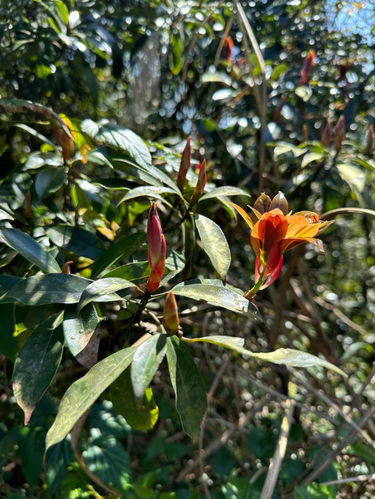


Machilus
Machilus thunbergii
Pickup available at Aiken Nursery
Usually ready in 2-4 days
The Lauraceae is an underappreciated family. Its members include cinnamon, camphor, bay laurel, and the avocado, which gives you some sense of the range of things the family has contributed to human civilization. Machilus thunbergii is another member in good standing, though these trees arrive in the Western garden with considerably less fanfare than their relatives. In East Asia they are well known: a coastal evergreen tree native to Japan, Korea, Taiwan, China, and Vietnam, valued for timber, planted as a street tree, and the source of makko, a powder derived from the bark and used for centuries to bind incense and, in a more practical application, to repel mosquitoes. The bark also has a history in traditional medicine. Here, in other words, is a tree that has been useful to people for a very long time, which is not a bad thing for a plant to be.
In the Western garden the appeal is different. The foliage is the primary draw: large, glossy, dark green leaves with a slightly glaucous underside that catch light differently depending on how you stand relative to them. New growth emerges in shades of copper and bronze before settling into the deep green of maturity, giving the canopy a layered seasonal interest that most broadleaf evergreens never manage. The form is upright and somewhat architectural, with flattened sprays of branches that give the tree a composed, deliberate quality in the landscape.
Woodlanders grows this from seed sourced from a tree of Korean origin growing in George Mitchell's garden here in Aiken, South Carolina, where the tree has proven completely hardy. That provenance matters: Machilus thunbergii is a coastal plant, and hardiness varies significantly by origin.
A note on taxonomy, since taxonomists cannot resist: the genus Machilus has been periodically absorbed into Persea by those who find the distinction botanically indistinct, and periodically restored by those who disagree. The argument continues. We list these trees as Machilus here because that is how serious gardeners know them, and because taking sides in genus-level disputes is above our pay grade.
- Hardiness
- USDA Zones 8–10
- Sun
- Full Sun, Part Shade
- Soil
- Well-drained, Loam
- Mature size
- Height 30–40 Feet · Spread 15–20 Feet
- Growth rate
- Moderate
- Seasonality
- Evergreen
From rooting to shipping, our top priority is ensuring you receive healthy, thriving plants for your garden’s success.
Because most of our plants are grown from rooted cuttings — alongside seed, air layering, and grafting chosen for each variety — you receive a stronger, true-to-type plant that establishes quickly in your garden.
Raised on organic soil blends and eco-friendly pest management — never harsh chemicals — your plant arrives healthy for your garden, your family, and the pollinators they feed.
Every purchase gives back. We donate to the Aiken Arboretum and support local wildlife conservation, so growing your garden helps protect the wider ecosystem too.

All our plant material is carefully propagated, grown, and nurtured at our humble nursery in Aiken, South Carolina.

Your plant arrives carefully packed and ready to settle in. Unpack them promptly, give them a day or two to acclimate, then plant following the notes we include — that’s all it takes. Clear care guidance comes with every order, so success is the easy part.
What to expect upon delivery
All our plants are sold in 1-gallon sizes, though the height of each plant can vary depending on its growth rate and seasonality, typically ranging from 1/2 to 2.5 feet.
Each plant is carefully packaged with its roots enclosed in a secure plastic bag containing moist soil, forming a compact root ball. To ensure safe transport, the box is padded with recycled newspaper, providing both stability and eco-friendly protection from weather during shipping.
What is your return policy?
Review our full return policy information on our SHIPPING AND RETURNS POLICY page.
What payment methods can I use?
We offer 35 different payment methods including major providers like Mastercard, Visa, PayPal, American Express and Diners as well as many different local payment methods including Klarna, iDEAL, AliPay, Sofort, giropay, and many more.
Can I make changes to my order after it’s been placed?
At Woodlanders, we strive to fulfill orders as quickly as possible. Therefore, we can only accommodate changes to your order within the first 24 hours after it has been placed. These changes include adding or removing products and modifying the delivery address. If you need to make any changes or if there has been a mistake with your order information, please reach out to us promptly via our CONTACT page with your order number for the quickest resolution.
Your satisfaction is our priority, and we appreciate your understanding and cooperation.