


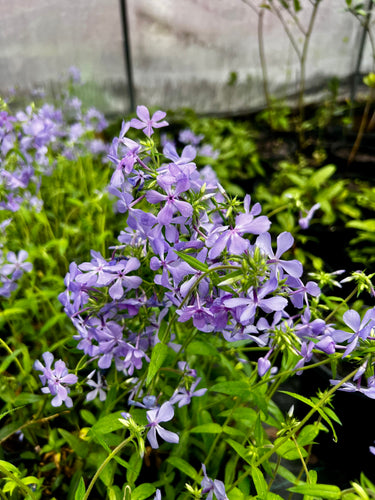


Wild Blue Phlox
Phlox divaricata
Pickup currently unavailable at Aiken Nursery
Wild blue phlox turned up in the Woodlanders catalog almost by insisting on it, growing in the woods around Aiken the way the plant has for as long as anyone can remember. We have watched these colonies for years, and taking this long to offer them is either a comment on our patience or on our woody bias. Possibly both.
Phlox divaricata is a native of the eastern woodland understory, ranging from Quebec to the Gulf Coast and west to the Great Plains, a distribution that speaks to a plant far more adaptable than the delicate look suggests. In the wild the phlox threads through rich, humus-filled soils beneath deciduous canopy, forming loose colonies on the forest floor where the light arrives filtered and the moisture stays reliable. In the garden the habit is the same: a spreading, semi-evergreen groundcover that quietly fills the difficult shaded spaces where little else thrives.
The flowers arrive in mid-spring, April into May, in loose clusters atop slender stems that stand ten to fifteen inches above the mat of foliage. The color runs from the palest lavender-blue to a deeper violet, now and then white, each five-petaled flower with a slightly notched petal tip that lends the clusters a softly fringed look up close. The fragrance is light and sweet, present on warm afternoons rather than assertive, and swallowtails find the flowers reliably.
What makes Phlox divaricata worth growing, beyond the flowers, is the behavior across the other ten months. The semi-evergreen foliage forms a low, dense mat that suppresses weeds, holds the soil, and lends quiet structure to shaded beds through winter. The phlox spreads steadily but not aggressively, slowly colonizing the ground you want covered without pressing claims on the ground you don't. A native plant doing native-plant things, with rather more grace than most.
- Hardiness
- USDA Zones 3–9
- Sun
- Part Shade, Full Shade
- Soil
- Moist, Well-drained
- Mature size
- Height 10–15 Inches · Spread 12–24 Inches
- Growth rate
- Moderate
- Seasonality
- Semi-Evergreen
Lavender-blue to violet, occasionally white, mid-spring
From rooting to shipping, our top priority is ensuring you receive healthy, thriving plants for your garden’s success.
Because most of our plants are grown from rooted cuttings — alongside seed, air layering, and grafting chosen for each variety — you receive a stronger, true-to-type plant that establishes quickly in your garden.
Raised on organic soil blends and eco-friendly pest management — never harsh chemicals — your plant arrives healthy for your garden, your family, and the pollinators they feed.
Every purchase gives back. We donate to the Aiken Arboretum and support local wildlife conservation, so growing your garden helps protect the wider ecosystem too.

All our plant material is carefully propagated, grown, and nurtured at our humble nursery in Aiken, South Carolina.

Your plant arrives carefully packed and ready to settle in. Unpack them promptly, give them a day or two to acclimate, then plant following the notes we include — that’s all it takes. Clear care guidance comes with every order, so success is the easy part.
What to expect upon delivery
All our plants are sold in 1-gallon sizes, though the height of each plant can vary depending on its growth rate and seasonality, typically ranging from 1/2 to 2.5 feet.
Each plant is carefully packaged with its roots enclosed in a secure plastic bag containing moist soil, forming a compact root ball. To ensure safe transport, the box is padded with recycled newspaper, providing both stability and eco-friendly protection from weather during shipping.
What is your return policy?
Review our full return policy information on our SHIPPING AND RETURNS POLICY page.
What payment methods can I use?
We offer 35 different payment methods including major providers like Mastercard, Visa, PayPal, American Express and Diners as well as many different local payment methods including Klarna, iDEAL, AliPay, Sofort, giropay, and many more.
Can I make changes to my order after it’s been placed?
At Woodlanders, we strive to fulfill orders as quickly as possible. Therefore, we can only accommodate changes to your order within the first 24 hours after it has been placed. These changes include adding or removing products and modifying the delivery address. If you need to make any changes or if there has been a mistake with your order information, please reach out to us promptly via our CONTACT page with your order number for the quickest resolution.
Your satisfaction is our priority, and we appreciate your understanding and cooperation.