


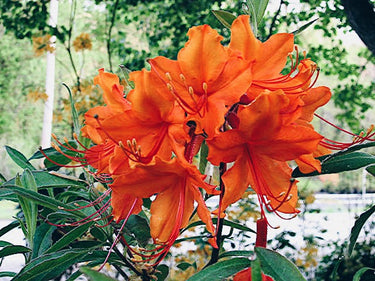

Great Balls of Fire Azalea
Rhododendron 'Great Balls of Fire'
See all 49 Azaleas & Rhododendrons
In propagation
Currently growing out 1 Gallon pots. Expected season to be announced.
Add your name with the notify button below, and we will email you the moment this plant is ready to bring home.
Learn how we grow on The Prop House.
Pickup currently unavailable at Aiken Nursery
'Great Balls of Fire' belongs to the celebrated line of Aromi azaleas, the life's work of Dr. Eugene Aromi, a University of South Alabama education professor who set out in the late 1960s simply to help the azaleas in his Mobile front yard survive the Gulf Coast's brutal heat and humidity. What began as a backyard experiment grew into one of the great American breeding programs. From 1971 onward Aromi crossed cold-hardy Exbury and Knap Hill azaleas with tough southern native species, chief among them the Florida azalea, Rhododendron austrinum, chasing large, fragrant, heat-proof deciduous flowers. He made more than a thousand crosses and raised over fifty thousand seedlings before his death in 2004, and roughly a hundred of the best were named. This is counted among them.
A deciduous azalea rather than the evergreen sort, 'Great Balls of Fire' erupts in spring with rounded trusses of two-inch blooms in tones that run from molten orange to deep, glowing tangerine, each flaring flower carrying a slim red tube and long, arching stamens that give the whole cluster a fiery, honeysuckle-like poise. A soft sweetness rides the air around the shrub, and the color reads from clear across the garden. The genus name Rhododendron comes from the Greek for rose tree, while azalea traces to azaleos, meaning dry, an old reference to the open ground where some kinds were found; neither name prepares a visitor for how incandescent these flowers can be.
The name is pure showmanship. Christened for Jerry Lee Lewis's 1957 barn-burner "Great Balls of Fire," the shrub practically demands a soundtrack, and we stand by the original advice to blast the song through the speakers while you coronate this beauty in the ground. Difficult to propagate and slow to bulk up, the plant reaches very few nurseries, which makes each one something of a collector's prize. A word of caution familiar to every azalea grower: like all Rhododendron, the leaves and nectar carry grayanotoxins and should never be eaten by people or pets.
Give 'Great Balls of Fire' the classic deciduous-azalea situation, dappled light or morning sun with shelter from the hottest afternoon, in moist, sharply drained, acidic soil enriched with pine bark or leaf mold. Standing four to six feet tall and nearly as wide with an open, informal frame, the shrub shines at the woodland edge, among high-branched pines and oaks, or threaded through a naturalistic border where the spring fireworks can blaze against fresh green. Underplant with ferns, native phlox, or foamflower, and site the shrub where low morning light can set the trusses aglow. Photo courtesy of Merri Oxley.
- Hardiness
- USDA Zones 6–9
- Sun
- Part Shade, Full Sun
- Soil
- Well-drained, Acid
- Mature size
- Height 4–6 Feet · Spread 4–5 Feet
- Growth rate
- Moderate
- Seasonality
- Deciduous
Rounded spring trusses of two-inch flowers in fiery orange to deep tangerine, each with a slender red tube and long stamens, softly fragrant.
From rooting to shipping, our top priority is ensuring you receive healthy, thriving plants for your garden’s success.
Because most of our plants are grown from rooted cuttings — alongside seed, air layering, and grafting chosen for each variety — you receive a stronger, true-to-type plant that establishes quickly in your garden.
Raised on organic soil blends and eco-friendly pest management — never harsh chemicals — your plant arrives healthy for your garden, your family, and the pollinators they feed.
Every purchase gives back. We donate to the Aiken Arboretum and support local wildlife conservation, so growing your garden helps protect the wider ecosystem too.

All our plant material is carefully propagated, grown, and nurtured at our humble nursery in Aiken, South Carolina.

Your plant arrives carefully packed and ready to settle in. Unpack them promptly, give them a day or two to acclimate, then plant following the notes we include — that’s all it takes. Clear care guidance comes with every order, so success is the easy part.
What to expect upon delivery
All our plants are sold in 1-gallon sizes, though the height of each plant can vary depending on its growth rate and seasonality, typically ranging from 1/2 to 2.5 feet.
Each plant is carefully packaged with its roots enclosed in a secure plastic bag containing moist soil, forming a compact root ball. To ensure safe transport, the box is padded with recycled newspaper, providing both stability and eco-friendly protection from weather during shipping.
What is your return policy?
Review our full return policy information on our SHIPPING AND RETURNS POLICY page.
What payment methods can I use?
We offer 35 different payment methods including major providers like Mastercard, Visa, PayPal, American Express and Diners as well as many different local payment methods including Klarna, iDEAL, AliPay, Sofort, giropay, and many more.
Can I make changes to my order after it’s been placed?
At Woodlanders, we strive to fulfill orders as quickly as possible. Therefore, we can only accommodate changes to your order within the first 24 hours after it has been placed. These changes include adding or removing products and modifying the delivery address. If you need to make any changes or if there has been a mistake with your order information, please reach out to us promptly via our CONTACT page with your order number for the quickest resolution.
Your satisfaction is our priority, and we appreciate your understanding and cooperation.