


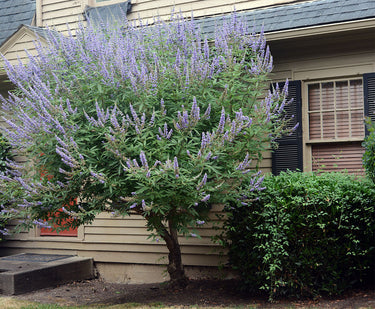


Chaste Tree
Vitex agnus-castus
Pickup available at Aiken Nursery
Usually ready in 2-4 days
Some plants stand quietly in the garden, and some speak. Vitex agnus-castus has been speaking for more than two thousand years, from sun-washed Mediterranean shores to monastery cloisters, from the herbals of ancient Greece to the borders of Southern gardens. In Homer's day the fragrant leaves and lavender flower spikes were woven into ritual garlands. The Romans knew the shrub as the chaste tree, a name wrapped in legend, since the peppery seeds were once thought to cool passion, which earned the seeds the cloister nickname of monk's pepper. The double name says as much twice over: agnus is Latin for lamb and castus for chaste, while the genus Vitex comes from vieo, to weave, a nod to the pliant branches once bent into baskets.
In the heat of summer the chaste tree is a feast for the senses. Long, slender spikes of violet-blue flowers stand above palmate, gray-green leaves and release a resinous, spicy-sweet scent at a touch. Honeybees, swallowtails, and hummingbirds arrive in procession. Though native to southern Europe and western Asia, the plant found a willing home in American gardens centuries ago, and thrives across the South, where a tolerance for heat, drought, and neglect makes the chaste tree as dependable as any crepe myrtle.
The berries carry a long medicinal history that continues in herbalism today, still listed in old pharmacopoeias under the name agnus-castus. Traditional European use centered on women's health, and modern research has looked most closely at the dried ripe berries for premenstrual complaints and hormone balance. The picture is promising but not settled, and nothing here is medical advice.
Vitex asks for little: full sun, sharp drainage, and room to grow. Prune to a single trunk for a formal small tree, or leave the plant multi-stemmed for a looser, informal effect, and cut back hard in late winter to spur the heaviest bloom on new wood. Site near a patio, a path, or an entry where the summer flowers and warm fragrance can be met up close, and pair with rosemary, lavender, and other sun-loving, drought-tolerant companions. In return comes an entire season of bloom and a living link to gardens both ancient and new.
Photos courtesy of Oregon State University.
- Hardiness
- USDA Zones 6–9
- Sun
- Full Sun, Part Shade
- Soil
- Well-drained
- Mature size
- Height 10–20 Feet · Spread 10–20 Feet
- Growth rate
- Fast
- Seasonality
- Deciduous
Violet-blue spikes, fragrant, summer
These statements have not been evaluated by the Food and Drug Administration. This information is shared for traditional and educational interest only and is not intended to diagnose, treat, cure, or prevent any disease. Please consult a qualified healthcare professional before any medicinal use.
- Not for use during pregnancy or while breastfeeding
- May interact with hormonal contraceptives, hormone therapy, and dopamine-related medications
- Consult a qualified healthcare practitioner before use
From rooting to shipping, our top priority is ensuring you receive healthy, thriving plants for your garden’s success.
Because most of our plants are grown from rooted cuttings — alongside seed, air layering, and grafting chosen for each variety — you receive a stronger, true-to-type plant that establishes quickly in your garden.
Raised on organic soil blends and eco-friendly pest management — never harsh chemicals — your plant arrives healthy for your garden, your family, and the pollinators they feed.
Every purchase gives back. We donate to the Aiken Arboretum and support local wildlife conservation, so growing your garden helps protect the wider ecosystem too.

All our plant material is carefully propagated, grown, and nurtured at our humble nursery in Aiken, South Carolina.

Your plant arrives carefully packed and ready to settle in. Unpack them promptly, give them a day or two to acclimate, then plant following the notes we include — that’s all it takes. Clear care guidance comes with every order, so success is the easy part.
What to expect upon delivery
All our plants are sold in 1-gallon sizes, though the height of each plant can vary depending on its growth rate and seasonality, typically ranging from 1/2 to 2.5 feet.
Each plant is carefully packaged with its roots enclosed in a secure plastic bag containing moist soil, forming a compact root ball. To ensure safe transport, the box is padded with recycled newspaper, providing both stability and eco-friendly protection from weather during shipping.
What is your return policy?
Review our full return policy information on our SHIPPING AND RETURNS POLICY page.
What payment methods can I use?
We offer 35 different payment methods including major providers like Mastercard, Visa, PayPal, American Express and Diners as well as many different local payment methods including Klarna, iDEAL, AliPay, Sofort, giropay, and many more.
Can I make changes to my order after it’s been placed?
At Woodlanders, we strive to fulfill orders as quickly as possible. Therefore, we can only accommodate changes to your order within the first 24 hours after it has been placed. These changes include adding or removing products and modifying the delivery address. If you need to make any changes or if there has been a mistake with your order information, please reach out to us promptly via our CONTACT page with your order number for the quickest resolution.
Your satisfaction is our priority, and we appreciate your understanding and cooperation.