


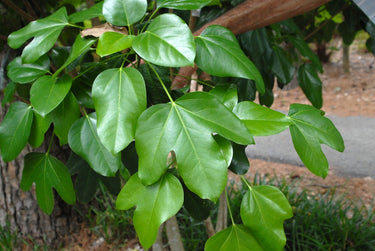


Tree Ivy, Kakuremino
Dendropanax trifidus
Pickup currently unavailable at Aiken Nursery
Dendropanax trifidus is one of those quiet, aristocratic evergreens that rewards a second look and then a third. To the casual eye the plant reads as a glossy, tropical-looking small tree, something you would expect to sulk at the first frost; in truth this is a tough, warm-temperate native of the coastal forests of southern Japan, Korea, and Taiwan, hardy well into the Southeast and unbothered by heat, humidity, or a mild winter.
The genus name tells part of the story. Dendropanax joins the Greek for tree, dendron, to panax, the same root behind ginseng and the old idea of a cure-all, so the botanical name reads almost as tree ginseng. The kinship is real, because this is a member of the Araliaceae, the ivy and ginseng family, cousin to English ivy, to Fatsia, to Aralia, and to ginseng itself, and the rounded summer umbels of small yellow-green flowers, followed by clusters of black autumn drupes, echo that family resemblance exactly.
The Japanese common name is the poetry, though. Gardeners there call this tree kakuremino, the cloak of invisibility, after a magical straw cape from folklore that hid whoever wore it. The name was borrowed for the plant because the deeply cut, three-lobed juvenile leaves resemble that mythical mino, the woven rain cloak, and it also happens to describe how the tree behaves in a planting, slipping quietly into the green background until the light catches the lacquered leaves. The species name, trifidus, meaning split into three, records the same lobed juvenile foliage, which is only half the trick: as the tree matures the leaves gradually give up their lobes and settle into simple, entire ovals, so a single specimen in transition often carries both leaf forms at once, a botanical curiosity called heteroblasty.
Here in the United States the plant is still barely known. This particular tree grew in our own garden in Aiken, South Carolina for years, and Dendropanax trifidus was very possibly first offered to American gardeners by Woodlanders. Use the dense, upright form as a rare evergreen for shade: a woodland understory, a shaded courtyard, or a narrow green screen in a tight side yard, where the glossy foliage lends a tropical calm that belies real hardiness. Pair with fatsia, aucuba, ferns, and hellebores, give shade to semi-shade and moist, well-drained soil, and shelter the plant from harsh winter wind. In cold snaps the leaves flush burgundy and copper, then return to deep green with spring.
- Hardiness
- USDA Zones 7–9
- Sun
- Part Shade
- Soil
- Moist, Rich, Well-drained
- Mature size
- Height 12–15 Feet · Spread 8–12 Feet
- Growth rate
- Slow
- Seasonality
- Evergreen
From rooting to shipping, our top priority is ensuring you receive healthy, thriving plants for your garden’s success.
Because most of our plants are grown from rooted cuttings — alongside seed, air layering, and grafting chosen for each variety — you receive a stronger, true-to-type plant that establishes quickly in your garden.
Raised on organic soil blends and eco-friendly pest management — never harsh chemicals — your plant arrives healthy for your garden, your family, and the pollinators they feed.
Every purchase gives back. We donate to the Aiken Arboretum and support local wildlife conservation, so growing your garden helps protect the wider ecosystem too.

All our plant material is carefully propagated, grown, and nurtured at our humble nursery in Aiken, South Carolina.

Your plant arrives carefully packed and ready to settle in. Unpack them promptly, give them a day or two to acclimate, then plant following the notes we include — that’s all it takes. Clear care guidance comes with every order, so success is the easy part.
What to expect upon delivery
All our plants are sold in 1-gallon sizes, though the height of each plant can vary depending on its growth rate and seasonality, typically ranging from 1/2 to 2.5 feet.
Each plant is carefully packaged with its roots enclosed in a secure plastic bag containing moist soil, forming a compact root ball. To ensure safe transport, the box is padded with recycled newspaper, providing both stability and eco-friendly protection from weather during shipping.
What is your return policy?
Review our full return policy information on our SHIPPING AND RETURNS POLICY page.
What payment methods can I use?
We offer 35 different payment methods including major providers like Mastercard, Visa, PayPal, American Express and Diners as well as many different local payment methods including Klarna, iDEAL, AliPay, Sofort, giropay, and many more.
Can I make changes to my order after it’s been placed?
At Woodlanders, we strive to fulfill orders as quickly as possible. Therefore, we can only accommodate changes to your order within the first 24 hours after it has been placed. These changes include adding or removing products and modifying the delivery address. If you need to make any changes or if there has been a mistake with your order information, please reach out to us promptly via our CONTACT page with your order number for the quickest resolution.
Your satisfaction is our priority, and we appreciate your understanding and cooperation.