


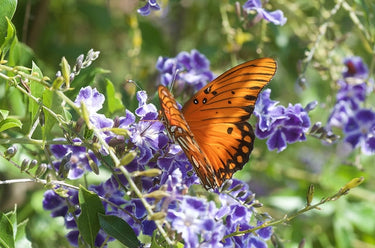


Golden Dewdrop
Duranta erecta
Pickup currently unavailable at Aiken Nursery
Golden dewdrop, Duranta erecta, is a member of the verbena family grown across the warm world for two ornaments the shrub carries at once: loose, drooping sprays of soft lilac-blue flowers, each with a darker eye, and long chains of round, glossy amber berries that hang like strings of wet gold. The common name catches that second gift exactly, while older names, pigeon berry and skyflower, catch the first. Native from Mexico and the Caribbean through much of tropical South America, the shrub has been carried into gardens throughout the subtropics, where the plant flowers and fruits nearly year round.
Left alone the shrub builds a fountain of arching, sometimes weeping branches six to ten feet tall, often armed with slim axillary spines, and takes readily to shaping as a loose informal hedge, a screen, or a single standard clipped into a small flowering tree. The great charm is that flower and fruit appear together, green berries ripening to gold while fresh blue sprays open above them, so the shrub is rarely without color. Bees, butterflies, and hummingbirds work the flowers through the day, so set the plant where that traffic can be enjoyed, against a warm wall, at the back of a mixed border, or wherever a long season of blue is wanted.
Golden dewdrop is a creature of heat. Reliably evergreen only in zones 9 and 10, the shrub behaves as a die-back plant at the cold edge of zone 8, where hard freezes cut the top down but established roots usually push back in spring to flower and fruit the same season. Plant in a sheltered, sunny spot with good soil, mulch the crown heavily for winter, and give full sun for the heaviest bloom. Fast-growing and forgiving of most soils so long as drainage is decent, the shrub asks little beyond warmth and a yearly pruning to keep the fountain in bounds.
Behind the ornamental face sits a plant with a double reputation. Across West Africa, and eastern Nigeria in particular, the leaves and fruit have long been used in traditional medicine against malaria, intestinal worms, and abscesses, and the fruit juice has served as a folk mosquito repellent. Yet the same berries and foliage are genuinely poisonous, holding saponins and other compounds that have killed children, dogs, and cats who ate the fruit. Handsome as the shrub is, keep the plant well away from grazing pets and curious toddlers, and treat the golden berries as strictly ornamental.
- Hardiness
- USDA Zones 8–10
- Sun
- Full Sun, Part Shade
- Soil
- Well-drained
- Mature size
- Height 6–10 Feet · Spread 5–8 Feet
- Growth rate
- Fast
- Seasonality
- Semi-Evergreen
Loose, drooping sprays of soft lilac-blue tubular flowers, often with a darker throat, borne nearly year round in warm climates
These statements have not been evaluated by the Food and Drug Administration. This information is shared for traditional and educational interest only and is not intended to diagnose, treat, cure, or prevent any disease. Please consult a qualified healthcare professional before any medicinal use.
- Leaves and berries are poisonous and have caused fatalities in children, dogs, and cats
- Any therapeutic dose sits dangerously close to a toxic dose
- Recorded here for historical and educational reference only, not for self-treatment
From rooting to shipping, our top priority is ensuring you receive healthy, thriving plants for your garden’s success.
Because most of our plants are grown from rooted cuttings — alongside seed, air layering, and grafting chosen for each variety — you receive a stronger, true-to-type plant that establishes quickly in your garden.
Raised on organic soil blends and eco-friendly pest management — never harsh chemicals — your plant arrives healthy for your garden, your family, and the pollinators they feed.
Every purchase gives back. We donate to the Aiken Arboretum and support local wildlife conservation, so growing your garden helps protect the wider ecosystem too.

All our plant material is carefully propagated, grown, and nurtured at our humble nursery in Aiken, South Carolina.

Your plant arrives carefully packed and ready to settle in. Unpack them promptly, give them a day or two to acclimate, then plant following the notes we include — that’s all it takes. Clear care guidance comes with every order, so success is the easy part.
What to expect upon delivery
All our plants are sold in 1-gallon sizes, though the height of each plant can vary depending on its growth rate and seasonality, typically ranging from 1/2 to 2.5 feet.
Each plant is carefully packaged with its roots enclosed in a secure plastic bag containing moist soil, forming a compact root ball. To ensure safe transport, the box is padded with recycled newspaper, providing both stability and eco-friendly protection from weather during shipping.
What is your return policy?
Review our full return policy information on our SHIPPING AND RETURNS POLICY page.
What payment methods can I use?
We offer 35 different payment methods including major providers like Mastercard, Visa, PayPal, American Express and Diners as well as many different local payment methods including Klarna, iDEAL, AliPay, Sofort, giropay, and many more.
Can I make changes to my order after it’s been placed?
At Woodlanders, we strive to fulfill orders as quickly as possible. Therefore, we can only accommodate changes to your order within the first 24 hours after it has been placed. These changes include adding or removing products and modifying the delivery address. If you need to make any changes or if there has been a mistake with your order information, please reach out to us promptly via our CONTACT page with your order number for the quickest resolution.
Your satisfaction is our priority, and we appreciate your understanding and cooperation.