


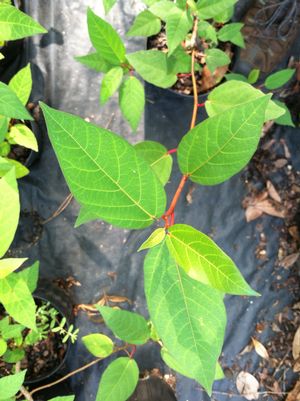

Variable-leaved Fig
Ficus heterophylla
Pickup currently unavailable at Aiken Nursery
We are identifying this little-known fig as Ficus heterophylla thanks to Tony Avent of Plant Delights, who was most likely the source of the cuttings we originally started with. The species name means different leaves, and the plant lives up to the promise: juvenile foliage may be lobed and wandering in outline, while the mature leaves settle into dark green, pointed, slightly heart-shaped blades carried on handsome red petioles. A faint sweetness hangs about the shrub, and the long, almost vine-like branches lend the whole plant a loose, scrambling grace.
In the wild Ficus heterophylla ranges widely across warm Asia, from India and Sri Lanka through southern China and Myanmar into Thailand and the islands of western Malesia, haunting moist valleys, streambanks, and the flood-margins of rivers. Like every fig, the plant belongs to the mulberry family, Moraceae, and shares that family's strange and beautiful bargain with wasps: the true flowers are hidden inside a hollow receptacle, the syconium, pollinated by a single dedicated species of fig wasp that crawls within to complete the exchange.
Across parts of that native range the shrub is more than a curiosity. Village healers have long put the plant to use, pounding the leaves into pastes laid on aching joints or troubled ears and simmering leaves and young fruit into folk decoctions, while the small ripe figs feed birds and other wildlife. In the garden, though, the appeal is chiefly ornamental: those variable leaves, the red-stemmed new growth, and the pliant branches that beg to be trained.
Given a shady or half-shaded wall, Ficus heterophylla would very likely make an intriguing espalier, the long branches pinned flat into a living tracery of changeable leaves. Site the plant in moist, well-drained soil with shelter from hard frost, since this is a warm-country fig happiest in the mild gardens of zones 9 to 11 or in a container that can move indoors when winter threatens. As a new and still lightly tested introduction, the shrub is offered in a spirit of shared experiment, and we will gladly welcome any customer reports on the plant's performance and merit.
- Hardiness
- USDA Zones 9–11
- Sun
- Full Sun, Part Shade
- Soil
- Well-drained
- Mature size
- Height 4–10 Feet · Spread 4–8 Feet
- Growth rate
- Moderate
- Seasonality
- Semi-Evergreen
These statements have not been evaluated by the Food and Drug Administration. This information is shared for traditional and educational interest only and is not intended to diagnose, treat, cure, or prevent any disease. Please consult a qualified healthcare professional before any medicinal use.
- Regional traditional use, poorly studied; not intended as medical advice.
- Fig sap may irritate skin.
From rooting to shipping, our top priority is ensuring you receive healthy, thriving plants for your garden’s success.
Because most of our plants are grown from rooted cuttings — alongside seed, air layering, and grafting chosen for each variety — you receive a stronger, true-to-type plant that establishes quickly in your garden.
Raised on organic soil blends and eco-friendly pest management — never harsh chemicals — your plant arrives healthy for your garden, your family, and the pollinators they feed.
Every purchase gives back. We donate to the Aiken Arboretum and support local wildlife conservation, so growing your garden helps protect the wider ecosystem too.

All our plant material is carefully propagated, grown, and nurtured at our humble nursery in Aiken, South Carolina.

Your plant arrives carefully packed and ready to settle in. Unpack them promptly, give them a day or two to acclimate, then plant following the notes we include — that’s all it takes. Clear care guidance comes with every order, so success is the easy part.
What to expect upon delivery
All our plants are sold in 1-gallon sizes, though the height of each plant can vary depending on its growth rate and seasonality, typically ranging from 1/2 to 2.5 feet.
Each plant is carefully packaged with its roots enclosed in a secure plastic bag containing moist soil, forming a compact root ball. To ensure safe transport, the box is padded with recycled newspaper, providing both stability and eco-friendly protection from weather during shipping.
What is your return policy?
Review our full return policy information on our SHIPPING AND RETURNS POLICY page.
What payment methods can I use?
We offer 35 different payment methods including major providers like Mastercard, Visa, PayPal, American Express and Diners as well as many different local payment methods including Klarna, iDEAL, AliPay, Sofort, giropay, and many more.
Can I make changes to my order after it’s been placed?
At Woodlanders, we strive to fulfill orders as quickly as possible. Therefore, we can only accommodate changes to your order within the first 24 hours after it has been placed. These changes include adding or removing products and modifying the delivery address. If you need to make any changes or if there has been a mistake with your order information, please reach out to us promptly via our CONTACT page with your order number for the quickest resolution.
Your satisfaction is our priority, and we appreciate your understanding and cooperation.