


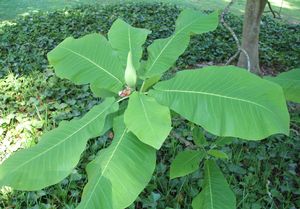

Ashe x Bigleaf Magnolia
Magnolia ashei x macrophylla
Pickup currently unavailable at Aiken Nursery
Magnolia ashei × macrophylla is a rare hybrid of colossal foliage and dinner-plate blooms, a deliberate cross between two of North America's most dramatic native magnolias: the endangered Ashe magnolia, Magnolia ashei, and the bigleaf magnolia, Magnolia macrophylla. The cross brings together the best of both parents, the immense tropical-looking leaves, the enormous fragrant flowers, and a habit that settles into a handsome middle ground between shrub and small tree.
The hybrid was first raised by Dr. Fred Meyer at the United States National Arboretum, and remains uncommon in gardens. The genus name honors Pierre Magnol, the seventeenth-century botanist of Montpellier; macrophylla is simply Greek for large-leaved, and ashei remembers William Willard Ashe, the pioneering United States Forest Service forester who botanized the Southeast. Both parents belong to the small group of American bigleaf magnolias famous for the largest simple leaves of any tree on the continent, and this cross inherits the trait in full: single leaves that can pass two feet in length, pale and almost silvered beneath, building a bold, primeval silhouette in a shaded corner.
Magnolias are among the most ancient of flowering plants, in bloom long before bees existed, and to this day the heavy, fruit-scented flowers are worked chiefly by beetles rather than bees. In late spring and early summer the branches of this hybrid carry huge, creamy-white goblets, richly fragrant and marked with purple at the base of the inner petals, blooms that rival any exotic for sheer scale. From the shrubby Ashe parent the cross often takes an obliging habit of flowering while still young, a rare gift among the big magnolias. By late summer the spent flowers give way to rosy, cone-like fruit clusters that split to dangle scarlet seeds on slender threads for birds.
In stature this hybrid grows between the parents, more upright and tree-like than the low, spreading Ashe magnolia, yet nowhere near as lofty as the towering bigleaf, settling in around twenty-five to thirty-five feet over many years. The intermediate frame, along with the precocious flowering, makes the plant far easier to place in an ordinary garden than either parent alone.
This is a magnolia of presence and poise, at best as a specimen or a focal point in a sheltered, richly planted shade garden. Give rich, moist, well-drained soil and shelter from wind, since the great leaves tear in a gale, and site the plant where the vast foliage and flowers can be met at close range. A mature specimen at Hopelands Gardens in Aiken, South Carolina, stands as a living measure of what this uncommon cross can become in a Southern garden.
- Hardiness
- USDA Zones 5–9
- Sun
- Full Sun, Part Shade
- Soil
- Moist, Well-drained, Rich
- Mature size
- Height 25–35 Feet · Spread 15–25 Feet
- Growth rate
- Medium
- Seasonality
- Deciduous
- Provenance
- Hybrid raised by Dr. Fred Meyer at the United States National Arboretum; a mature specimen grows at Hopelands Gardens in Aiken, South Carolina.
Creamy white with a purple basal blotch, up to a foot across, fragrant, late spring to early summer
From rooting to shipping, our top priority is ensuring you receive healthy, thriving plants for your garden’s success.
Because most of our plants are grown from rooted cuttings — alongside seed, air layering, and grafting chosen for each variety — you receive a stronger, true-to-type plant that establishes quickly in your garden.
Raised on organic soil blends and eco-friendly pest management — never harsh chemicals — your plant arrives healthy for your garden, your family, and the pollinators they feed.
Every purchase gives back. We donate to the Aiken Arboretum and support local wildlife conservation, so growing your garden helps protect the wider ecosystem too.

All our plant material is carefully propagated, grown, and nurtured at our humble nursery in Aiken, South Carolina.

Your plant arrives carefully packed and ready to settle in. Unpack them promptly, give them a day or two to acclimate, then plant following the notes we include — that’s all it takes. Clear care guidance comes with every order, so success is the easy part.
What to expect upon delivery
All our plants are sold in 1-gallon sizes, though the height of each plant can vary depending on its growth rate and seasonality, typically ranging from 1/2 to 2.5 feet.
Each plant is carefully packaged with its roots enclosed in a secure plastic bag containing moist soil, forming a compact root ball. To ensure safe transport, the box is padded with recycled newspaper, providing both stability and eco-friendly protection from weather during shipping.
What is your return policy?
Review our full return policy information on our SHIPPING AND RETURNS POLICY page.
What payment methods can I use?
We offer 35 different payment methods including major providers like Mastercard, Visa, PayPal, American Express and Diners as well as many different local payment methods including Klarna, iDEAL, AliPay, Sofort, giropay, and many more.
Can I make changes to my order after it’s been placed?
At Woodlanders, we strive to fulfill orders as quickly as possible. Therefore, we can only accommodate changes to your order within the first 24 hours after it has been placed. These changes include adding or removing products and modifying the delivery address. If you need to make any changes or if there has been a mistake with your order information, please reach out to us promptly via our CONTACT page with your order number for the quickest resolution.
Your satisfaction is our priority, and we appreciate your understanding and cooperation.