




Tamaulipas Palmetto
Sabal tamaulipensis
Pickup available at Aiken Nursery
Usually ready in 2-4 days
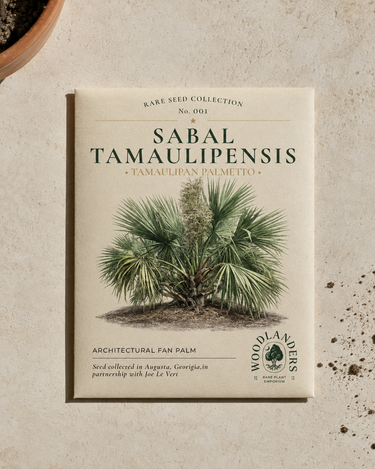
Sabal tamaulipensis is a solitary fan palm from the dry limestone hills of northeastern Mexico, where the species climbs the San Carlos Mountains of Tamaulipas and neighboring Nuevo Leon. Stiff, rounded, blue-green fans are held on arching stalks above a trunk that stays short for many years, so young plants read as a fountain of palmate leaves close to the ground. In habitat the palm can eventually reach fifteen to twenty feet, though cultivated plants are slow and often stay compact, and older specimens sometimes recline on a horizontal trunk rather than standing straight. Small, fragrant, creamy flowers give way to round black fruit in the wild.
The path to a name was long. Carl Schoenfeld and John Fairey of the pioneering Yucca Do Nursery first collected the palm on expeditions into the mountains of Tamaulipas in the late 1980s, puzzled by trunkless sabals that ran along the limestone rather than standing upright, and offered the earliest seed-grown plants in their 1990 catalog. For years the plant passed among collectors as Sabal sp. Tamaulipas, prized for cold tolerance to rival dwarf palmetto yet dismissed by some authorities as merely a Mexican form of Sabal minor. Only after DNA work confirmed a distinct sister species did the palm earn formal standing: Ayress Grinage, then a doctoral student at Cornell University, described Sabal tamaulipensis with coauthors K. A. Peralta and M. M. Salinas-Rodriguez in Palms, the journal of the International Palm Society, in September 2025, drawing the type specimen from a plant grown at Tony Avent's Juniper Level Botanic Garden.
The names carry their own histories. The genus name Sabal is an old botanical puzzle, a word whose origin was never explained by the author who first coined the term, while the epithet tamaulipensis simply means of Tamaulipas, the northeastern Mexican state that shelters the largest wild stands. These seeds are Woodlanders' first seed offering in decades, and a chance to grow one of the newest and least common hardy palms from the very beginning.
Palms in the genus Sabal have long been woven into daily life across their range. Related species such as the cabbage palmetto gave the Seminole the broad fans that thatched their chickees, along with leaves for hats, mats, and baskets, a craft that continues in Gullah communities of the Southeast. The fruit fed many Indigenous peoples, dried and ground into a sweet, prune-flavored meal, and the tender growing bud was eaten as heart-of-palm, a harvest that kills the palm. Little of this tradition is recorded for the Tamaulipas palmetto specifically, a plant known to science only recently, yet the kinship places the species in one of the most useful genera of the Americas.
In the garden, the Tamaulipas palmetto offers something uncommon: a true fan palm for gardeners in zones eight and warmer who thought palms were beyond their reach. The blue-green fans bring architecture to a gravel garden, a courtyard, or a dry Mediterranean bed, and the roots, schooled on limestone, shrug off drought and alkaline soil once settled in. Pair the palm with agaves, yuccas, hardy cacti, and bold ornamental grasses for a xeric planting with real presence, and site young plants where their slow, deliberate growth can be admired up close. Patience is the price of admission, and the reward is a rare palm few neighbors will recognize.
- Hardiness
- USDA Zones 8–11
- Sun
- Full Sun, Part Shade
- Soil
- Well-drained
- Mature size
- Height 8–20 Feet · Spread 6–10 Feet
- Growth rate
- Slow
- Seasonality
- Evergreen
Small fragrant creamy-white flowers on branched panicles in summer, followed by round black fruit
From rooting to shipping, our top priority is ensuring you receive healthy, thriving plants for your garden’s success.
Because most of our plants are grown from rooted cuttings — alongside seed, air layering, and grafting chosen for each variety — you receive a stronger, true-to-type plant that establishes quickly in your garden.
Raised on organic soil blends and eco-friendly pest management — never harsh chemicals — your plant arrives healthy for your garden, your family, and the pollinators they feed.
Every purchase gives back. We donate to the Aiken Arboretum and support local wildlife conservation, so growing your garden helps protect the wider ecosystem too.

All our plant material is carefully propagated, grown, and nurtured at our humble nursery in Aiken, South Carolina.

Your plant arrives carefully packed and ready to settle in. Unpack them promptly, give them a day or two to acclimate, then plant following the notes we include — that’s all it takes. Clear care guidance comes with every order, so success is the easy part.
What to expect upon delivery
All our plants are sold in 1-gallon sizes, though the height of each plant can vary depending on its growth rate and seasonality, typically ranging from 1/2 to 2.5 feet.
Each plant is carefully packaged with its roots enclosed in a secure plastic bag containing moist soil, forming a compact root ball. To ensure safe transport, the box is padded with recycled newspaper, providing both stability and eco-friendly protection from weather during shipping.
What is your return policy?
Review our full return policy information on our SHIPPING AND RETURNS POLICY page.
What payment methods can I use?
We offer 35 different payment methods including major providers like Mastercard, Visa, PayPal, American Express and Diners as well as many different local payment methods including Klarna, iDEAL, AliPay, Sofort, giropay, and many more.
Can I make changes to my order after it’s been placed?
At Woodlanders, we strive to fulfill orders as quickly as possible. Therefore, we can only accommodate changes to your order within the first 24 hours after it has been placed. These changes include adding or removing products and modifying the delivery address. If you need to make any changes or if there has been a mistake with your order information, please reach out to us promptly via our CONTACT page with your order number for the quickest resolution.
Your satisfaction is our priority, and we appreciate your understanding and cooperation.