


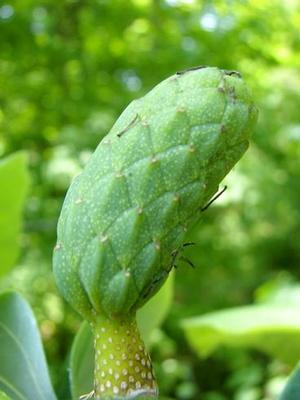

Cucumbertree Magnolia
Magnolia acuminata
Pickup currently unavailable at Aiken Nursery
Magnolia acuminata, the cucumbertree, is the giant of the native magnolias and the only one hardy far into the North. A deciduous forest tree of the eastern United States, most majestic in the southern Appalachians, the cucumbertree can rise seventy to ninety feet into a broad, rounded canopy, valued as a fast-growing, exceptionally hardy shade tree for parks and large lawns.
The odd common name comes from the young fruit: the knobby, elongated seed cones look, when green and unripe, remarkably like small cucumbers, before ripening to a startling pink-red and splitting to drop scarlet seeds. The tulip-shaped spring flowers are the quiet ones of the genus, greenish yellow and held high among the leaves, easy to miss, yet those same flowers carry the yellow pigment that breeders have used to create the celebrated yellow magnolias like 'Elizabeth' and 'Butterflies'. The leaves are large, six to eight inches long, with the tapered tip the epithet acuminata describes, and the genus itself honors Pierre Magnol, the seventeenth-century French botanist of Montpellier.
This is a working tree as much as an ornamental one. The pale, straight-grained wood resembles that of the related tulip tree, Liriodendron, and has long been cut and sold with it as yellow poplar. Nurseries and plant breeders prize the cucumbertree twice over: as a tough rootstock onto which choicer magnolias are grafted, and as the cold-hardy, yellow-flowered parent behind many modern hybrids. Native peoples and early settlers steeped the aromatic bark as a folk tonic, one of the tree's quieter historical uses.
Give the cucumbertree room, because this is a tree for the long view and the large space: a park, a big lawn, a woodland edge, where the massive trunk and high canopy can develop over generations. Full sun to part shade and deep, rich, well-drained soil suit the tree best, and the fast early growth rewards patience quickly. Site the cucumbertree as a stately shade tree and a piece of American forest heritage, and leave the fallen pink fruit for the birds.
- Hardiness
- USDA Zones 4–9
- Sun
- Full Sun, Part Shade
- Soil
- Well-drained, Rich
- Mature size
- Height 70–90 Feet · Spread 50–70 Feet
- Growth rate
- Fast
- Seasonality
- Deciduous
Greenish-yellow, tulip-like, lightly fragrant flowers in spring; cucumber-like fruit ripening pink-red
From rooting to shipping, our top priority is ensuring you receive healthy, thriving plants for your garden’s success.
Because most of our plants are grown from rooted cuttings — alongside seed, air layering, and grafting chosen for each variety — you receive a stronger, true-to-type plant that establishes quickly in your garden.
Raised on organic soil blends and eco-friendly pest management — never harsh chemicals — your plant arrives healthy for your garden, your family, and the pollinators they feed.
Every purchase gives back. We donate to the Aiken Arboretum and support local wildlife conservation, so growing your garden helps protect the wider ecosystem too.

All our plant material is carefully propagated, grown, and nurtured at our humble nursery in Aiken, South Carolina.

Your plant arrives carefully packed and ready to settle in. Unpack them promptly, give them a day or two to acclimate, then plant following the notes we include — that’s all it takes. Clear care guidance comes with every order, so success is the easy part.
What to expect upon delivery
All our plants are sold in 1-gallon sizes, though the height of each plant can vary depending on its growth rate and seasonality, typically ranging from 1/2 to 2.5 feet.
Each plant is carefully packaged with its roots enclosed in a secure plastic bag containing moist soil, forming a compact root ball. To ensure safe transport, the box is padded with recycled newspaper, providing both stability and eco-friendly protection from weather during shipping.
What is your return policy?
Review our full return policy information on our SHIPPING AND RETURNS POLICY page.
What payment methods can I use?
We offer 35 different payment methods including major providers like Mastercard, Visa, PayPal, American Express and Diners as well as many different local payment methods including Klarna, iDEAL, AliPay, Sofort, giropay, and many more.
Can I make changes to my order after it’s been placed?
At Woodlanders, we strive to fulfill orders as quickly as possible. Therefore, we can only accommodate changes to your order within the first 24 hours after it has been placed. These changes include adding or removing products and modifying the delivery address. If you need to make any changes or if there has been a mistake with your order information, please reach out to us promptly via our CONTACT page with your order number for the quickest resolution.
Your satisfaction is our priority, and we appreciate your understanding and cooperation.