


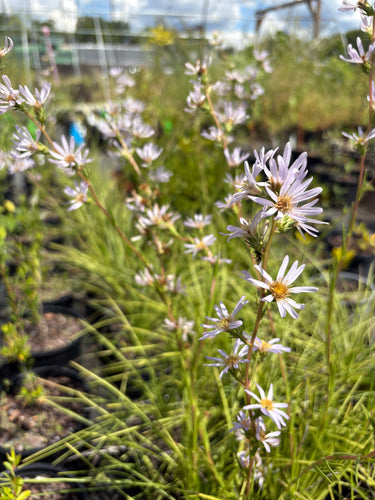


Pineland Aster
Eurybia spinulosa
Pickup available at Aiken Nursery
Usually ready in 2-4 days
This very rare aster, now placed in the genus Eurybia, is a true Florida endemic, native only to the moist pine flatwoods of the lower Apalachicola River. The plant is a botanical oddity: the clumping, foot-tall foliage is narrow, stiff, and grass-like, so unlike the leafy stems of an ordinary aster that a passerby might take the clump for a tuft of sedge. From late spring into early summer, slender flower stems rise above the leaves carrying clusters of inch-wide lavender-purple daisies, each ringing a small yellow eye.
The Apalachicola aster is a plant of serious conservation concern, ranked critically imperiled and listed as endangered by the state of Florida, the narrow native world squeezed by development along the river. That rarity is part of what makes the plant so worth growing: nursery propagation keeps a threatened native in cultivation and takes a little pressure off the wild stands. Our current stock traces to a wild collection Bob McCartney sourced in southern Georgia, and that stock has grown at the nursery for about ten years.
Happily, the pineland aster has proven willing. The plant has grown well and multiplied in containers here, and should settle readily into a sunny garden bed with sandy, sharply drained soil. The grassy clumps stay tidy and upright, and the late-spring lavender flowers arrive as many earlier perennials fade, drawing bees and other small pollinators to a quiet turn of the year.
Seldom seen in gardens and rarer still in the wild, this is a collector's native for the sunny meadow, the sandy border, or the rock garden, where the stiff grassy texture plays against softer neighbors. Because the plant is so little known in cultivation, we welcome your reports on how the aster performs for you; every garden trial helps secure the future of a genuine Florida rarity.
- Hardiness
- USDA Zones 7–9
- Sun
- Full Sun, Part Shade
- Soil
- Well-drained
- Mature size
- Height 2–3 Feet · Spread 1–2 Feet
- Growth rate
- Moderate
- Seasonality
- Dies back, depends on zone
Lavender-purple, late spring to early summer
From rooting to shipping, our top priority is ensuring you receive healthy, thriving plants for your garden’s success.
Because most of our plants are grown from rooted cuttings — alongside seed, air layering, and grafting chosen for each variety — you receive a stronger, true-to-type plant that establishes quickly in your garden.
Raised on organic soil blends and eco-friendly pest management — never harsh chemicals — your plant arrives healthy for your garden, your family, and the pollinators they feed.
Every purchase gives back. We donate to the Aiken Arboretum and support local wildlife conservation, so growing your garden helps protect the wider ecosystem too.

All our plant material is carefully propagated, grown, and nurtured at our humble nursery in Aiken, South Carolina.

Your plant arrives carefully packed and ready to settle in. Unpack them promptly, give them a day or two to acclimate, then plant following the notes we include — that’s all it takes. Clear care guidance comes with every order, so success is the easy part.
What to expect upon delivery
All our plants are sold in 1-gallon sizes, though the height of each plant can vary depending on its growth rate and seasonality, typically ranging from 1/2 to 2.5 feet.
Each plant is carefully packaged with its roots enclosed in a secure plastic bag containing moist soil, forming a compact root ball. To ensure safe transport, the box is padded with recycled newspaper, providing both stability and eco-friendly protection from weather during shipping.
What is your return policy?
Review our full return policy information on our SHIPPING AND RETURNS POLICY page.
What payment methods can I use?
We offer 35 different payment methods including major providers like Mastercard, Visa, PayPal, American Express and Diners as well as many different local payment methods including Klarna, iDEAL, AliPay, Sofort, giropay, and many more.
Can I make changes to my order after it’s been placed?
At Woodlanders, we strive to fulfill orders as quickly as possible. Therefore, we can only accommodate changes to your order within the first 24 hours after it has been placed. These changes include adding or removing products and modifying the delivery address. If you need to make any changes or if there has been a mistake with your order information, please reach out to us promptly via our CONTACT page with your order number for the quickest resolution.
Your satisfaction is our priority, and we appreciate your understanding and cooperation.