


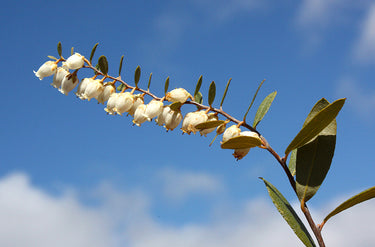


Leatherleaf
Chamaedaphne calyculata
In propagation
Currently rooting cuttings. Expected Winter 2028.
Add your name with the notify button below, and we will email you the moment this plant is ready to bring home.
Learn how we grow on The Prop House.
Pickup currently unavailable at Aiken Nursery
Leatherleaf is the quiet constant of the northern bog. Chamaedaphne calyculata, the only species in the genus, is a low, thicket-forming evergreen of the heath family that ranges right around the cold northern world, from the peatlands of North America east to the bogs of Finland and Japan, and southward in this country to the pocosins and acid bogs of the coastal plain, as far as South Carolina. Across that vast range, leatherleaf forms the dense, spreading colonies that hold a bog together and shelter the wildlife within.
The common name comes from the foliage: small, leathery, evergreen leaves, dark green above and scurfy-brown beneath, that flush bronze in winter cold. In earliest spring, before much else stirs in the bog, leafy one-sided racemes of little white urn-shaped flowers line the arching stems, a heath in miniature. Some Native peoples steeped the dried leaves as a tea, though the plant belongs to a family rich in grayanotoxins, and the leaves were handled with care, the steeping done gently in a sunny jar rather than a hard boil, to keep the brew mild.
In the garden, leatherleaf is a specialist worth the trouble for anyone with wet, acid ground. Use the shrub at a pond edge, in a bog or rain garden, or in a peaty rock garden that stays moist, where the early flowers and year-round evergreen frame can be enjoyed. Pair with other acid-loving bog plants, cranberry, pitcher plants, and sphagnum, and let the colony knit slowly into the dependable green backbone of a wetland planting.
- Hardiness
- USDA Zones 2–8
- Sun
- Full Sun, Part Shade
- Soil
- Moist, Acid
- Mature size
- Height 2–3 Feet · Spread 3–4 Feet
- Growth rate
- Moderate
- Seasonality
- Evergreen
white heath-like bell-shaped, March-April
These statements have not been evaluated by the Food and Drug Administration. This information is shared for traditional and educational interest only and is not intended to diagnose, treat, cure, or prevent any disease. Please consult a qualified healthcare professional before any medicinal use.
- Belongs to a grayanotoxin-bearing family; boiling the leaves can release toxic levels
- Not for internal use without expert guidance
- Grayanotoxins can affect the heart and nervous system if taken in quantity
From rooting to shipping, our top priority is ensuring you receive healthy, thriving plants for your garden’s success.
Because most of our plants are grown from rooted cuttings — alongside seed, air layering, and grafting chosen for each variety — you receive a stronger, true-to-type plant that establishes quickly in your garden.
Raised on organic soil blends and eco-friendly pest management — never harsh chemicals — your plant arrives healthy for your garden, your family, and the pollinators they feed.
Every purchase gives back. We donate to the Aiken Arboretum and support local wildlife conservation, so growing your garden helps protect the wider ecosystem too.

All our plant material is carefully propagated, grown, and nurtured at our humble nursery in Aiken, South Carolina.

Your plant arrives carefully packed and ready to settle in. Unpack them promptly, give them a day or two to acclimate, then plant following the notes we include — that’s all it takes. Clear care guidance comes with every order, so success is the easy part.
What to expect upon delivery
All our plants are sold in 1-gallon sizes, though the height of each plant can vary depending on its growth rate and seasonality, typically ranging from 1/2 to 2.5 feet.
Each plant is carefully packaged with its roots enclosed in a secure plastic bag containing moist soil, forming a compact root ball. To ensure safe transport, the box is padded with recycled newspaper, providing both stability and eco-friendly protection from weather during shipping.
What is your return policy?
Review our full return policy information on our SHIPPING AND RETURNS POLICY page.
What payment methods can I use?
We offer 35 different payment methods including major providers like Mastercard, Visa, PayPal, American Express and Diners as well as many different local payment methods including Klarna, iDEAL, AliPay, Sofort, giropay, and many more.
Can I make changes to my order after it’s been placed?
At Woodlanders, we strive to fulfill orders as quickly as possible. Therefore, we can only accommodate changes to your order within the first 24 hours after it has been placed. These changes include adding or removing products and modifying the delivery address. If you need to make any changes or if there has been a mistake with your order information, please reach out to us promptly via our CONTACT page with your order number for the quickest resolution.
Your satisfaction is our priority, and we appreciate your understanding and cooperation.