


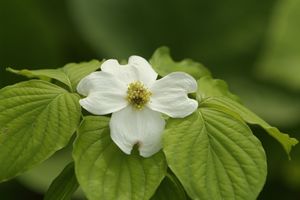


Spreading Flowering Dogwood
Cornus florida 'Suwanee Squat'
In propagation
Currently growing out 1 Gallon pots. Expected Fall 2026.
Add your name with the notify button below, and we will email you the moment this plant is ready to bring home.
Learn how we grow on The Prop House.
Pickup currently unavailable at Aiken Nursery
There is a version of the flowering dogwood almost nobody has met. Cornus florida 'Suwanee Squat' was found in Suwannee County, Florida, by Bob Simons, a forest ecologist who spent half a century protecting the wild hardwood country of north Florida. As a young man in the early 1970s he walked a mixed-hardwood hammock outside Gainesville, decided the place was worth saving, and talked ten landowners and the state into making it San Felasco Hammock; that became the pattern of his life. A man who knew that kind of forest the way most of us know our own street is exactly the sort to notice a dogwood doing something a dogwood is not supposed to do. Woodlanders introduced his low, sprawling oddity to cultivation, and the plant has stayed scarce ever since, the kind of tree you mostly hear about secondhand from someone who saw one and never got over it.
Where the species reaches for the canopy, 'Suwanee Squat' does the opposite, running wide and staying close to the ground, branches layering outward in flat, horizontal tiers. Our stock plant has sat at roughly waist height and four feet across for years now, in no apparent hurry; given a long enough run the tree may slowly gain a little more height, but height has never been the point. The point is the spread, and the architecture of that spread, the way these low limbs pool at the foot of taller things rather than competing with them.
The flowers are pure Cornus florida: four creamy white bracts cupped around a knot of small true flowers, blooming heavily in early spring. Strung out along those low limbs, the bracts read as a scattered horizontal drift instead of the familiar upright cloud, catching light down at the woodland floor where you do not expect to find it. Come autumn the leaves turn through red and burgundy and bronze, a quieter second season. And unlike the contorted, sullen-looking weeping dogwoods this selection sometimes gets shelved beside, 'Suwanee Squat' keeps clean, well-mannered foliage.
Give the tree partial shade to shade and rich, well-drained soil, and resist the urge to plant deep; dogwoods like to sit high, the root flare just grazing the soil line. Let the low limbs cascade over a low wall, settle the pitch of a slope, or build out the layered edge of a shaded bed. Cornus florida is woven deep into the eastern woods and into most of our earliest garden memories. 'Suwanee Squat' is that same familiar tree, lying down, found by a man who spent his life making sure such places stayed standing.
- Hardiness
- USDA Zones 7–9
- Sun
- Part Shade
- Soil
- Well-drained
- Mature size
- Height 4–6 Feet · Spread 12–18 Feet
- Growth rate
- Moderate
- Seasonality
- Deciduous
From rooting to shipping, our top priority is ensuring you receive healthy, thriving plants for your garden’s success.
Because most of our plants are grown from rooted cuttings — alongside seed, air layering, and grafting chosen for each variety — you receive a stronger, true-to-type plant that establishes quickly in your garden.
Raised on organic soil blends and eco-friendly pest management — never harsh chemicals — your plant arrives healthy for your garden, your family, and the pollinators they feed.
Every purchase gives back. We donate to the Aiken Arboretum and support local wildlife conservation, so growing your garden helps protect the wider ecosystem too.

All our plant material is carefully propagated, grown, and nurtured at our humble nursery in Aiken, South Carolina.

Your plant arrives carefully packed and ready to settle in. Unpack them promptly, give them a day or two to acclimate, then plant following the notes we include — that’s all it takes. Clear care guidance comes with every order, so success is the easy part.
What to expect upon delivery
All our plants are sold in 1-gallon sizes, though the height of each plant can vary depending on its growth rate and seasonality, typically ranging from 1/2 to 2.5 feet.
Each plant is carefully packaged with its roots enclosed in a secure plastic bag containing moist soil, forming a compact root ball. To ensure safe transport, the box is padded with recycled newspaper, providing both stability and eco-friendly protection from weather during shipping.
What is your return policy?
Review our full return policy information on our SHIPPING AND RETURNS POLICY page.
What payment methods can I use?
We offer 35 different payment methods including major providers like Mastercard, Visa, PayPal, American Express and Diners as well as many different local payment methods including Klarna, iDEAL, AliPay, Sofort, giropay, and many more.
Can I make changes to my order after it’s been placed?
At Woodlanders, we strive to fulfill orders as quickly as possible. Therefore, we can only accommodate changes to your order within the first 24 hours after it has been placed. These changes include adding or removing products and modifying the delivery address. If you need to make any changes or if there has been a mistake with your order information, please reach out to us promptly via our CONTACT page with your order number for the quickest resolution.
Your satisfaction is our priority, and we appreciate your understanding and cooperation.