


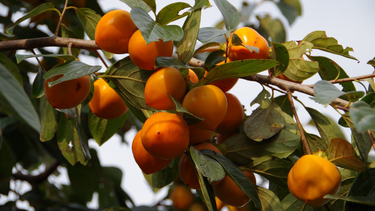


Common Persimmon
Diospyros virginiana
In propagation
Currently growing out 1 Gallon pots. Expected Fall 2026.
Add your name with the notify button below, and we will email you the moment this plant is ready to bring home.
Learn how we grow on The Prop House.
Pickup currently unavailable at Aiken Nursery
The botanical name reads like a compliment: Diospyros joins the Greek dios, divine, to pyros, grain, so the genus translates roughly as "fruit of the gods," a lofty title for a tree that drops sweet, homely orange fruit onto the forest floor each autumn. The common name travels the other direction, plain and American, from the Powhatan word putchamin for a dried fruit, a reminder that Native peoples were drying persimmons into cakes long before the botanists arrived.
Diospyros virginiana is a medium, deciduous tree of the ebony family, native across the eastern United States, pyramidal in youth and rounding with age. The deeply blocky, gray-black bark, cracked into neat squares like alligator hide, is one of the surest ways to know the tree in winter. Persimmon is dioecious, carrying male and female flowers on separate trees, and only the females bear fruit; the small, greenish-yellow, bell-shaped blooms of late spring are quiet but draw bees in numbers. We offer seedling trees of undetermined sex.
The fruit is a lesson in patience. Bite one too soon and the tannins seize the whole mouth shut, which is exactly why generations of country children have dared each other to try. Left to ripen, often past the first frost, the same fruit turns to soft, honeyed pulp prized for puddings, breads, and preserves. Beyond the kitchen, persimmon has long served as a medicinal tree: the astringent inner bark was traditionally made into a wash for sore throats, and a vitamin-rich leaf tea was taken as a tonic. Learn about the healing properties of the American Persimmon here. The wood, meanwhile, is among the hardest in North America, dense enough that the heads of old golf clubs and the shuttles of textile looms were once turned from persimmon.
In the landscape, give Diospyros virginiana room as a specimen shade tree, a wildlife tree at a woodland edge, or an anchor in an edible or native planting. Persimmon tolerates a wide range of soil and moisture and asks little once established, and the autumn fruit feeds deer, foxes, opossums, and birds as generously as the gardener. Set the tree where the ripe fruit can drop without staining a patio, and plant a known female, or a group of seedlings, if a crop is the goal.
Photo courtesy of Alan Cressler.
- Hardiness
- USDA Zones 4–9
- Sun
- Full Sun, Part Shade
- Soil
- Well-drained, Moist
- Mature size
- Height 55–60 Feet · Spread 30–35 Feet
- Growth rate
- Slow
- Seasonality
- Deciduous
Small greenish-yellow bell flowers, May to June, male and female on separate trees
These statements have not been evaluated by the Food and Drug Administration. This information is shared for traditional and educational interest only and is not intended to diagnose, treat, cure, or prevent any disease. Please consult a qualified healthcare professional before any medicinal use.
- Unripe fruit is intensely astringent
- Large amounts of unripe fruit may cause a digestive blockage (bezoar)
- Traditional use only; not a substitute for medical care
From rooting to shipping, our top priority is ensuring you receive healthy, thriving plants for your garden’s success.
Because most of our plants are grown from rooted cuttings — alongside seed, air layering, and grafting chosen for each variety — you receive a stronger, true-to-type plant that establishes quickly in your garden.
Raised on organic soil blends and eco-friendly pest management — never harsh chemicals — your plant arrives healthy for your garden, your family, and the pollinators they feed.
Every purchase gives back. We donate to the Aiken Arboretum and support local wildlife conservation, so growing your garden helps protect the wider ecosystem too.

All our plant material is carefully propagated, grown, and nurtured at our humble nursery in Aiken, South Carolina.

Your plant arrives carefully packed and ready to settle in. Unpack them promptly, give them a day or two to acclimate, then plant following the notes we include — that’s all it takes. Clear care guidance comes with every order, so success is the easy part.
What to expect upon delivery
All our plants are sold in 1-gallon sizes, though the height of each plant can vary depending on its growth rate and seasonality, typically ranging from 1/2 to 2.5 feet.
Each plant is carefully packaged with its roots enclosed in a secure plastic bag containing moist soil, forming a compact root ball. To ensure safe transport, the box is padded with recycled newspaper, providing both stability and eco-friendly protection from weather during shipping.
What is your return policy?
Review our full return policy information on our SHIPPING AND RETURNS POLICY page.
What payment methods can I use?
We offer 35 different payment methods including major providers like Mastercard, Visa, PayPal, American Express and Diners as well as many different local payment methods including Klarna, iDEAL, AliPay, Sofort, giropay, and many more.
Can I make changes to my order after it’s been placed?
At Woodlanders, we strive to fulfill orders as quickly as possible. Therefore, we can only accommodate changes to your order within the first 24 hours after it has been placed. These changes include adding or removing products and modifying the delivery address. If you need to make any changes or if there has been a mistake with your order information, please reach out to us promptly via our CONTACT page with your order number for the quickest resolution.
Your satisfaction is our priority, and we appreciate your understanding and cooperation.