


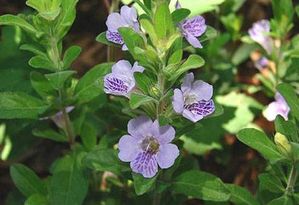

Oblongleaf Twinflower
Dyschoriste oblongifolia
In propagation
Currently growing out 1 Quart pots. Expected Spring 2027.
Add your name with the notify button below, and we will email you the moment this plant is ready to bring home.
Learn how we grow on The Prop House.
Pickup currently unavailable at Aiken Nursery
Oblongleaf twinflower, Dyschoriste oblongifolia, is a low, spreading wildflower of the American Southeast, a member of the acanthus family that carpets the dry pine flatwoods, sandhills, and open savannas of Florida and neighboring states. The common name comes from the habit of carrying the small, funnel-shaped flowers in pairs, twinned in the leaf axils along low stems, while the botanical epithet oblongifolia simply describes the neat, oblong leaves. An older regional name is snakeherb, a tag shared across the genus Dyschoriste.
From late spring into early winter the plant opens inch-wide blooms of soft blue to lavender-purple, each a five-lobed funnel veined in a deeper tone at the throat. Modest one at a time, they add up to a long, quiet season of color across the mat. For native-garden makers the real value runs deeper than looks: oblongleaf twinflower is a documented larval host for the common buckeye butterfly, and the flowers draw bees and a range of butterflies through the warm months, so a planting works as quietly for wildlife as for the eye.
Standing only six to eight inches tall and spreading slowly into a dense, low groundcover, the plant fills the ground layer where taller things would overwhelm. Set oblongleaf twinflower between stepping stones, along a path edge, at the front of a native bed, or as a tidy understory beneath pines and open-canopy shrubs. The slow, clumping spread stays where wanted rather than running, which makes the plant an easy neighbor in mixed native plantings and a natural fit for water-wise, low-input gardens.
True to the dry, sunny flatwoods of the plant's origin, oblongleaf twinflower wants full sun to light shade and sharp, sandy drainage, and shrugs off heat and short droughts once the roots take hold. Hardy through roughly USDA zones 7 to 10 and semi-evergreen in the warmer end of that range, the plant returns dependably year after year. Woodlanders grew this stock from wild Florida material, so gardeners in the Southeast get a genuinely local native, at home in the very soils and seasons the species evolved to meet.
- Hardiness
- USDA Zones 7–10
- Sun
- Full Sun, Part Shade
- Soil
- Well-drained
- Mature size
- Height 6–8 Inches · Spread 1–2 Feet
- Growth rate
- Moderate
- Seasonality
- Semi-Evergreen
Inch-wide, five-lobed funnel flowers in soft blue to lavender-purple, carried in pairs in the leaf axils from late spring into early winter
From rooting to shipping, our top priority is ensuring you receive healthy, thriving plants for your garden’s success.
Because most of our plants are grown from rooted cuttings — alongside seed, air layering, and grafting chosen for each variety — you receive a stronger, true-to-type plant that establishes quickly in your garden.
Raised on organic soil blends and eco-friendly pest management — never harsh chemicals — your plant arrives healthy for your garden, your family, and the pollinators they feed.
Every purchase gives back. We donate to the Aiken Arboretum and support local wildlife conservation, so growing your garden helps protect the wider ecosystem too.

All our plant material is carefully propagated, grown, and nurtured at our humble nursery in Aiken, South Carolina.

Your plant arrives carefully packed and ready to settle in. Unpack them promptly, give them a day or two to acclimate, then plant following the notes we include — that’s all it takes. Clear care guidance comes with every order, so success is the easy part.
What to expect upon delivery
All our plants are sold in 1-gallon sizes, though the height of each plant can vary depending on its growth rate and seasonality, typically ranging from 1/2 to 2.5 feet.
Each plant is carefully packaged with its roots enclosed in a secure plastic bag containing moist soil, forming a compact root ball. To ensure safe transport, the box is padded with recycled newspaper, providing both stability and eco-friendly protection from weather during shipping.
What is your return policy?
Review our full return policy information on our SHIPPING AND RETURNS POLICY page.
What payment methods can I use?
We offer 35 different payment methods including major providers like Mastercard, Visa, PayPal, American Express and Diners as well as many different local payment methods including Klarna, iDEAL, AliPay, Sofort, giropay, and many more.
Can I make changes to my order after it’s been placed?
At Woodlanders, we strive to fulfill orders as quickly as possible. Therefore, we can only accommodate changes to your order within the first 24 hours after it has been placed. These changes include adding or removing products and modifying the delivery address. If you need to make any changes or if there has been a mistake with your order information, please reach out to us promptly via our CONTACT page with your order number for the quickest resolution.
Your satisfaction is our priority, and we appreciate your understanding and cooperation.