


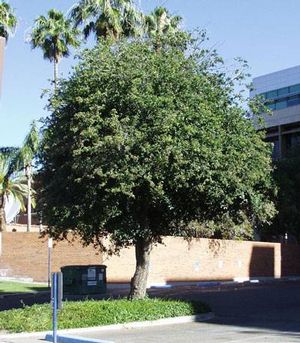


Anacua
Ehretia anacua
In propagation
Currently growing out 1 Gallon pots. Expected Summer 2027.
Add your name with the notify button below, and we will email you the moment this plant is ready to bring home.
Learn how we grow on The Prop House.
Pickup currently unavailable at Aiken Nursery
Anacua, Ehretia anacua, is one of the signature small trees of the south Texas brush country and the lower Rio Grande, a member of the borage family that goes by a small crowd of names. The rough, sandpapery upper surface of the leaves earns the tag sandpaper tree, while old-timers along the border call the tree anacua or, corrupted through generations, knockaway. Evergreen to semi-evergreen depending on the winter, the anacua holds dark green, leathery leaves that feel like fine grit under a thumb.
In spring, and often again after summer rains, the tree covers itself in dense two-to-three-inch panicles of small, white, sweetly fragrant flowers, a display heavy enough to look like a late snow and rich enough to draw clouds of bees. The flowers give way to small, round drupes about a quarter inch across that ripen from green through yellow to orange. The fruit is edible and pleasantly sweet, if a little mealy, and has long been eaten fresh or cooked into jellies, though people tend to lose the race to the birds and mammals that strip a fruiting anacua in short order.
Anacua shifts shape with the site. On good ground with room and water the tree matures into a round-crowned specimen twenty to forty feet tall with handsome, flaking, cinnamon-and-gray bark, while on dry, poor soils the same species stays lower and suckers into a dense, multi-stemmed thicket. Both forms are useful: the single-trunk tree makes a tough, drought-proof shade or street tree for hot climates, and the suckering form reads as a wildlife hedge or screen. Let the anacua stand as a specimen where the spring bloom and the fruiting birds can be enjoyed, or plant a run of them for cover.
Little troubles this tree. Native to south Texas and northeastern Mexico and hardy in USDA zones 8 through 11, the anacua takes full sun, tolerates a wide range of soils including thin, alkaline, caliche ground, and shrugs off heat and drought once established. Frost at the cold edge of the range may cut back young growth, but the tree returns. Uncommon in cultivation outside the native south Texas, the anacua deserves a wider audience among gardeners who want a tough, fragrant, wildlife-feeding native for difficult sites.
Fruit picture courtesy of Rachel Cywinski.
- Hardiness
- USDA Zones 8–11
- Sun
- Full Sun, Part Shade
- Soil
- Well-drained
- Mature size
- Height 10–50 Feet · Spread 10–30 Feet
- Growth rate
- Moderate
- Seasonality
- Semi-Evergreen
Dense two-to-three-inch panicles of small, fragrant, white flowers in spring and after summer rains, followed by sweet orange edible drupes
From rooting to shipping, our top priority is ensuring you receive healthy, thriving plants for your garden’s success.
Because most of our plants are grown from rooted cuttings — alongside seed, air layering, and grafting chosen for each variety — you receive a stronger, true-to-type plant that establishes quickly in your garden.
Raised on organic soil blends and eco-friendly pest management — never harsh chemicals — your plant arrives healthy for your garden, your family, and the pollinators they feed.
Every purchase gives back. We donate to the Aiken Arboretum and support local wildlife conservation, so growing your garden helps protect the wider ecosystem too.

All our plant material is carefully propagated, grown, and nurtured at our humble nursery in Aiken, South Carolina.

Your plant arrives carefully packed and ready to settle in. Unpack them promptly, give them a day or two to acclimate, then plant following the notes we include — that’s all it takes. Clear care guidance comes with every order, so success is the easy part.
What to expect upon delivery
All our plants are sold in 1-gallon sizes, though the height of each plant can vary depending on its growth rate and seasonality, typically ranging from 1/2 to 2.5 feet.
Each plant is carefully packaged with its roots enclosed in a secure plastic bag containing moist soil, forming a compact root ball. To ensure safe transport, the box is padded with recycled newspaper, providing both stability and eco-friendly protection from weather during shipping.
What is your return policy?
Review our full return policy information on our SHIPPING AND RETURNS POLICY page.
What payment methods can I use?
We offer 35 different payment methods including major providers like Mastercard, Visa, PayPal, American Express and Diners as well as many different local payment methods including Klarna, iDEAL, AliPay, Sofort, giropay, and many more.
Can I make changes to my order after it’s been placed?
At Woodlanders, we strive to fulfill orders as quickly as possible. Therefore, we can only accommodate changes to your order within the first 24 hours after it has been placed. These changes include adding or removing products and modifying the delivery address. If you need to make any changes or if there has been a mistake with your order information, please reach out to us promptly via our CONTACT page with your order number for the quickest resolution.
Your satisfaction is our priority, and we appreciate your understanding and cooperation.