


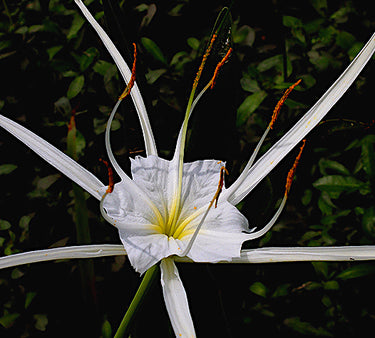


Spring Spiderlily
Hymenocallis liriosme
Pickup currently unavailable at Aiken Nursery
Few native bulbs command a wet margin the way Hymenocallis liriosme does. From a basal fountain of arching, strap-shaped, glossy green leaves rise leafless scapes, each crowned with several large white flowers whose narrow segments splay outward like pale spider legs around a central membranous cup. The fragrance arrives at dusk, sweet and carrying, a signal to the night-flying moths that pollinate the blooms in late spring and early summer.
The name carries the flower's signature. Hymenocallis joins the Greek hymen, a membrane, with kallos, beauty, a nod to the thin translucent tissue that webs the stamens into a shallow crown, the feature that separates a true spider lily from the many look-alikes. The epithet liriosme reads as lily-scented, from lirion and osme, and the plant earns the name honestly on a warm evening. Gardeners across the Gulf know the plant as spring spiderlily or Texas spiderlily, though the range runs well beyond Texas.
Hymenocallis liriosme belongs to the amaryllis family, Amaryllidaceae, alongside crinum, rain lily, and the ornamental daffodils, and shares that clan's chemistry: the bulbs are laced with alkaloids that make them unpalatable to grazers and toxic if eaten, a quiet defense that has let wild colonies persist in ditches and low prairies. The plant is native across the south-central United States, from Texas and Oklahoma east through Louisiana, Arkansas, Mississippi, and Alabama, where the bulbs settle into the edges of marshes, swamps, sloughs, and slow streams, growing lush through a wet spring and resting through a dry summer.
In the garden the spring spiderlily asks for the conditions the bulbs know best: a low, wet spot that floods in spring and dries somewhat later, the margin of a pond, a rain garden, or a bog bed in full sun to part shade. Give the bulbs room to clump and they will thicken into a fragrant colony. Louisiana iris, swamp hibiscus, canna, and rain lilies make natural companions in the same damp ground, and a stand set near a path or seating area repays the placement each evening the flowers open.
- Hardiness
- USDA Zones 7–10
- Sun
- Full Sun, Part Shade
- Soil
- Well-drained, Moist
- Mature size
- Height 1–2 Feet · Spread 1–2 Feet
- Growth rate
- Moderate
- Seasonality
- Dies back, depends on zone
White, fragrant, spider-form, late spring to early summer
From rooting to shipping, our top priority is ensuring you receive healthy, thriving plants for your garden’s success.
Because most of our plants are grown from rooted cuttings — alongside seed, air layering, and grafting chosen for each variety — you receive a stronger, true-to-type plant that establishes quickly in your garden.
Raised on organic soil blends and eco-friendly pest management — never harsh chemicals — your plant arrives healthy for your garden, your family, and the pollinators they feed.
Every purchase gives back. We donate to the Aiken Arboretum and support local wildlife conservation, so growing your garden helps protect the wider ecosystem too.

All our plant material is carefully propagated, grown, and nurtured at our humble nursery in Aiken, South Carolina.

Your plant arrives carefully packed and ready to settle in. Unpack them promptly, give them a day or two to acclimate, then plant following the notes we include — that’s all it takes. Clear care guidance comes with every order, so success is the easy part.
What to expect upon delivery
All our plants are sold in 1-gallon sizes, though the height of each plant can vary depending on its growth rate and seasonality, typically ranging from 1/2 to 2.5 feet.
Each plant is carefully packaged with its roots enclosed in a secure plastic bag containing moist soil, forming a compact root ball. To ensure safe transport, the box is padded with recycled newspaper, providing both stability and eco-friendly protection from weather during shipping.
What is your return policy?
Review our full return policy information on our SHIPPING AND RETURNS POLICY page.
What payment methods can I use?
We offer 35 different payment methods including major providers like Mastercard, Visa, PayPal, American Express and Diners as well as many different local payment methods including Klarna, iDEAL, AliPay, Sofort, giropay, and many more.
Can I make changes to my order after it’s been placed?
At Woodlanders, we strive to fulfill orders as quickly as possible. Therefore, we can only accommodate changes to your order within the first 24 hours after it has been placed. These changes include adding or removing products and modifying the delivery address. If you need to make any changes or if there has been a mistake with your order information, please reach out to us promptly via our CONTACT page with your order number for the quickest resolution.
Your satisfaction is our priority, and we appreciate your understanding and cooperation.