


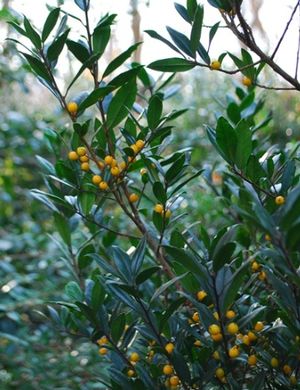

Yellow-Berried Foster Holly 'Alagold'
Ilex x attenuata 'Alagold'
Pickup currently unavailable at Aiken Nursery
The Foster hollies are among the most planted evergreens in the South, a group of hybrids between the native dahoon, Ilex cassine, and the native American holly, Ilex opaca, raised at Foster Nursery in northern Alabama. They carry narrow, dark, lightly spined leaves on a neat pyramidal frame and fruit heavily in red. 'Alagold' is the exception in color: a yellow-berried seedling of Foster number two, hanging clear amber-gold fruit each winter against dark olive-green foliage, on the same dependable, upright, tree-like holly.
Yellow-fruited hollies have a long hold on collectors, prized for the way the gold reads warm where red reads bright, and for the surprise of a holly that breaks the Christmas-card expectation. 'Alagold' keeps all the working virtues of a Foster holly, the glossy evergreen density, the wildlife value, the clean pyramidal outline, and simply trades scarlet for amber. Songbirds take the fruit through winter, though, as with all hollies, the berries are for the birds and not for people, being mildly toxic if eaten.
Foster hollies came out of Foster Nursery as chance hybrids of two Southeastern natives, and 'Alagold' arose as a yellow-berried seedling within that line. The Foster clones are notably self-fruitful, setting a good crop with no mate in sight, though a male of either parent species nearby only improves the show. That reliability, and the amber fruit, make the plant an easy, distinctive evergreen.
Give 'Alagold' room to become a small tree, twenty feet and more in time, and use the upright pyramid as a specimen, a tall evergreen screen, or a corner anchor where the gold berries can glow against dark foliage or a winter sky. The color pairs beautifully with red-berried hollies for a two-tone winter planting, and the lacquered, fruited branches cut well for holiday greenery. Full sun to part shade and moist, well-drained, acidic soil suit the plant best.
- Hardiness
- USDA Zones 6–9
- Sun
- Full Sun, Part Shade
- Soil
- Moist, Well-drained
- Mature size
- Height 15–25 Feet · Spread 8–12 Feet
- Growth rate
- Moderate to Fast
- Seasonality
- Evergreen
Small greenish-white spring flowers; rare amber-gold berries fall through winter, largely self-fruitful
From rooting to shipping, our top priority is ensuring you receive healthy, thriving plants for your garden’s success.
Because most of our plants are grown from rooted cuttings — alongside seed, air layering, and grafting chosen for each variety — you receive a stronger, true-to-type plant that establishes quickly in your garden.
Raised on organic soil blends and eco-friendly pest management — never harsh chemicals — your plant arrives healthy for your garden, your family, and the pollinators they feed.
Every purchase gives back. We donate to the Aiken Arboretum and support local wildlife conservation, so growing your garden helps protect the wider ecosystem too.

All our plant material is carefully propagated, grown, and nurtured at our humble nursery in Aiken, South Carolina.

Your plant arrives carefully packed and ready to settle in. Unpack them promptly, give them a day or two to acclimate, then plant following the notes we include — that’s all it takes. Clear care guidance comes with every order, so success is the easy part.
What to expect upon delivery
All our plants are sold in 1-gallon sizes, though the height of each plant can vary depending on its growth rate and seasonality, typically ranging from 1/2 to 2.5 feet.
Each plant is carefully packaged with its roots enclosed in a secure plastic bag containing moist soil, forming a compact root ball. To ensure safe transport, the box is padded with recycled newspaper, providing both stability and eco-friendly protection from weather during shipping.
What is your return policy?
Review our full return policy information on our SHIPPING AND RETURNS POLICY page.
What payment methods can I use?
We offer 35 different payment methods including major providers like Mastercard, Visa, PayPal, American Express and Diners as well as many different local payment methods including Klarna, iDEAL, AliPay, Sofort, giropay, and many more.
Can I make changes to my order after it’s been placed?
At Woodlanders, we strive to fulfill orders as quickly as possible. Therefore, we can only accommodate changes to your order within the first 24 hours after it has been placed. These changes include adding or removing products and modifying the delivery address. If you need to make any changes or if there has been a mistake with your order information, please reach out to us promptly via our CONTACT page with your order number for the quickest resolution.
Your satisfaction is our priority, and we appreciate your understanding and cooperation.