


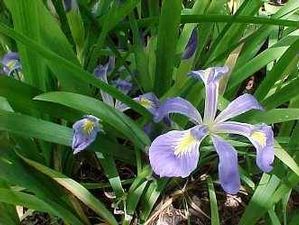

Lamance Iris
Iris brevicaulis
Pickup currently unavailable at Aiken Nursery
Iris brevicaulis is the low, quiet member of a famous clan. One of the five wild species known collectively as the Louisiana irises, the plant carries broad blue to violet flowers on curiously kinked, zigzagging stems, so short that the blooms rarely clear the fan of sword-shaped leaves. Botanists call that back-and-forth habit fractiflex, and the trait gives the plant one of the common names, zigzag iris; the Latin brevicaulis, short-stemmed, records the same feature, while a third name, Lamance iris, honors the American horticulturist Lora La Mance.
The species ranges widely for a wetland plant, from the north shore of Lake Erie in Ontario down through the Mississippi basin to the Gulf, following river bottoms and damp meadows. That broad, hardy distribution made Iris brevicaulis one of the cornerstones of Louisiana iris breeding. The five species interbreed freely with one another and with nothing else, and one of the earliest deliberate crosses, W. R. Dykes's 'Fulvala', paired this iris with the coppery Iris fulva. From that small beginning came the whole race of Louisiana iris hybrids grown around the world today, so a gardener who plants the zigzag iris is holding a piece of that living pedigree.
For all the horticultural importance, Iris brevicaulis keeps a wildflower's modesty. The blooms open in late spring and early summer, two to three inches across, in shades from clear blue to violet and now and then white, each fall marked with a paler signal that guides visiting bees to the nectar. Like most irises the rhizomes are best left uneaten, since the family is mildly toxic, a quiet chemical defense that also helps explain why deer and rabbits tend to pass the fans by. The zigzag stems, sometimes lying along the ground before turning up at the tips, lend cut stems and garden clumps alike an informal, faintly architectural line.
In the garden the plant belongs wherever the ground stays reliably moist: the margin of a pond, the low end of a border, a rain garden, or a bog bed, in full sun to part shade. Massed, the short habit reads as a dense, grassy groundlayer studded with blue, and a drift naturalizes slowly into a handsome colony over the years. Pair the zigzag iris with other moisture lovers such as Louisiana iris hybrids, swamp milkweed, and native sedges, and give a little afternoon shade where summers turn fierce. Little else is needed once the clump settles, beyond dividing every few years to keep the rhizomes vigorous.
- Hardiness
- USDA Zones 4–9
- Sun
- Full Sun, Part Shade
- Soil
- Well-drained, Moist
- Mature size
- Height 10–15 Inches · Spread 10–12 Inches
- Growth rate
- Moderate
- Seasonality
- Deciduous
From rooting to shipping, our top priority is ensuring you receive healthy, thriving plants for your garden’s success.
Because most of our plants are grown from rooted cuttings — alongside seed, air layering, and grafting chosen for each variety — you receive a stronger, true-to-type plant that establishes quickly in your garden.
Raised on organic soil blends and eco-friendly pest management — never harsh chemicals — your plant arrives healthy for your garden, your family, and the pollinators they feed.
Every purchase gives back. We donate to the Aiken Arboretum and support local wildlife conservation, so growing your garden helps protect the wider ecosystem too.

All our plant material is carefully propagated, grown, and nurtured at our humble nursery in Aiken, South Carolina.

Your plant arrives carefully packed and ready to settle in. Unpack them promptly, give them a day or two to acclimate, then plant following the notes we include — that’s all it takes. Clear care guidance comes with every order, so success is the easy part.
What to expect upon delivery
All our plants are sold in 1-gallon sizes, though the height of each plant can vary depending on its growth rate and seasonality, typically ranging from 1/2 to 2.5 feet.
Each plant is carefully packaged with its roots enclosed in a secure plastic bag containing moist soil, forming a compact root ball. To ensure safe transport, the box is padded with recycled newspaper, providing both stability and eco-friendly protection from weather during shipping.
What is your return policy?
Review our full return policy information on our SHIPPING AND RETURNS POLICY page.
What payment methods can I use?
We offer 35 different payment methods including major providers like Mastercard, Visa, PayPal, American Express and Diners as well as many different local payment methods including Klarna, iDEAL, AliPay, Sofort, giropay, and many more.
Can I make changes to my order after it’s been placed?
At Woodlanders, we strive to fulfill orders as quickly as possible. Therefore, we can only accommodate changes to your order within the first 24 hours after it has been placed. These changes include adding or removing products and modifying the delivery address. If you need to make any changes or if there has been a mistake with your order information, please reach out to us promptly via our CONTACT page with your order number for the quickest resolution.
Your satisfaction is our priority, and we appreciate your understanding and cooperation.