


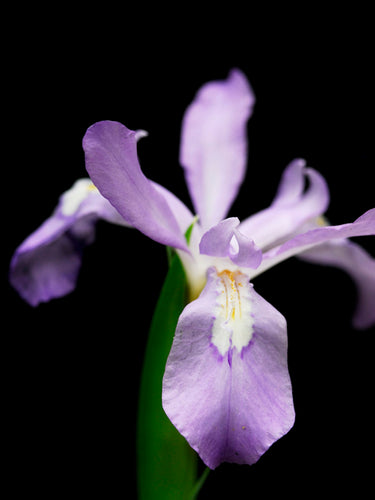


Dwarf Crested Iris
Iris cristata
Pickup currently unavailable at Aiken Nursery
Iris cristata is the iris scaled down for the woodland floor, a dwarf native barely six inches high that spreads into low, overlapping fans of bright green blades. In mid to late spring the mats light up with small flowers, an inch and a half to two inches across, in soft lavender-blue to violet, each fall stamped with a white patch and a raised orange or yellow ridge. That ridge is the crest that gives the plant both the Latin name cristata, crested, and the common name crested iris, and the feature sets the species apart from the bearded and beardless irises alike.
The dwarf crested iris is a plant of the eastern woods, ranging from Maryland west to Oklahoma and south to Georgia and Mississippi, where the species threads through rich soil on shaded ravine slopes and wooded bluffs. Gardeners have carried the plant into cultivation for well over a century as one of the most obliging of native spring wildflowers, content to knit a shaded corner together where showier things sulk. The rhizomes creep along at or just below the surface, branching as they go, so a few starts widen season by season into a slow, well-behaved groundcover.
Small as the flowers are, they are built for company: the crest and pale signal patch act as a landing guide for the early bees that pollinate them, and the plant closes the spring flush before the woodland canopy fully leafs out. Like other irises the rhizome carries the family's mild toxicity and is better admired than sampled, which is part of why deer and rabbits tend to leave the fans alone. After bloom the foliage often goes quietly summer-dormant in dry shade, returning the following spring, so the crested iris asks for a season's patience and gives decades of return.
In the garden Iris cristata is a natural for the front of a shaded bed, the edge of a woodland path, a shaded rock garden, or the dappled ground beneath deciduous trees, wherever the soil is rich, humusy, and evenly moist but never soggy, since the plant resents wet feet. Massed as a groundcover the low fans and spring flowers make a fine carpet, and single clumps tuck neatly among ferns, foamflower, wild ginger, and other woodland companions. Give part to full shade, a top-dressing of leaf mold, and shelter from harsh afternoon sun, and let a colony broaden at a natural pace. Photo courtesy of Steven Faucette.
- Hardiness
- USDA Zones 4–8
- Sun
- Part Shade, Full Shade
- Soil
- Moist, Fertile, Well-drained
- Mature size
- Height 6–8 Inches · Spread 10–12 Inches
- Growth rate
- Moderate
- Seasonality
- Deciduous
From rooting to shipping, our top priority is ensuring you receive healthy, thriving plants for your garden’s success.
Because most of our plants are grown from rooted cuttings — alongside seed, air layering, and grafting chosen for each variety — you receive a stronger, true-to-type plant that establishes quickly in your garden.
Raised on organic soil blends and eco-friendly pest management — never harsh chemicals — your plant arrives healthy for your garden, your family, and the pollinators they feed.
Every purchase gives back. We donate to the Aiken Arboretum and support local wildlife conservation, so growing your garden helps protect the wider ecosystem too.

All our plant material is carefully propagated, grown, and nurtured at our humble nursery in Aiken, South Carolina.

Your plant arrives carefully packed and ready to settle in. Unpack them promptly, give them a day or two to acclimate, then plant following the notes we include — that’s all it takes. Clear care guidance comes with every order, so success is the easy part.
What to expect upon delivery
All our plants are sold in 1-gallon sizes, though the height of each plant can vary depending on its growth rate and seasonality, typically ranging from 1/2 to 2.5 feet.
Each plant is carefully packaged with its roots enclosed in a secure plastic bag containing moist soil, forming a compact root ball. To ensure safe transport, the box is padded with recycled newspaper, providing both stability and eco-friendly protection from weather during shipping.
What is your return policy?
Review our full return policy information on our SHIPPING AND RETURNS POLICY page.
What payment methods can I use?
We offer 35 different payment methods including major providers like Mastercard, Visa, PayPal, American Express and Diners as well as many different local payment methods including Klarna, iDEAL, AliPay, Sofort, giropay, and many more.
Can I make changes to my order after it’s been placed?
At Woodlanders, we strive to fulfill orders as quickly as possible. Therefore, we can only accommodate changes to your order within the first 24 hours after it has been placed. These changes include adding or removing products and modifying the delivery address. If you need to make any changes or if there has been a mistake with your order information, please reach out to us promptly via our CONTACT page with your order number for the quickest resolution.
Your satisfaction is our priority, and we appreciate your understanding and cooperation.