


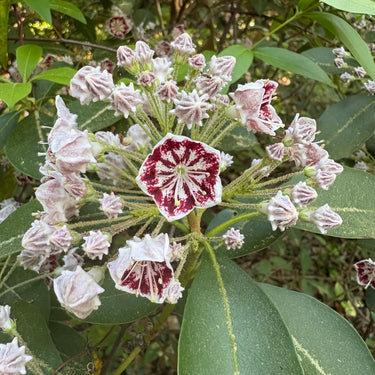


Mountain Laurel, 'Bullseye'
Kalmia latifolia 'Bullseye'
In propagation
Currently growing out 1 Gallon pots. Expected season to be announced.
Add your name with the notify button below, and we will email you the moment this plant is ready to bring home.
Learn how we grow on The Prop House.
Pickup currently unavailable at Aiken Nursery
Of all the patterned mountain laurels, 'Bullseye' plays the boldest trick with color. The cinnamon-purple buds are handsome in their own right, and when they open the flowers reveal a broad band of deep purple-maroon ringing a white throat and a clean white edge, the concentric target that gives this selection a name. 'Bullseye' belongs to Kalmia latifolia, the broadleaf evergreen native to the acid slopes of the eastern United States, and represents the golden era of Kalmia breeding led by Dr. Richard Jaynes at the Connecticut Agricultural Experiment Station, whose decades of selection gave gardeners the banded, picoteed, and richly budded laurels grown today.
The name Kalmia was bestowed by Linnaeus for his student Pehr Kalm, and latifolia means broad-leaved, though 'Bullseye' departs a little from type: the emerging foliage flushes reddish and the leaves are smaller and more twisted than those of the wild species, giving the shrub a slightly finer texture. Habit is vigorously upright yet compact. Our own very mature specimen at the old nursery site reached only about five feet tall and spread just as wide, so this is a laurel that furnishes a border without ever bullying the plants around it. The photographs here were taken at the Margaret Reid Wildflower Garden in Raleigh, North Carolina.
Mountain laurel carries a long human history alongside all that ornamental beauty. The hard, close-grained wood earned the name spoonwood, carved by Indigenous peoples of the East into spoons and small utensils and later turned for tool handles and bowls. That heritage comes with a firm caution: every green part of the plant, together with the pollen and any honey made from the flowers, contains grayanotoxins and is poisonous to livestock, wildlife, and people. 'Bullseye' is grown purely as an ornamental and pollinator plant, never a medicinal or edible one, and the foliage should be kept away from grazing animals and curious mouths.
In the garden, 'Bullseye' wants the same treatment as any mountain laurel: part sun to part shade, cool and consistently moist roots, and an organic mulch such as pine straw, especially while establishing. Kalmia are slow to settle, but few investments repay a gardener so richly over time. Plant this laurel where the banded flowers can be studied up close, among rhododendrons, blueberries, and native ferns in acidic woodland soil, and let the toxic evergreen foliage do quiet duty as a deer-resistant backbone through the year.
- Hardiness
- USDA Zones 5–9
- Sun
- Full Sun, Part Shade
- Soil
- Well-drained, Moist, Acid
- Mature size
- Height 4–5 Feet · Spread 4–5 Feet
- Growth rate
- Moderate
- Seasonality
- Evergreen
White with a broad purple band, cinnamon-purple buds, late spring
From rooting to shipping, our top priority is ensuring you receive healthy, thriving plants for your garden’s success.
Because most of our plants are grown from rooted cuttings — alongside seed, air layering, and grafting chosen for each variety — you receive a stronger, true-to-type plant that establishes quickly in your garden.
Raised on organic soil blends and eco-friendly pest management — never harsh chemicals — your plant arrives healthy for your garden, your family, and the pollinators they feed.
Every purchase gives back. We donate to the Aiken Arboretum and support local wildlife conservation, so growing your garden helps protect the wider ecosystem too.

All our plant material is carefully propagated, grown, and nurtured at our humble nursery in Aiken, South Carolina.

Your plant arrives carefully packed and ready to settle in. Unpack them promptly, give them a day or two to acclimate, then plant following the notes we include — that’s all it takes. Clear care guidance comes with every order, so success is the easy part.
What to expect upon delivery
All our plants are sold in 1-gallon sizes, though the height of each plant can vary depending on its growth rate and seasonality, typically ranging from 1/2 to 2.5 feet.
Each plant is carefully packaged with its roots enclosed in a secure plastic bag containing moist soil, forming a compact root ball. To ensure safe transport, the box is padded with recycled newspaper, providing both stability and eco-friendly protection from weather during shipping.
What is your return policy?
Review our full return policy information on our SHIPPING AND RETURNS POLICY page.
What payment methods can I use?
We offer 35 different payment methods including major providers like Mastercard, Visa, PayPal, American Express and Diners as well as many different local payment methods including Klarna, iDEAL, AliPay, Sofort, giropay, and many more.
Can I make changes to my order after it’s been placed?
At Woodlanders, we strive to fulfill orders as quickly as possible. Therefore, we can only accommodate changes to your order within the first 24 hours after it has been placed. These changes include adding or removing products and modifying the delivery address. If you need to make any changes or if there has been a mistake with your order information, please reach out to us promptly via our CONTACT page with your order number for the quickest resolution.
Your satisfaction is our priority, and we appreciate your understanding and cooperation.