


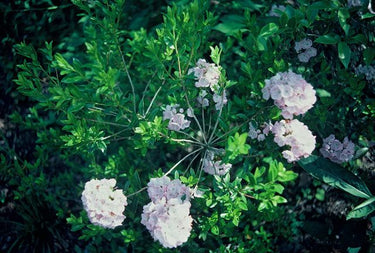

Hybrid Laurel
Kalmia latifolia x hirsuta
In propagation
Currently growing out 1 Gallon pots. Expected Spring 2027.
Add your name with the notify button below, and we will email you the moment this plant is ready to bring home.
Learn how we grow on The Prop House.
Pickup currently unavailable at Aiken Nursery
This seemingly unlikely hybrid crosses the familiar mountain laurel (Kalmia latifolia) with the diminutive, far less known sandhill laurel (Kalmia hirsuta) of the Deep South, two species that could hardly look more different. The cross was probably first made by the late, great Alabama nurseryman Tom Dodd, Jr., and further investigated by the Connecticut Kalmia expert Dr. Richard Jaynes, whose lifetime of work did more than anyone's to bring the genus into gardens.
The genus Kalmia was named by Linnaeus for his student Pehr Kalm, the naturalist who explored eastern North America in the 1740s. This hybrid sits neatly between the parents in both size and hardiness, staying a compact three to four feet high and wide, and bears the typical pink flower clusters of a mountain laurel. Each cup-shaped bloom carries the family's signature mechanism, ten stamens held under spring tension in pockets of the corolla, ready to snap forward and dust a visiting bee with pollen. The sandhill laurel parent lends heat tolerance and a smaller frame, making this an intriguing laurel for gardeners in the warmer Southeast.
Mountain laurels carry a long human history under the common name spoonwood, from the hard, close-grained wood that Indigenous peoples of the East carved into spoons and small utensils. That heritage comes with a firm caution. Every green part of a Kalmia, along with the pollen and any honey made from the flowers, contains grayanotoxins and is poisonous to livestock, wildlife, and people. This hybrid is grown as an ornamental and pollinator plant, never a medicinal or edible one, and the foliage is best kept away from grazing animals and curious mouths.
In the garden, this compact laurel is an attractive and unusual choice for a spot with well-drained acid soil, semi-shade, and dependable moisture. The modest size suits a woodland border, a foundation planting, or a collector's corner among rhododendrons, blueberries, inkberry, and native ferns. Plant high rather than deep, mulch with pine straw to keep the roots cool and sour, and let the toxic evergreen foliage serve as quiet deer resistance through the year.
- Hardiness
- USDA Zones 6–9
- Sun
- Full Sun, Part Shade
- Soil
- Well-drained, Moist
- Mature size
- Height 3–4 Feet · Spread 3–4 Feet
- Growth rate
- Moderate
- Seasonality
- Evergreen
Soft pink clusters, late spring to early summer
From rooting to shipping, our top priority is ensuring you receive healthy, thriving plants for your garden’s success.
Because most of our plants are grown from rooted cuttings — alongside seed, air layering, and grafting chosen for each variety — you receive a stronger, true-to-type plant that establishes quickly in your garden.
Raised on organic soil blends and eco-friendly pest management — never harsh chemicals — your plant arrives healthy for your garden, your family, and the pollinators they feed.
Every purchase gives back. We donate to the Aiken Arboretum and support local wildlife conservation, so growing your garden helps protect the wider ecosystem too.

All our plant material is carefully propagated, grown, and nurtured at our humble nursery in Aiken, South Carolina.

Your plant arrives carefully packed and ready to settle in. Unpack them promptly, give them a day or two to acclimate, then plant following the notes we include — that’s all it takes. Clear care guidance comes with every order, so success is the easy part.
What to expect upon delivery
All our plants are sold in 1-gallon sizes, though the height of each plant can vary depending on its growth rate and seasonality, typically ranging from 1/2 to 2.5 feet.
Each plant is carefully packaged with its roots enclosed in a secure plastic bag containing moist soil, forming a compact root ball. To ensure safe transport, the box is padded with recycled newspaper, providing both stability and eco-friendly protection from weather during shipping.
What is your return policy?
Review our full return policy information on our SHIPPING AND RETURNS POLICY page.
What payment methods can I use?
We offer 35 different payment methods including major providers like Mastercard, Visa, PayPal, American Express and Diners as well as many different local payment methods including Klarna, iDEAL, AliPay, Sofort, giropay, and many more.
Can I make changes to my order after it’s been placed?
At Woodlanders, we strive to fulfill orders as quickly as possible. Therefore, we can only accommodate changes to your order within the first 24 hours after it has been placed. These changes include adding or removing products and modifying the delivery address. If you need to make any changes or if there has been a mistake with your order information, please reach out to us promptly via our CONTACT page with your order number for the quickest resolution.
Your satisfaction is our priority, and we appreciate your understanding and cooperation.