


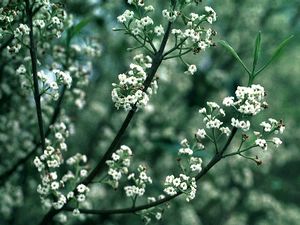

Devilwood
Cartrema americanum (Osmanthus americanus)
In propagation
Currently growing out 1 Gallon pots. Expected season to be announced.
Add your name with the notify button below, and we will email you the moment this plant is ready to bring home.
Learn how we grow on The Prop House.
Pickup currently unavailable at Aiken Nursery
Devilwood earns the odd name honestly. Cartrema americanum, long known and still widely sold as Osmanthus americanus, carries a wood so cross-grained and stubborn that early woodworkers swore the timber was possessed, and the name has stuck for centuries, a small piece of American folklore hung on an otherwise gracious plant. The leaves are leathery, elliptical, and smooth-margined, a deep glossy green without the spines that arm so many tea olives, and they build into a dense, rounded evergreen of fifteen to twenty-five feet, handsome as screen, understory, or small tree.
This is one of the few members of the tea olive clan native to North America, ranging through the coastal plain woodlands of the Southeast from Virginia to Texas and on into Mexico. Botanists now place the plant in the segregate genus Cartrema after the old Osmanthus proved a mixed assembly, and the accepted name takes the neuter ending, Cartrema americanum, which is worth knowing because the feminine spelling is still in wide circulation. In April and May come small clusters of creamy-white flowers, tucked among the leaves and easy to miss by eye, though the sweet fragrance carries on the air and draws the pollinators of mid-spring.
Dark blue-black drupes follow the flowers, olive-like and about half an inch across, and the larger birds and small mammals strip them through fall. For all the Southern range, the devilwood proves surprisingly cold hardy, holding as an evergreen well north of the native ground and ranking among the toughest broadleaf evergreens a cold-edge gardener can try, which is why other nurseries have taken the plant up and set the shrub into landscapes far from the coast.
Plant devilwood in sun or semi-shade, in most any soil including the moist and occasionally flooded ground of the native swamps, with extra water through prolonged drought. Growth runs slow and thin in deep shade at the northern edge of the range, so give more light where summers are short. Use the plant as an evergreen screen, a naturalized hedgerow, or a woodland understory among native azaleas and hollies, and site the shrub near a path or doorway where the spring fragrance can be met in passing. A quiet, underused native that asks little and gives year-round green.
- Hardiness
- USDA Zones 6–10
- Sun
- Full Sun, Part Shade
- Soil
- Well-drained, Moist
- Mature size
- Height 15–25 Feet · Spread 12–18 Feet
- Growth rate
- Slow to Moderate
- Seasonality
- Evergreen
Small, fragrant, creamy-white flowers in early spring; dark blue-black drupes in fall
From rooting to shipping, our top priority is ensuring you receive healthy, thriving plants for your garden’s success.
Because most of our plants are grown from rooted cuttings — alongside seed, air layering, and grafting chosen for each variety — you receive a stronger, true-to-type plant that establishes quickly in your garden.
Raised on organic soil blends and eco-friendly pest management — never harsh chemicals — your plant arrives healthy for your garden, your family, and the pollinators they feed.
Every purchase gives back. We donate to the Aiken Arboretum and support local wildlife conservation, so growing your garden helps protect the wider ecosystem too.

All our plant material is carefully propagated, grown, and nurtured at our humble nursery in Aiken, South Carolina.

Your plant arrives carefully packed and ready to settle in. Unpack them promptly, give them a day or two to acclimate, then plant following the notes we include — that’s all it takes. Clear care guidance comes with every order, so success is the easy part.
What to expect upon delivery
All our plants are sold in 1-gallon sizes, though the height of each plant can vary depending on its growth rate and seasonality, typically ranging from 1/2 to 2.5 feet.
Each plant is carefully packaged with its roots enclosed in a secure plastic bag containing moist soil, forming a compact root ball. To ensure safe transport, the box is padded with recycled newspaper, providing both stability and eco-friendly protection from weather during shipping.
What is your return policy?
Review our full return policy information on our SHIPPING AND RETURNS POLICY page.
What payment methods can I use?
We offer 35 different payment methods including major providers like Mastercard, Visa, PayPal, American Express and Diners as well as many different local payment methods including Klarna, iDEAL, AliPay, Sofort, giropay, and many more.
Can I make changes to my order after it’s been placed?
At Woodlanders, we strive to fulfill orders as quickly as possible. Therefore, we can only accommodate changes to your order within the first 24 hours after it has been placed. These changes include adding or removing products and modifying the delivery address. If you need to make any changes or if there has been a mistake with your order information, please reach out to us promptly via our CONTACT page with your order number for the quickest resolution.
Your satisfaction is our priority, and we appreciate your understanding and cooperation.